Author Archives: Angel Concepcion

Inferno Reverberations in Popular Culture

Angel Concepcion

Professor Porcelli

Italian

6 May 2019

Inferno Reverberations in Popular Culture

Dante Alighieri’s famous Divine Comedy ranks high amongst the most famous epic poems to be ever written. In fact, Inferno, the first part of the Divine Comedy is so appreciated that it has been adapted throughout visual arts since its creation and continues to do so. There are numerous famous cinematic works that implement certain elements of Inferno into different characters with similar circumstances. The Harry Potter series of fantasy novels/films

serves as a prime example of implementing ideas from Inferno into their fantasy empire. Pirates of the Caribbean is also another high-grossing adventurous fantasy film series to implement ideas from Inferno. The list extends to many other appreciated visual and literary arts; some reverberations being more subtle than others, but the most obvious film to simultaneously implement exact elements from the Inferno and not be directly based in its entirety to it is the film As Above So Below. Furthermore, we can conclude that although Dante was guilty of pridefulness, his high regard for his poetic talent was not misplaced.

Above all, the most compellingly symmetrical theme to Inferno is the setting of the film. The setting of the movie takes place in the underground Parisian Catacombs of Paris, France. Similar to the idea of Hell, the Parisian Catacombs hold over six million corpses. This epic cemetery’s structure is solely made up of bones and skulls, which makes for a very eerie and unstable setting. Aside from the setting of the film, the characters also make for a compelling emulation for the sinners of Inferno. Perdita Weeks (Scarlett), the protagonist of the film is a tomb raider in search for Nicholas Flamel’s philosophers stone. Dante (1265-1321) predated Flamel (1340-1418) which is why we do not see Flamel’s guest appearance in his comedy. Ben Feldman (George) is a supporting character to Scarlett much like Virgil is to Dante. George knows multiple dead languages that Scarlett does not and plays a well-versed historian when Scarlett fails to do so. Edwin Hodge (Benji) plays the role of the claustrophobic camera-man of this film. The film makes for an intimately empathetic setting due to its documentary style capture. Francois Civil (Papillon) embodies the role of Virgil more literally since he plays the guide that leads them throughout the catacombs. Papillon has ventured throughout the catacombs multiple times in the past and knows which paths are evil and those that are safe. He only agrees to lead them in this venture because there is promised treasure. Along with Papillon is his team Marion Lambert (Souxie) and Ali Marhyar (Zed). Their roles are superficial throughout the film are largely meant to reflect certain contrapassos that occur in Inferno.

In the beginning of Inferno, Dante finds himself in the bitter dark woods. As he journeys on and attempts to turn back, his path is impeded by a she-wolf and a jaguar at the foot of the hill. Similarly when setting off towards the entrance of the catacombs, George is weary and hesitant to journey on with them. However, venturing into restricted parts of the catacombs is illegal and as they are all entering the forbidden entrance Papillion is tackled to the ground. Everyone scurries into the cave fearing capture along with Papillion after he escapes the police officer’s grip. As they make their way through what I interpret to be limbo, a choir of naked women are gathered, singing in alto voices. Benji catches the provocative gaze of the lead conductor and moves on. Now, in retrospect this is the third time that Benji attentively films a woman. The prior two times where once inside of the night club where they find Papillon and the other was the lady that granted them access into the museum that held Flamel’s tombstone. His tombstone led to an important clue for their journey. As they descend from limbo into what I interpret to be the circle of lust, Benji injures his hands badly on his climbing rope because his latch broke off. This is the first hint to the attribution of Benji’s sin.

As they continue their journey they become lost and make a full circle not knowing the true structure of the catacombs. They make a full a circle because they are trying to evade the true path that they must take in order to find the philosophers stone. Scarlett points out that the most efficient way to the treasure area is through a forbidden hole in the wall. However, Papillon is strongly against it claiming that they had a friend named the Mole that went through there and was never heard of again. The mole senses their confusion and tells them that the only way out is further down into the catacombs. Shortly after, the wall collapses and leaves them with no other choice but to go through the forbidden hole. Needless to say, the journey takes a horrible turn after venturing through the hole. They encounter someone who seemed to be their old friend on the other side; he was changed, distorted. The mole aids them on their path to the treasure. However, once they find the treasure and set off the booby trap that comes with it, his body disappears under all of the rubble. Again, they are trapped with only one way out, down. They descend into a lower level with a mirror image to the last; everything the same but in a different order. This is the level that reflects the entrance to the city of Dis in Inferno. Above the entrance to Dis reads “abandon every hope you who enter.” (Canto III. 8). Similarly, in As Above So Below, the entrance reads “abandon all hope ye who enter here.” Furthermore, as they breach the next level, they encounter the Mole again; only this time he was only capable of screeching. Souxie approaches the Mole attemting to reassure him that he is safe, however, once Souxie touches him, he violently picks her up and smashes her head on the ground repeatedly. The Mole can be interpreted a number of ways. Much like Virgil, he often speaks in provocatively ambiguous tones, alluding to their hallucinations insightfully. However, a more compelling comparison would be that of a Malabranche demon. Just as the Malabranche demons guide Dante and Virgil because of the fallen bridge, the Mole guides their group after the ceiling collapses. Only, here the Mole plays another role as well. He plays the role of the sinners that inhabit the circle of violence. Also, he murders Souxie because she feels guilty for the Mole’s death; that they did not come back to look for the Mole after his disappearance and evidently does not repent for it.

They descend into the next level of fraudulence where another tomb raider meets their fate. Again, scaling down the rope last is Benji. However, as he is about to climb down he hears a wailing baby. He pauses, and as a cliché horror movie character, he asks if anyone is there. The camera catches the obscure shape of a woman pass by, and as he picks up the camera to turn around, the woman appears cradling a baby in her arms. This literally frightens him to death as he falls down the hole and dies on impact. I believe that Benji’s sins were that of simple fraud, flattery and seducery which lie in the first bolgia of the eighth circle. Benji was a womanizer guilty of being a neglectful father and abandoning his child in the real world.

Rewinding to an earlier part of the film where the team of tomb raiders had just met each other, Benji notices Papillon’s burned hands and asks Zed how he had gotten those scars. Zed replies, “we do not talk about that.” Further down into the third bolgia of the fraudulent circle, Papillon is confronted with his sin. They find a flaming car with a boy inside of it. It was the same boy that had told Scarlett where to find Papillon. As their eyes see this incredibly terrifying scene, Papillon says, “It wasn’t my fault. I didn’t do it.” Immediately after saying this, the flaming boy reaches out and pulls Papillon into the car which then sinks into the ground as if it were placed over super quicksand only leaving his legs sticking out of the ground. Throughout the entire film, this scene is the most apparent scene to reflect a contrapasso in Inferno. Dante the poet illustrates in Canto 19, “ I saw, from the mouth of every hole were sticking out a single sinner’s feet, and then the legs up to the calf-the rest was stuffed inside. The soles of every sinner’s feet were flaming; their naked legs were twitching frenziedly they would have broken any chain or rope.”(Canto 19.22-27). Papillon is guilty of simony. Although obscure, viewers can discern that he sold his intangible guidance into the catacombs for the treasure that was to be found.

Finally, they make their way down to the final circle of treachery amid many other obstacles not relevant to this paper. Until, they reach the last hole that leads to their exit and consequent rectification. George, Scarlett and Zedd confess their deepest sin and jump down the hole, but they do not die. With no apparent way out but a manhole at the center they start to scream and panic. Attempting to lift the pot hole, Scarlett mistakenly pushes it down. At this moment everything becomes clear. As they push further down into the man hole and push it aside, they see the illuminated night sky. Everything was as above so below.


https://wtfbabe.files.wordpress.com/2014/12/as-above-so-below-14-wtf-watch-the-film-saint-pauly.jpg?w=648&h=349

Image of the lady that scares Benji to death. https://www.google.com/url?sa=i&rct=j&q=&esrc=s&source=images&cd=&cad=rja&uact=8&ved=2ahUKEwih38_QtLXiAhVBmeAKHZIsCXIQjhx6BAgBEAM&url=https%3A%2F%2Fwww.imdb.com%2Ftitle%2Ftt2870612%2Fmediaindex&psig=AOvVaw2R4DIwjXxAmK-14jFC1hQ5&ust=1558830044761342
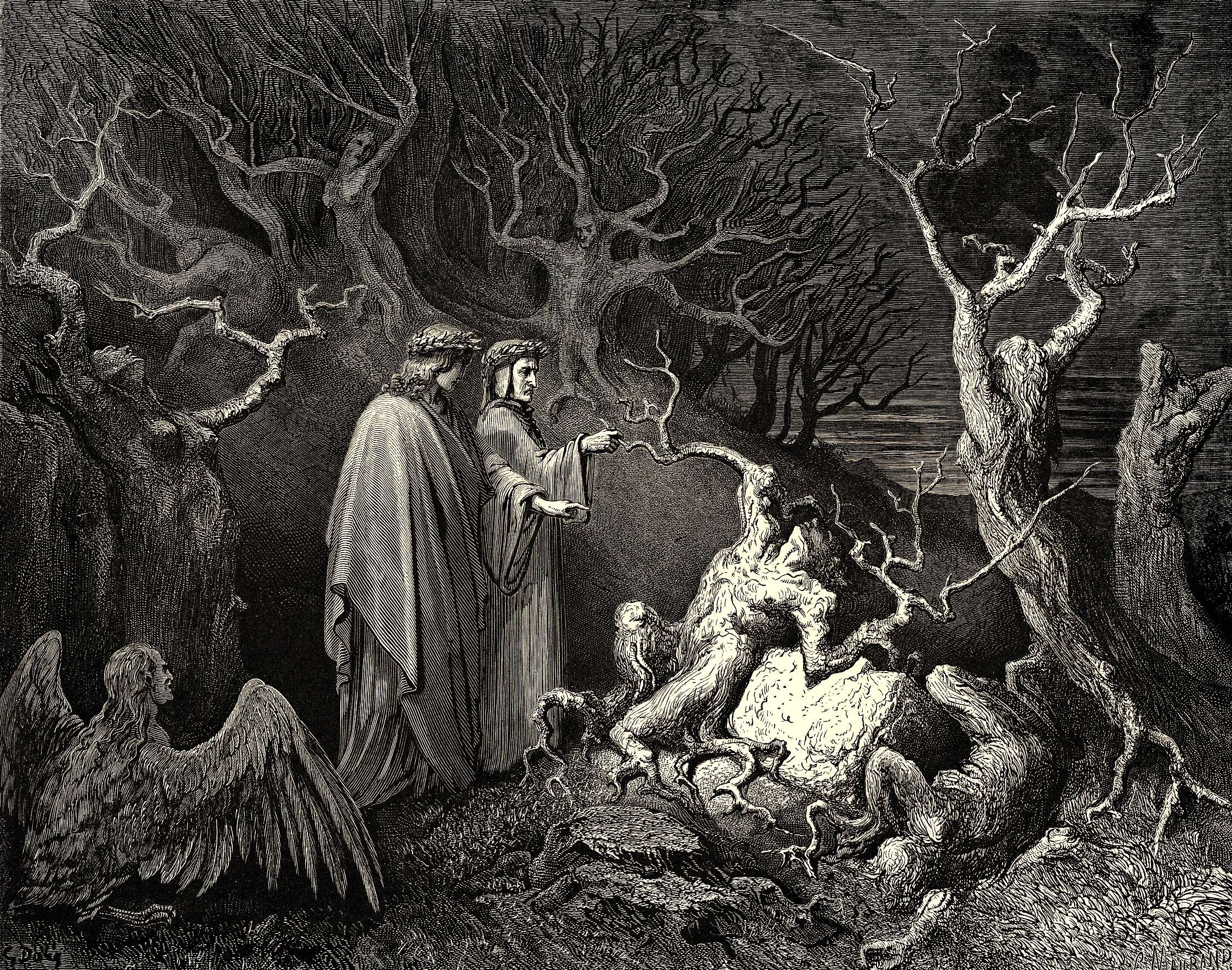
 

Garden of Eden vs. Forest of Harpies

Image result for canto 13

Image result for canto 28 purgatorio

indrasmusings – WordPress.com

Paris Review

In Canto 28, we can see the first major juxtaposition of Purgatorio and Inferno. As both scenes embody a forest environment, Dante uses his great ability of imagery to illustrate what we find out is the Garden of Eden in canto 28. Dante starts the canto with with a lively attitude: “eager already to search within and about the dark forest, thick and alive, which tempered the new day to my eyes.” This reading portrays the first scene of livelihood–without worry– and “eagerness” of Dante. Dante no longer is to be cautioned or held back by Virgil because there is nothing to caution against.

The amount of beauty reflected in Dante’s words are unparalleled throughout his journey of Inferno and Purgatorio. Unlike the dark forest in canto 13 with the harpies and souls of the suicides, the Garden of Eden has but a sweet breeze, graceful enough to disturb the branches of the trees but not the resounding birds with their lovely songs. Dante elevates the beauty of the Garden to that of a beauty of scenic art; just as Dante incorporates fictional characters in inferno, he does the same in the garden of eden by incorporating Matelda as a nymph. She is a figure of beauty inhabiting the garden along the river and serves as partial tour guide of the Garden by explaining that the garden was meant to be a “token of eternal peace” for man because he was made in the image of God but fell from sanctity into sin.

Furthermore, canto 13 in Inferno depicts a forest that tokens the eternal suffering of sinners that think they can end their lives on their own terms. The forest of the harpies is inaccessible to the souls that aren’t victims of suicides–we know this– but it isn’t brought into full perspective until we read this canto of the garden of eden. The garden of eden is placed on top of the mountain, therefore being inaccessible to those unworthy of the perilous mountain climb. Dante does very well in comparing and contrasting the layout of inferno and Purgatorio, they seem to be perfectly juxtaposed in their structure and therefore in their scenic elements.

Canto 27, Dante’s Use of Logic

https://hubpages.com/literature/Dantes-Inferno-Canto-XXVII

In Canto 27 Dante comes across Guido da Montefeltro in the ninth bolgia where we can find the sowers of discord. After reading this Canto it made me realize just how moral and logical Dante (the poet) is. Dante portrays his high moral regard for God in a very logical and simple way. Although, Dante does not say who he is talking to in this Canto, the reader can conclude that it is Guido da Montefeltro speaking by the confessing of his sins and the attribution of his home to the story. Guido only does this because he is confident that Dante won’t be able to make it out of hell to tell this story. Guido recounts his story about his encounter with the high priest, ” then he said again: let not your heart fear: henceforth i absolve you, if you teach me how to raze Palestrina to the ground. Heaven i can lock and unlock, as you know; for that reason the keys are two which my predecessor did not prize.” Here, Dante exemplifies his standpoint on morality and his usefulness of logic by deliberately  putting this passage in Inferno. In the non-contemporary times that Dante lived in–thinking outside of the natural order of things must have been very audacious and uncommon. But, here he takes on an Aristotlian tone by applying Aristotle’s principle of contradiction. One cannot be two things at once. One cannot be saved or absolved from their sins if one does not repent. The high priest tells Guido he can save him, but the only person that can save Guido is God along with Guido’s repentance.

Reflection #1: My Past Commentary and Thoughts

When reflecting on my first post on Canto III and the posts that follow after, I cannot find any specific trend in my posts. I do not seem to fall into a niche when posting about a selective reading, rather I first tend to say what particularly interests me and why; often making a contemporary analysis in relation to our current social atmosphere. I also never reread my writing before submitting which makes my arguments unclear. Furthermore, progressing throughout the cantos and our course discussions allowed for me to take on different perspectives on how to read the poetry. I realized that language in poetry is very important and often, when read carefully, provides deeper meaning in relation to the material. In the more recent readings I’ve begun to analyze why Dante (the writer) chooses to construct the inferno the way that he does. I do not believe that anything read thus far has been a gimmick. Then, I noticed that Dante often ironically assigns crime to punishment effectively. This means that each punishment alone may be enough to allow the reader to guess the crime that entails it.

Furthermore, I need to interact with the characters on a deeper level and understand their respective stories. Once I can understand cantos in their entirety, I will be able to reflect better with the story and be more insightful.

Religious and Political Allegory in Canto 13

In Canto 13 Dante reintroduces a political and religious allegory through the folly recount Pier Delle Vigne. In this Canto, Dante and Virgil arrive at the seventh circle, second sub-circle, where obscure atmosphere confuses Dante and gives forth to the instruction from Virgil to rip a branch from a tree. As Dante dismembers the branch he sees blood spewing from its end. The tree then cries out ” Why do you split me?” (Canto 13, 31.3). This cry of pain was the voice of Pier Delle Vigne, a politician who acted as secretary to Emperor Frederick II. Within this seventh circle the sin is that of suicide, which Dante uses as a religious allegory by showing that although Pier may have been without sin, meaning, Pier might have been innocent of the treasonous crimes attributed to him at the time and therefore sinless, Pier committed suicide which is blasphemous to God and in and of itself condemns the suicided to hell through lack of ability to repent. Furthermore a religious contrast between Pier and St. Peter by noting that Pier scarcely let anyone from the emperors presence, ” that i excluded almost everyone from his intimacy;” (Canto 13, 61.1) whereas Peter is the one who holds the gates of heaven open to those worthy. This shows a love of openness in Peter and not in Pier. However, as Pier continues to unpack his emotional distress, he reveals folly in his lack of wisdom and repentance stating, “by the strange new roots i swear to you that i never broke faith with my lord.”; Pier is incredulous to his betrayal of God and feels pitiful towards himself.

In terms of political allegory, Dante illustrates the corrupt political nature in Florence. Although Pier is possibly innocent, the ease in which corruptness is introduced and convicted upon Pier depicts an unstable and weak political system in which corruptness is expected and will be apparent throughout the rest of Dante’s journey through hell.

The Power to do Good

Image result for canto 7

http://danteworlds.laits.utexas.edu/circle4.html

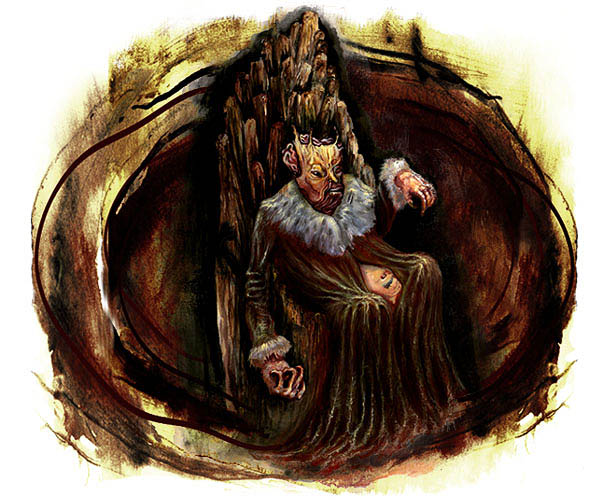
In Canto 7 Dante descends to the 4th circle where there are two kinds of dammed dwelling. That of avaricious and prodigal nature respectively. It is interesting to see that two sides of the same coin are to be stuck in the same circle of hell. Both, with one thing in common which is the misuse or the lack there of of their power. Money is a driving force in the world that Dante lives in and even in the world that we live in , so it is understandable to see where being corrupt or loose with money can make you end up. Furthermore, this Canto provides insight on the power struggle and self control people in high places must maintain in hopes of not ending up in the 4th circle of hell. Today, especially, we can relate this to our messed up political system in which the rich are meant to become richer because of their power and the system that adheres to them. Also, with many musical artists, particularly hip-hop artists that misuse their money and spend a large chunk of it on unnecessary materialistic things that have come about from war and bloodshed.  When thinking of the subject of money and monetary actions of good and bad it is helpful to refer to this Canto as well as this painting or image that I found on the web which is meant to resemble Plutus, the demon which Dante encounters, but I feel this demon painting resembles more anyone that is enslaved to the thirst for money. Just like any other addiction, massively hoarding or wastefully spending money can be looked at as a disease in which there may be no cure once too far gone.


Assignment #1 – Canto III

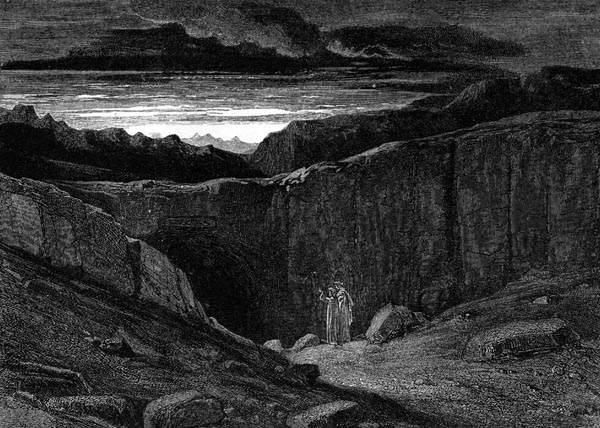
Gustave Doré Illustration - Inferno Canto 3, 27

Above is an image that I found under our resource page, poetryintranslation.com.

This image depicts a dark scene in which Dante, in front of an entrance in what it looks like to  me a huge tunnel like cave. Atop this cave entrance reads,

“THROUGH ME THE WAY TO THE INFERNAL CITY:

THROUGH ME THE WAY TO ETERNAL SADNESS:

THROUGH ME THE WAY TO THE LOST PEOPLE.

JUSTICE MOVED MY SUPREME MAKER:

I WAS SHAPED BY DIVINE POWER,

BY HIGHEST WISDOM, AND BY PRIMAL LOVE.

BEFORE ME, NOTHING WAS CREATED,

THAT IS NOT ETERNAL: AND ETERNAL I ENDURE.

FORSAKE ALL HOPE, ALL YOU THAT ENTER HERE.”

where the Devil makes it clear that these are the gates of hell. The devil refers to God as a justice moving supreme maker with divine power, highest wisdom and primal love, further establishing the fact that he is in fact the Devil, hell’s gate keeper, and the infamous fallen angel in which he takes much pride. It is nearly impossible for Dante not to be discouraged and afraid standing in front of the gates of hell to which he confesses to Virgil of feeling that this not-so welcoming message is “hard” to him, implying a sense of hesitance. Virgil then replies, “‘Here, all uncertainty must be left behind: all cowardice must be dead. We have come to the place where I told you that you would see the sad people who have lost the good of the intellect.” Virgil, both encouraging and comforting Dante leads him into the unknown abyss where he finds a plethora of diverse signs of anguish and instability.

I chose this image because I seldom like to think of what heaven will look like but never what hell will look like. I feel that it is hard to picture such unpleasant sceneries and also uninviting to my interest. Instead, when I am provided with such insights on what hell might look like it further intrigues me in reflecting on how awfully severe it might be to end up there.