Azka Irfan
The Christian Doctrine “The Harrowing of Hell” has countless literary adaptations that attempt to make the theology linguistically and culturally accessible in a rapidly modernizing society. The “Harrowing of Hell” describes the Christian belief that Christ descended into Hell before he resurrected in order to save all the righteous souls that existed before him. The Bible briefly mentions the event in St. Peter scriptures however, the event is more vividly described in the Gospel of Nicodemus which postdates the Bible. “Dante’s Inferno” by the Italian poet Dante Allighieri is a 14th Century epic that draws on the Christian doctrine to emphasize the importance of the Christian faith in redeeming the condemned souls in limbo. Likewise, the “Harrowing of Hell” by Dr. Jeff S. Dailey and the American Theatre of Actors is a play primarily based on translated medieval texts that narrate the events leading upto and including the Harrowing of Hell. The play is composed of 4 components: the 14th century medieval play “The Fall of the Angels”, the 20th century poem “The Soliloquy of Satan” by African American poet Eliot Blaine Henderson, a reading from the Gospel of Nicodemus, and the 13th century poem “The Harrowing of Hell.” Dr. Dailey simplifies the Old English in medieval texts while preserving its authenticity and intended message. The production modernizes the texts in order to convey the importance of Christ’s sacrifice. The poem of “Dante’s Inferno” and the theatre production of the “Harrowing of Hell” both acknowledge that Christ descends to hell to save almost the same souls however, the epic portrays Lucifer as a submissive monster however, the play depicts Lucifer as a grieving angel that transforms into a vengeful monster that controls the mechanisms of hell.
The epic “Dante’s Inferno” establishes Christ’s descent into hell through the physical destruction and presence of love in the inferno.When Dante and Virgil are traveling to the first circle of hell, Virgil notes that the cliff was still intact when he visited hell the last time. He states, “on every this deep, foul valley trembled so that I thought the universe must be feeling love, by which, some believe, / the world has often been turned into Chaos…” (Canto 12, lines 40-42). The Gospel of Matthew states that an earthquake coincided with Christ’s crucifixion. Virgil personifies the “foul valley” trembling to symbolize that earthquake which devastated the inferno during Christ’s death. Virgil mirrors the violent nature of Christ’s death with the violent destruction of the inferno, to show that the inferno only changed when Christ died. He further elaborates on the metaphorical changes in the world and the inferno in terms of the presence and absence of love. The break in the verse “the universe must be feeling love” and “the world has often been turned into chaos” parallels the first time that hell is experiencing love since its creation with the world losing its ability to experience love again. The phrase the “universe must be feeling love” is specifically referring to Christ’s descent into hell. God structured hell in such a manner that the sinners can’t experience love. Thus, the only figure that can exude love in a loveless place is God himself because he’s the one who made the inferno incapable of hosting such emotions in the first place. The verse “the world has often been turned into chaos” specifically refers to the absence of love in the world in the aftermath of Christ’s death. The verse is placed after the clause referring to Christ’s descent into hell to show that Christ’s death took away the love and order that governed the earthly world, hence causing it to spiral into chaos. Virgil establishes Christ’s descent to the inferno following his death on Earth by setting up a parallel between the presence of love in the inferno with the lack of love in the Earthly world.
The theatre production “The Harrowing of Hell” establishes Christ’s descent into hell by relating his death to the promise of salvation and eternal life for all those that believe in him. The 13th century poem “The Harrowing of Hell” narrates “He was born for us,/ In this world, in poverty; / In this world he died,/ To deliver us from the evil one.” (Halliwell – Phillipps, lines 33-36). The verse “In this world, in poverty;” the “world” refers to the earthly world because “poverty” is a vice that is exclusive to the materialistic world. Heaven, purgatory, and hell don’t have poverty because the souls aren’t defined by their economic status but by their virtues in those domains. The 3rd verse “In this world he died,” also refers to the earthly world because only the living can experience death, souls cannot die. The 4th verse states “To deliver us from the evil one,” however the “us” does not refer to the living souls but to the virtuous souls trapped in the inferno and the “evil one” refers to Lucifer. Christ’s birth and death all occurred in the earthly world however the souls that are being saved are in the inferno. The narrator cleverly showcases that even though Christ was born on Earth and guided the humans to live a more virtuous life, his purpose was not only to offer a path to redemption to all the living souls but to also save the repentant and virtuous souls that already died. The poem narrates “When Jesus had shed his blood/ For us, upon the cross,/ In his divinity he proceeded/ Toward the gates of hell.” (Halliwell – Phillipps, line 37-40). The bible states that “Without the shedding of blood, there is no forgiveness” (Hebrews 9:22). Thus, when Christ bled on the cross, he offered humans a path towards forgiveness and salvation. God warned Adam and Eve that if they consume the apple “you [they] will surely die” (Genesis 2:16-17), the death refers to a physical and spiritual death. When Adam and Eve consumed the apple, they condemned all of mankind to this absolute death. However, when Christ died on the cross, he was the perfect sacrifice that promised eternal life to all those that believed in him. The bible states “He has now reconciled in his body of flesh by his death, in order to present you holy and blameless and above reproach before him,” (Colossians 1:22). His sacrificed cleansed mankind of its sins and offered them a path to redemption, salvation, and eternal life. However, the souls in the inferno that died before him are also bought by his sacrifice. Hence, the play showcases that Christ’s blood on the cross saved the souls in the inferno.

Christ outside the Gates of Dis
The epic “Dante’s inferno” shows that Christ saved the almost the same souls as the ones in the play because they had faith in him. In the inferno, Virgil claims that “But certainly, if I remembered well, a little before he came who took the city from Dis the great spoils of the highest circle,” (Canto 12, line 36 – 37). The souls are not allowed to leave the inferno because their punishment is eternal. The “he” pronoun refers to Christ and the “great spoils of the highest circle” refers to Adam and Eve who formerly resided in the Earthly Paradise before their disobedience led to their placement in the inferno. The text implies that Christ saved Adam and Eve from limbo. Virgil also narrates that “I was still in this condition, when I saw a powerful one come, crowned with a sign of victory./ He led forth from here the shade of our first parent, of Abel his son, and that of Noah and Moses, lawgiver and obedient,/ Abraham and the patriarch and David the King, Israel with his father, and his children, and Raechel for whom he did so much,/ and many others, and he made them blessed.” (Canto 4, lines 51-60) Virgil is referring to Christ when he says “the powerful one” because the phrase “crowned” with victory is a play on the thorn crown that Christ wore when he died. The verse “the shade of our first parent” refers to Adam and Eve who are the parents of all mankind. The other figures including Noah, Moses, Abraham, David the King, Israel, Raechel and others are the ones that were virtuous in their life and had faith in Christ, thus, they were granted salvation. In the South Atlantic Review, the article “Dear life redeems you”: The Winter’s Tale and the Harrowing of Hell” by Christina Romanelli states that “Looking at The Winter’s Tale through the lens of the Harrowing of Hell shows how this play is an argument against the skepticism that leads to secularization. Both a doctrine and narrative tradition, the Harrowing of Hell serves as a nexus of religious, magical, and scientific discourses that explains how Christ defeated Satan in Hell.” (Romanelli). The Harrowing of Hell has many adaptations however many famous writers including Shakespeare claimed that since the Harrowing of Hell is absent from the bible, Christ never descended into hell and came to the “conclusion that the one God did not exist.”(Romanelli). However Romanelli argues that the intention of the medieval play is to have faith. She even claims that “I argue that this tradition offers a model of identification with Christ that empowers early modern subjects to combat negative forces in their lives” (Romanelli). The souls in the inferno knew that they were eternally condemned because of the inherent sin of Adam and Eve yet they still believed that Christ would come to save them despite their suffering in hell. Romanelli argues that the novel allows society to modernize but it still teaches them to have faith in their hardships and turmoils.
The play the “Harrowing of Hell” shows that Christ saved some of the same souls mentioned in the inferno because they had faith in him however, the play leaves out some of the ones that Dante mentions. In the play, Christ walks in a white robe with a thorn crown to Adam and Eve. He claims “Adam, I have given my life,/ For thee and for Eve thy wife./ Thinkest thou I died for nought?/ By my death was mankind bought.” (Halliwell – Phillipps, lines 179-182). In the play, Adam and Eve beg God to take them away from “this hateful place [hell]” (Halliwell – Phillipps, lines 177). Christ asks Adam and Eve the rhetorical question “Thinkest thou I died for nought?” which translates into “Do you think I died for nothing?” Christ states to Adam and Eve that “I have my life” to you and “bought” mankind because Adam and Eve’s condemnation was inherited by their children. However, when Christ died, he not only offered mankind the opportunity to salvation but he also freed the souls that still believed in him including Adam and Eve despite their initial disobedience. In another exchange, Abraham says to Christ that God told him “Should a child be born;/ who would rescue us from pain,-/ Me and with me all mine.” (Halliwell – Phillipps, lines 186-188). The child refers to “Christ” as he is considered the son of God and a physical manifestation of his grace. The “us” that Abraham is referring to are the souls trapped in the inferno with him including King David, John the Saint, and Moses that still believed in God. “Dante’s Inferno” mentioned many more souls that were saved that the play did not mention such as Abel, Noah, Israel with his family, and Raechel. However, the play also mentioned St. John which “Dante’s Inferno” did not mention. In the Journal of English and Germanic philology, the article “The Performance of Power in Medieval English households: the Case of the Harrowing of Hell” by Ingrid Nelson states that “Adam, Eve, and the patriarchs (Abraham, David, John the Baptist, and Moses) then speak to Christ in turn, and he releases each of them from Hell.” (Nelson). He confirms that all medieval texts mention these souls explicitly however, there is an “improvisational spirit among scribes, who adapted the framing material to fit its material context.” Since Dante’s inferno is written after the integration of the Harrowing of Hell in biblical readings, he might’ve included more souls. Despite this disparity, in “Dante’s Inferno,” Virgil states that there were others that were “blessed” and in the play “The Harrowing of Hell,” Abraham mentions “us” ambiguously. Thus, there is the possibility that there are other souls in both adaptations which could’ve been the same but were not specified. Nevertheless, both adaptations show that Christ saved most of the same souls because they had had faith in him.

Christ with Adam and Eve

Christ with Abraham
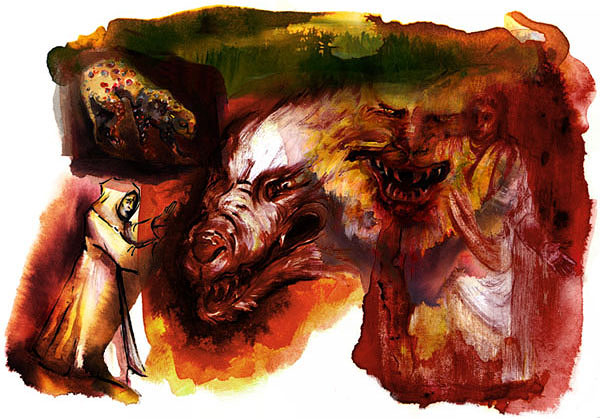
In Dante’s inferno, Lucifer is portrayed as a submissive creature that is physically integral to the mechanisms of the inferno. Dante describes Lucifer as the “The emperor of the dolores Kingdom issued from the ice at the mid-point of his breast;” (Canto 34, lines 28-29). The “emperor” refers to Lucifer and he rules over a “dolores” or sorrowful Kingdom. The “ice at the midpoint of his breast” holds Lucifer in place so that he’s immobile. However, Lucifer is a King “issued from” this ice to show that Lucifer is the “emperor” not because he has a choice but because the ice holds him in place and integrates him into the structure of the inferno. He’s an emperor because he’s stuck in the inferno. Dante further describes that he had “three faces on his head”(Canto 34, lines 37) and “beneath each one came out two great wings, such as befitted so great a bird:” (Canto 34, lines 45). The deliberate simile that Lucifer’s wings resemble a bird’s is ironic because a bird can fly however Lucifer despite having wings is unable to. This emphasizes that even though Lucifer is a giant with multi-heads and wings, he’s incapacitated and rendered helpless because he “lifted his brow against his maker.” (Canto 34, lines 34). Dante further elaborates that Lucifer was “fanning them, so that three winds went out from under him:/ by them Cocytus was frozen.” (Canto 34, lines 48- 52). When a bird wants to fly, it fans it wings out before it takes flight. Likewise, Lucifer is fanning his wings out but he’s can’t fly. Instead, the wings produce a wind that further freezes hell and incapacitates him further. The theme that this Lucifer is in this position through fault of his own is reiterated in this canto. Lucifer defied God thus he was punished for his rebellion. Likewise, he’s stuck in the inferno because he keeps on fanning his wings which further freezes him. Dante narrates “with six eyes he was weeping, and down three chins dripped the tears and the bloody slobber.” (Canto 34, line 52). Usually, the depiction of multiple heads means that a person is unfaithful or has ulterior motives but all 3 of Lucifer’s faces are “weeping” to show that he genuinely feels repentance, pain, and sorrow in all of his being. The “bloody slobber” is traveling down his chin because he’s chewing on Judas, Cassius, and Brutus. There is a parallel between Lucifer’s betrayal of God and the sinners that betrayed their loyalties. Judas betrayed Jesus when he called him a “rabbi” whereas Brutus and Cassius betrayed Julius Caesar which inevitably led to the fall of the Roman Republic. The epic portrays Lucifer as a submissive, repentant creature that is eternally punished for his betrayal of God.
The play “The Harrowing of Hell” depicts Lucifer as initially repentant fallen angel that transforms into a vengeful creature that wants to possess all human souls under his domain. In the “Soliloquy of Satan,” Lucifer is surrounded by darkness and his shrieks are resonating on stage. He’s crying “Fool! Hast thou been, proud Lucifer!/ To God thou shall yet bend in tears,/ Brought to the gravity of thy fate/ Clothed in the mantle of dire fears.” (Henderson, pg 9). Despite his hatred for humankind, he’s suffering the same problems as humans. Humans “bend” and pray for God’s forgiveness, likewise he’s also “bending” and asking God for forgiveness. Humans have to worry about their “fate” because its not in their control. Before Christ’s harrowing of hell, Adam and Eve’s sin condemned all humankind to the same fate of death. However, Lucifer also has to worry about his “fate” because part of God’s punishment is that he’s destined to suffer in the inferno for eternity. Moreover, humans wear clothes because they’re aware of their sexuality. Likewise, when Lucifer was cast from the heavens, his clothe burned with him and he became aware of the gruesomeness of his own body, thus he wears clothes. Humans also experience “fear” because they’re uncertain about their survival, likewise, Lucifer is also experiencing “fear” because he’s uncertain whether any former remnants of his glorious self will survive in hell. In many ways, Lucifer has been reduced to the same status of the humans that he despises. Lucifer implores to the heavens “Could my entreaty move thy will,/ For reinstatement ‘ round Thy Throne,/ Gladly would I flee to thee,/ Where dwell the glories of thy own.” (Henderson pg 9). Even though Lucifer desires his former place in the heavens around “Thy [God’s] Throne,” he says “could my entreaty move thy will” depicting uncertainty on his own faith and God’s ability to forgive. The condemned souls knew their fate and still chose to believe in God, hence they received salvation. However Lucifer hypothesized that God would never forgive him without even trying. He eventually concludes that “For every tear that I have shed,/ For every plea struck from my tongue,/ Summon! Thy most destructive powers,/ Let souls from Earth this hour be flung.” Lucifer’s pride makes him ashamed that he even pleaded with God thus, he calls upon his “most destructive powers” or the former angels that turned into demons. He commands them to “flung” the souls from Earth into the inferno. For every “tear” and “plea” that God made him cry because he didn’t respect humans, he wants a human soul thrown into the inferno so that it can also suffer under his mandate. He claims that the “law of Lucifer” (Henderson, pg 15) states that “Well might’st thy try to remove God’s throne,/ As try to touch this heart of stone!” (Henderson, pg 15). He dares that someone might as well attempt to dethrone God than appeal to his heart. He claims that he is just as immovable as God once against making the fault of equalizing himself with God and sealing his fateful doom.

Lucifer bending towards God in the Soliloquy of Satan

Lucifer torturing the souls
Both the epic “Dante’s inferno” and the play “The Harrowing of Hell” emphasize the importance of having faith in Christ as the ultimate path to salvation. However, the epic and the play depict Lucifer differently to fit their themes. The epic portrays Lucifer as a submissive creature to show that God is the true divine force that controls all of the domains including the inferno. However, the play shows Lucifer as this developed and internally broken antagonist to exaggerate the effect of the suspenseful confrontation between Christ and Lucifer. This conforms to the traditional portrayal of Christ as this hero like figure that prevails over the eternally vengeful Lucifer who holds much of mankind in his captivity.
Bibliography
Allen, Thomas Powers. A Critical Edition of the English Gospel of Nicodemus. 1968.
Alighieri, Dante, et al. The Divine Comedy of Dante Alighieri. Oxford University Press, 2013.
“1. The Barkers’ Play: The Fall of the Angels.” York Pageant 1: The Barkers’ Play, groups.chass.utoronto.ca/plspls/wp-content/uploads/2015/09/York01.html.
Halliwell-Phillipps, J. O. The Harrowing of Hell, a Miracle-Play Written in the Reign of Edward the Second, Now First Published from the Original Manuscript in the British Museum, with an Introduction, Translation, and Notes, by James Orchard Halliwell .. John Russell Smith, 1840.
HENDERSON, ELLIOTT BLAINE. SOLILOQUY OF SATAN: and Other Poems (Classic Reprint). FORGOTTEN Books, 2015.
Holy Bible: Containing the Old and New Testaments: King James Version. American Bible Society, 2010.
Romanelli, Christina. “‘Dear life redeems you’: The Winter’s Tale and the Harrowing of Hell.” South Atlantic Review, vol. 81, no. 1, 2016, p. 8+. Academic OneFile, http://link.galegroup.com/apps/doc/A450903880/AONE?u=cuny_hunter&sid=AONE&xid=f3389777.
Vol. 112, No. 1, January 2013 of The Journal of English …www.jstor.org/stable/10.5406/jenglgermphil.112.1.issue-1.