Tag Archives: Inferno

True Love Brought Together Two Lovers Caused by Eternal Passion —Final Paper

In The Divine Comedy specifically the Inferno, Dante and Virgil encounter Francesca and her lover Paolo, they are placed in the circle of the lustful. Because the lovers were swept away by sharing a kiss of passion, it ultimately led them to their death, they are punished in Hell doomed forever, trapped in an eternal whirlwind motion that sweeps them together. Dante wants to speak to the lovers and they willingly do so, Dante stops to speak with Francesca briefly. She gives little insight about her life and her death without giving Dante full-details. Dante already has heard the story and therefore identifies the woman figure by realizing she is Francesca. Dante is curious why Francesca and Paolo are damned souls; Francesca continues her story in which touches Dante with heart-felt emotion which causes him to faint because he feels pity for Francesca and Paolo. Although Francesca cheated on her husband with Paolo whom was her husband’s younger brother, she fell in love with Paolo during reading the story of Lancelot and Guinevere. In addition, Francesca was married off to Giovanni as a political tie between her family and the Malatesta’s. Therefore, Francesca never was in love with her husband and through the power of literature, Francesca and Paolo were capable of falling in love with each other. Francesca and Paolo shouldn’t be damned for their punishment because their love for each other is still an on-going desire that stems from both of their intellects.

In canto 5, Francesca says, “Love which pardons no one loved from loving in return, seized me for his beauty so strong that, as you see, it still does not abandon me” (lines 103-105). Therefore, Francesca and Paolo are still committing the sin of lustfulness because they have not abandoned each other – they are stuck with one each other for eternity, so they embrace each other in a wind whirl. Francesca also says, “Love, which is swiftly kindled in the noble heart, sized this one for the lovely person that was taken from me; and the manner still injuries me” (lines 100-102). Francesca admits that she is still hurt by the situation, which is ongoing. She still feels the pain of being murdered, she still remembers the horror of her death as well as the death of Paolo; she also still feels strong overpowering emotions for Paolo. Francesca also mentions the “noble heart” which indicates, the act in which they are still committing is pure and out of love and endearment, not out of spitefulness. According to Poggioli, the author states, Francesca’s “language is not only feminine, but ladylike, revealing delicacy of feeling, as well as refined tact. She behaves as well-born gentlewoman even in Hell, despite the fact that her misery and her love place her on the level with Dante, she still stands on her ceremony; her courtesy remains courtly… her attitude seems to be inspired by the graciousness and generosity of a great lady condescending to honor someone of a lower status or lineage than herself” (Poggioli 326). Therefore, Francesca is someone who is pure, kind cultivated and most of all loving, she and Paolo should be justified for their ‘sin’ because they feel immense passion for one-another, and passion shouldn’t be a sin because it derives from carnal love; its natural. Therefore, this act shouldn’t be seen as sinful because they chose to do it because it was in their human-nature, and human-nature is genuine — their act was not forced from an outside source, unlike the marriage Francesca was forced into — the ‘sin’ they committed happened because they wanted it to happen, and it was a decision on both their parts. Therefore, this ‘sinful’ act that is still-going was due because of the honest and sincere passion Paolo and Francesca feel for one another. This passion is also evident in the painting by George Frederic Watts: Watts depicts the two lovers in a positive light. The light reflects off of Francesca’s face which seems innocent and calm and her eyes to seem to be closed, Paolo holds onto Francesca embracing her in holding her hand, a sweet gesture that seems like he’s never letting her go. They are stuck together as if they are one entity, one body and one soul. It almost seems like they are in an airy, floating cloud, and they are the only thing that exists. The thing that I notice is also their nudity, and the nudity represents the purity and the comfortability they feel for one another. I feel this image represents Paolo and Francesca in a positive view because they are drawn out to be two lovers, who wish to be in an eternal life together; together they are complete because they are the dynamic duo, they are whole because they have one another. Although they committed adultery, the light overpowers the ‘sin’ of adultery, and displays their act of righteousness and immense affection that is still developing.


     However, some may argue that their punishment has led them to be placed in Hell instead of Purgatory or Paradise because their act was sinful. They committed a deed that is unfaithful, so they deserve the punishment they receive. Some may even argue that they don’t love each other and so their punishment is the one they deserve – to be stuck together in eternal misery. Some even argue that the reason Francesca and Paolo are placed in Hell is because “use of such an epithet shows that Dante needs to know everything about Francesca’s fall: and such a need is dictated not by a vicarious or morbid curiosity, but by a deep urge for a psychological and ethical knowledge” (Poggioli 334). Additionally, Dante places Francesca and Paolo in Hell is because he wanted to “evoke the fall pathetically, or more simply, romantically: but this would have involved an attitude of indulgent forgiveness, and so destroyed the stern mortality of the tale” (Poggioli 334). Therefore, the reason reflecting Poggioli’s views is that, Francesca and Paolo are placed in Hell because the romantic tragedy should be viewed as a failure and that they shouldn’t be forgiven because it would demolish the mortality. The scholar also argues that if Paolo and Francesca were forgiven, they would not receive the punishment and perhaps would have maybe escaped death. Therefore, they are in Hell because they shouldn’t be forgiven, and their act wasn’t proper.

However, one scholar argues that Dante could have given us the “circumstances of Francesca’s story, Francesca da Polenta of Ravenna, wife of Giovanni Malatesta, the crippled son of the Lord of Rimini, and mother of a ten-year-old daughter, became the lover of her husband’s younger brother, the dashing cavalry caption Paolo Malatesta, himself a married man with two children. They were betrayed by a servant, and the husband, crazed with the discovery, took them by surprise and stabbed them both to death. But Dante does not give us the story, for its only trace in the poem is the momentary flash…in the phrase ‘Caina awaits for him who quenched our life’” (Berthoud 25). Therefore, the husband should be punished because he killed both Paolo and Francesca and committing a sin of murder is much greater than two lovers falling in love because of the passion they feel and still feel for one another. In addition, Francesca never wanted to marry Giovanni – she was forced too because of the rivalry between her family and the Malatesta family, therefore she never decided who she wanted to marry, it was taken away from her. She was just used as a token for a peace treaty, so never had an option or an input when it came to her marriage. In a modern society of today’s culture, this would be frowned upon because Francesca has no voice and her option of whom she wanted to marry was taken away from her, therefore she had to marry a man of her families choosing and Francesca wasn’t content and therefore when she fell in love with Paolo; she committed adultery but with someone she actually felt immense desire for and still has on going desires for. So, although she committed a ‘sin’ she committed the sin because she fell in love with someone whom she has feelings for and is still in love with someone she wants to be with, forever, so she made the choice because it came from her intellect which stemmed from her feelings, which came from her decision and no one else’s. Because Paolo and Francesca shared a kiss, while reading a romance novel calledLancelot and Guinevere, it inspired them to kiss because their story was also a romantic tragedy. In addition, one author states, “In the erotic embrace of death love has been made eternal, true…here the two lovers become helpless victims of love. So strong is their passion.so foreordained is their fate. Paolo is enrapt by passion and cannot tear himself away from Francesca. Like innocents the two are led against their will to kiss for the time by the description of Lancelot’s kiss in the book. Even the conventional demon of the tale, Francesca’s husband Giovanni, is guided by forces that he cannot control. “Unwillingly they loved…unwilling I slew them.” Once he has killed the lovers, once, so to speak, he has fulfilled his role as the executor of a remorseless decree of Fate…” (Bugliani-Knox 227).Because Francesca and Paolo were reading a novel that stirred the monumental kiss, it was the intellect that influenced them and because Dante is a writer himself, he feels pity for Paolo and Francesca because literature has the capability of capturing one’s emotions. Dante understands Paolo and Francesca’s cause and sympathizes with them. The kiss shared between Paolo and Francesca has led them to a never-ending eternity, their love for each other is eternal as well this is evident in the painting by Gustave Doré.


File:Gustave Doré - Dante Alighieri - Inferno - Plate 15 (Canto V - Francesca di Rimini).jpg


Similarly, to the other painting, there seems to be a light portraying onto the two souls. Even when the painting is dark, there is still light that radiates from the two lovers — the light that signifies purity, goodness, honesty, virtue. Unlike the other painting, Francesca is completely nude to the viewers. Her nudity represents her sexual attraction but still symbolizes her innocence and chastity, modesty and delicacy of sentiment… Like the other painting, Paolo is still always looking down at Francesca, they are embracing each other, tightly and intensely. Francesca also has a cut in the middle of her breast which seems like it’s bleeding because the blood is dripping downward, which signifies pain. The blood is the haunting memory of the murder of she and Paolo. Francesca is still hurt from her death, the pain is still an ongoing matter, she looks at Paolo like she wants to be rescued because he is her savior, but also attentively and deeply stares into his eyes. They look like two angels floating together, no matter how much darkness surrounds them, they are brought into positive light. Therefore, I think Paolo and Francesca shouldn’t be blamed for their ‘sinful’ act because even in the dark, they reflect light – they represent faith even though they are surrounded of the storms of darkness and sin – their ongoing love affair represents the “light of the world” even though they are in Hell; light finds their way to them similar to a divine light, even though they are surrounded by the gloomed.

In conclusion, although, Dante places Francesca and Paolo in Hell in the Divine Comedy of Inferno, in the circle of the lustful they deserve to be placed in Purgatory because their sins can be overlooked and forgiven. Passion was the main cause of their death and they still receive recurring punishment because of it. Although Dante feels pity and faints for Francesca and Paolo, he still places them in the Inferno. Francesca whom cheated on her husband with Paolo, truly fell in love with Paolo because of her intellect and because she faithfully still wants to be Paolo and chose to love him. Paolo also couldn’t resist Francesca because he felt immense and still feels immense passion for her as well, they still desire each other which is an endless connection that brings them together. Essentially, Francesca and Paolo shouldn’t be damned for their punishment because their love for each other is still an on-going desire that stems from both of their intellects.


Works Cited

Berthoud, J. A. “The Vision of Eternity: an Introduction to Dante’s ‘Inferno.’” no. 25, 1965, pp. 17–32. JSTOR, www.jstor.org.proxy.wexler.hunter.cuny.edu/stable/41801520. Accessed 30 Apr. 2019.

Bugliani-Knox, Francesca. “Galeotto Fu Il Libro e Chi Lo Scrisse: Nineteenth–Century English Translations, Interpretations and Reworkings of Dante’s Paolo and Francesca.” no. 115, 1997, pp. 221–250. JSTOR,

Poggioli, Renato. “Tragedy or Romance? A Reading of the Paolo and Francesca Episode in Dante’s Inferno.” Vol. 72, no. 3, 1957, pp. 313–358. JSTOR, doi:10.2307/460460.


Ferrying the Damned

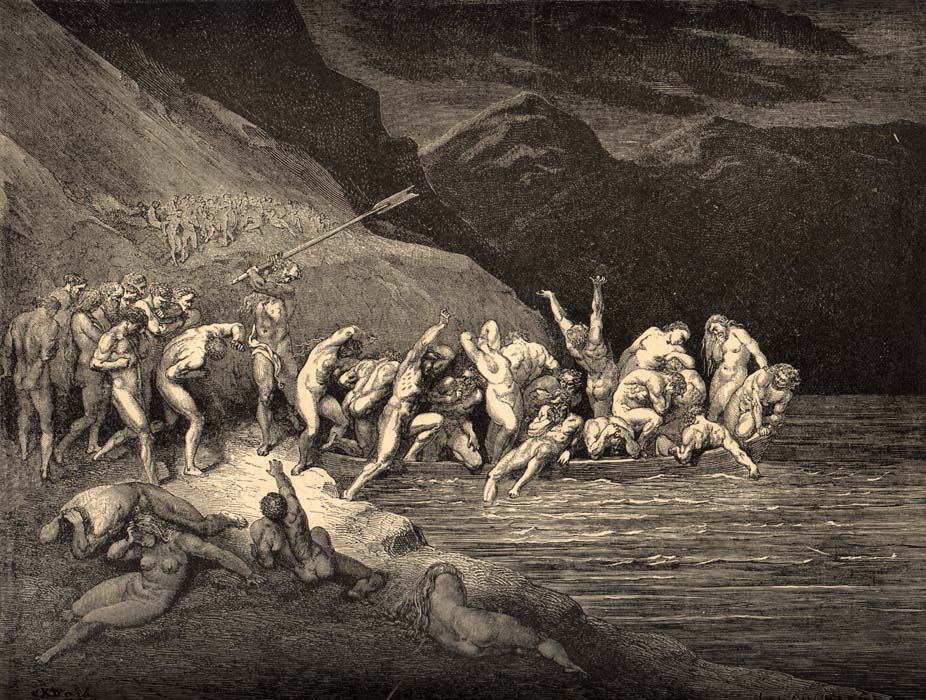
Illustration of “Charon Ferrying the Damned” by Gustave Dore

(Blog Post 1 make-up)

This work created by Gustave Dore which depicts Charon Ferrying the Damned has elements very similar to how Dante describes the scene in canto 3 of Inferno. In the work, we can easily see Charon as the figure with the oar which is how Dante has described him. Dante introduces this figure in Inferno as, “Charon the demon, with eyes like glowing coals, making signs to them, gathers them all in; he beats with his oar whoever lingers” (Inferno, 109-111). The work also shows Charon swinging back the oar as if he is about to whack the damned who are trying to squeeze themselves onto the boat. We can also tell that he might be close to striking the souls by the way the figure just behind Charon cowers and shrinks back in fear.

Another element of this work that is depicted similarly to how Dante describes it is the congregation of the damned souls. Dante describes the souls as, “… all of them together, weeping loudly, drew near the evil shore that awaits each one who does not fear God” (Inferno 3, 106-108). The pain and distress is depicted in work through the positioning of the bodies. Some reach up and out while other are stretched out in a helpless manner and other have their heads in their hands. When describing this scene Dante also mentions, “… over here again a new flock gathers” (Inferno 3, 119-120). This also depicted in the work with the group of souls just behind Charon and the congregation of souls we can faintly see in the background on the mountain side who will journey to the same fate. Through these elements it can be determined that Gustave Dore accurately depicted what Dante describes upon reaching the Acheron.


Pride and Position

Dante watches as the prideful purge themselves, Title: Proud Penitents (Oderisi da Gubbio), Illustration by Gustave Doré, Source: Danteworlds (UTexas) (Galleries of Purgatory (Terrace of Pride))

As Dante and Virgil continue to voyage through purgatory they find themselves on the first terrace in canto 10. Each of the seven terraces symbolize the seven capital vices, of which the travelers encounter the prideful souls. Dante, as the author, purposefully creates parallels between cantos of the same number in purgatory and inferno. As an example, upon entrance in both the sixth circle of heresy and the terrace of pride, not a single soul is visible in sight. The reason for this could possibly be that the arrogance with which the souls carry themselves push them to believe that any visitors that come their way aren’t worthy of seeing who they are immediately nor are the visitors worthy of knowing who they are. While this may not be true for all the souls of the sixth circle, the behavior of the souls that Dante does get to meet indicate otherwise. As for purgatory, the reason for this has to do with the contrapasso of the punishments of the prideful. Each of the souls are forced to look at the ground because of the tremendously heavy stones weighing them down on their spines. This is an opposition to the overly-confident attitudes that the souls have in their living days where their attitudes kept their heads up high during every encounter. The punishment allows them to understand the negative traits they possess and how one cannot spend eternity as someone who treats others as though they are below them. The simultaneous pounding of their chests reflects the process of the purging of the souls into better versions of who they used to be giving them an element of sincerity that lacks in the souls of inferno.

Meanwhile, the sinners of canto 10 in inferno have mainly committed heresy but one character, known as Farinata, shows evidence of pride and arrogance. Dante narrates, “I had already fixed my eyes in his; and he was/ rising up with his breast and forehead as if he had/ Hell in great disdain,” (34-37, 173, Inferno). The focus on his breast and forehead symbolize the importance of courage. Farinata keeps his head held high, which forces Dante to look up to him while they’re conversing as he stands at the base of Farinata’s tomb. This, consequently, creates a hierarchy between the two characters putting Farinata above Dante. As Farinata rises from his tomb in a prideful and arrogant manner, he maintains a calm and collected demeanor despite the circumstances he finds himself in. His pride is further emphasized when Dante proclaims, “…as if he had Hell in great disdain. (34-35, 157, Inferno). The superior tone, in sharp contrast to the souls of purgatory, implies an attitude of superiority that lacks in the atmosphere, itself, of purgatory. Farinata acts as though he is above the afflictions of Hell and cannot be bothered to concern himself with the sufferings that surround him. Furthermore, his bearing implies a concern with social status which is emphasized when he asks Dante if he comes from the opposing political faction of Guelphs. Such attitudes aren’t present either at Dante’s first encounter with the prideful, despite their vices, because if they behave in such a manner, which counters the will of God and his reasoning for placing the souls in either inferno, purgatory or paradise, then the purging souls would not be where they are now in the first place.

The social statuses, however, that Farinata preoccupies himself with are understandable because, the deeper one delves into inferno, the rougher, harsher and more terrifying the souls’ punishments become. Perhaps, he is attempting to prove to Dante that although he is in the sixth circle of Hell, he is worth much more than what God deems him to be, who consequently places him in this petrifying circle. When it comes to purgatory, the higher one climbs the levels of purgatory, the closer they come to the entrance of paradise and all the goodness and light it contains. This signifies that even though the prideful souls are in the first terrace and as a result, aren’t as close to paradise as the rest of the souls, their purging is considered worth the journey. Their social statuses, unlike the souls of inferno, are temporary and are subject to transforming into a brighter and more peaceful eternity as opposed to the devastating and never ending torments of inferno.

The Punishment of Satan/The Contrapasso of Lucifer

Dante and Virgil Encounter Lucifer in Hell, 1923 Giclee Print by Henry John Stock

In Canto 34, Dante is introduced to Satan, “the creature who had once been beautiful.” (17-18) Dante’s descriptions of Satan are haunting, so haunting that Dante pauses the dialogue to engage the reader stating: “I became frozen and feeble, do not ask reader, for I do not write it, and all speech would be insufficient.” (22-24) But Satan’s real punishment isn’t just his eternal fate in hell. He’s doomed to forever be one with hell, punishing not only Judas, Brutus, and Cassius, but also the other members of the 9th circle with the cold beats of his bat-like wings. In other words, he’s reduced to a mechanism of hell, equivalent to other beasts and lower forms we’ve seen in other Cantos, like Cerberus or Plutus from upper hell.

The contrapasso of Lucifer is very evident. Not only through his punishment, but Dante’s descriptions of Lucifer. Almost without exception Dante refers to Satan’s prior perfection, literally a “light-bearer,” the translation of Lucifer: “If he was as beautiful then as now he is ugly, when he lifted his brow against his Maker.” (34-35) This further develops the idea of his punishment. A rebel against God, he is now doomed to forever remain a mechanism of God’s divine justice. A punishment to others who also violated God’s divine authority.

Lucifer’s physical punishment also reflects this contrapasso. Massive in size, but rooted in ice, Lucifer is both incredibly intimidating but at the same time utterly docile. This is further illustrated by his utter silence throughout the canto, forced to continue God’s will and chew sinners for eternally with three mouths, a parallel to the trinity.

I think that the geology of lower hell is very interesting, especially in reference to Satan. As Virgil and Dante leave the 9th circle to exit hell, Dante describes how “I raised my eyes, thinking to see Lucifer as I had left him, and I saw that he extended his legs upward.” (88-89) I like to think that this is a reference to the 8th circle, 3rd Bolgia, in which the feet of simonists are engulfed in flame. In a certain way, Satan too used his position in a different context for personal gain.

Ultimately, I think that the punishment of Lucifer is a poetic and powerful transition into Purgatorio. I think that because of Lucifer’s silence in the Canto and his diminished state as a mechanism of hell reflects the punishment of sinners in the Anti-Inferno, who aren’t recognized at all. While Satan is recognized, he isn’t glorified or even dignified by speech, as other sinners have been. He’s simply condemned to his fate and eternally frozen in the absence of God’s light, and warmth.

Reflective Post 1

After rereading my posts, I noticed similarities and differences in my writing and responses. I included images for half of my posts. I think including artwork sometimes helped me understand the Cantos better and therefore respond better. My first two posts contained more summary than they contained analysis. With each consecutive post following the first two, I believe I progressed in my ability to make better connections, analysis, and find a theme within the Canto.

When looking through my work, I think my post entitled “Canto 11 – A Brief Break to Explain the Organization of Hell/The Presence of the Number 3 and The Importance of Nature” was done the most properly. To begin, I like how thorough and clear the title is as it sets up exactly what I focused on in the post. This was the first post I was able to notice a recurring technique of Dante the poet’s, in which he pauses to have Dante the pilgrim asks Virgil for clarity and the pilgrim’s confusions echo similar questions the reader probably has. I briefly gave a summary and dedicated the rest of my post to analysis. I think this is my first successful post because  I did a thorough analysis and I primarily focused on a theme of the importance of nature and God for Dante the poet. I also think this post is good because of its clarity. I separated it into 4 concise paragraphs in which I analyzed instead of just summarizing. The post that followed my Canto 11 post is “Canto 15: An Unexpected Encounter between a Teacher and Student.” I also like this title. I think this post is also good it mimics the structure of the preceding post. I gave a pretty thorough analysis of the connections between God, sodomy, and violence. I also included how Canto 15 ties to Canto 11. My analysis was presented well when I wrote, “In the third ring, a fiery rain falls on the sinners, which represents an unnatural phenomenon, like sodomy. Whereas regular rain replenishes the Earth, a fiery rain does the opposite since sodomizers also do not replenish Earth with new life.” I think it displays my comprehension of Canto 15.

In my future posts, I should use more outside resources. I also think I can dedicate more time to proofreading to avoid grammar mistakes. I have used quotes in my posts but I think I can include more. Lastly, I would like to make more connections to previous cantos. 

Reflection Post 1


After reading all my posts about the Inferno, I noticed numerous similarities and distinctions throughout them. My first four blog posts were more like summaries rather than reflective posts. They all included images with a short description of them but, I mostly summarized what the canto was about. However, my blog posts five and six had more connections, comparisons, similarities and changes in style. These two posts didn’t include images but made various connections between all the cantos we have read so far.

In my blog post 2 about gluttony, cerberus, and ciacco, my style was repetitive and colloquial. I included an image and a terzina but simply summarized what Canto 13 was about. I tried to include some imagery in my post but did it very poorly; I did the same thing with my first blog post. My first post included a picture of Virgil and Beatrice in paradise which I have not read at all but I thought it was related to Canto 2. I introduced who Beatrice was and how important she was to Dante. Moreover,  in my first two blog posts I  had countless grammar mistakes such as punctuation and fragmentation. In my fourth blog post, I was trying to use imagery to best describe Geryon but it sounds like a huge summary. For example, “ Dante was struck with horror when Virgil requested a ride from the monster. As he climbed on Geryon he saw countless sinners suffering from above and was scared the entire time”. Instead of summarizing what Canto 17 was about I should have made more comparisons and similarities with Geryon and the other beasts introduced in the Inferno. Also, I should try to include more outside resources rather than just quoting from the Inferno to support my posts. Lastly, my lack of present tense is evident throughout my posts but gets better toward my most recent post.

My most recent blog posts five and six are my most clear and concise posts so far. My fifth blog post I compared how Dante has treated the sinners and how Virgil has treated Dante from this throughout the Inferno. I made good comparisons and similarities between Cantos 5, 8, 13, 15, 19,  and 20. For instance, “ Like in Canto 19, Virgil is very pleased with Dante’s attitude towards these sinners because it is showing him not to sympathize with them anymore. He joyously hugs and kisses him in Canto 8 and happily carries him like a baby across the bridge in Canto 19”. Additionally, in my most recent blog post I wrote about how Virgil babies and reassures Dante like a mother throughout the Inferno. I made countless clear and concise similarities among Cantos 2, 8, 19, 23, and 24. I used many quotes to support my theme about Virgil and Dante; also, my writing style is not as repetitive as before.

Virgil’s reassurance towards Dante

Throughout the Inferno, Virgil always helps, reassures, and gives Dante confidence in any given circumstance. Virgil also tends to baby Dante when Dante does something to please him. In Canto 23, Virgil and Dante managed to slip away from Barbariccia and the other demons that were distracted by the demons Calcabrina and Alinchino fighting. Virgil and Dante saw this as their final opportunity to leave but Dante is terrified that the demons will come and look for them since they slipped away. Virgil reassures Dante by carrying him across. In lines 37-43, Dante says “ My leader seized me quickly, like a mother who is awakened by the noise and sees the flames burning close by, who takes up her son and flees, caring more ofr him than for herself, not stopping even to put on her shift:”. Virgil reassures Dante that nothing is going to happen to them by showing him this kind of affection. Similarly, in Canto 24, Virgil pushes Dante to get moving and helps him down the rocky bank. Dante mentions that if it weren’t for Virgil, he probably would’ve given up by now. In lines 23-27 “… he opened his arms and took hold of me. And like one who uses judgement as he acts, always seeming to look ahead, so, carrying me up to the top…”, Virgil carries him again to get to the summit of the bridge. Without Virgil being there, Dante would have been completely lost and hopeless throughout each circle of hell. Additionally, in Canto 19, Virgil also happily carries Dante like a baby across the bridge. Virgil was proud of him for not sympathizing with the sinner Pope Nicolas III. Evidently, there is a recurring theme of Virgil carrying Dante in these three cantos. Nonetheless, Virgil’s reassurance is shown in the beginning of the Inferno in Cantos 2 and 8. In Canto 2, Virgil reassures Dante that everything will be okay in his journey by telling him that he was sent by his beloved Beatrice. In lines 133-136, Dante says “Oh full of pity she who has helped me! And you courteous, who have quickly obeyed the true words she offered you!”. Dante is eternally grateful to have received Virgil as his master and guide throughout his journey. Furthermore, in Canto 8, thousands of enraged sinners try to bar Dante from getting into the city of Dis because of his “alive-ness”. Virgil reassures Dante that they will get into the city of Dis. Virgil at first fails but then succeeds in the beginning of Canto 9. In lines 121-123 of Canto 8, Virgil tells Dante “And to me he said: “You, though I am angered, do not be dismayed, for I will overcome this test, however they scurry about inside to prevent it”. Virgil’s ego does take over here, but he was successful either way when they both got into the city of Dis. Thus, Virgil’s reassurance and encouragement has helped Dante face numerous obstacles throughout the Inferno.

Dante’s tone towards sinners

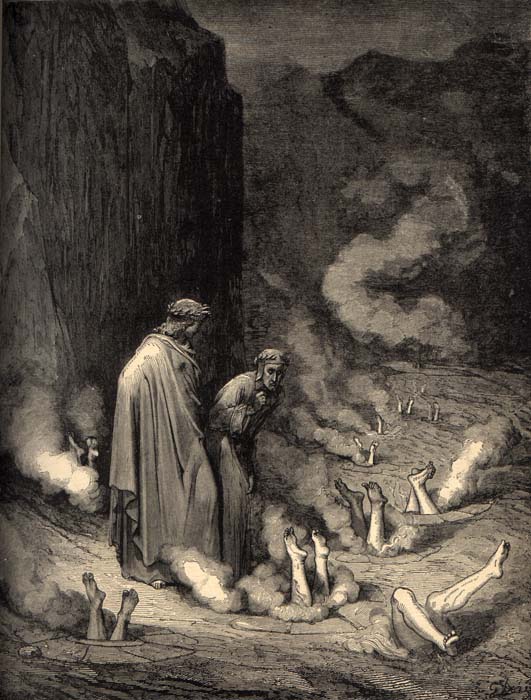
In Canto 19, Dante and Virgil have reached the third pouch of the eighth circle called the simonists. Dante considers these sinners the worst kind because these corrupt clergy fornicate for gold and silver. The simonists are punished by being buried upside down in holes the size of baptism basins; their feet also protrude only to be burnt by eternal flames. In lines 103-105, Dante says “I would still use heavier words; for your avarice afflicts the world, trampling the good and raising up the wicked”. If Dante did not have respect for the papal office, he would have many more negative things to say regarding the simonists. Throughout the Inferno, Dante’s tone has varied with different sinners. In this particular canto, he feels no pity or sympathy towards Pope Nicholas II and unconsciously takes the role of a friar at a religious confession. Pope Nicholas II is unaware of this and thinks it’s his successor but Dante later on reveals himself. Dante’s attitude toward this sinner is nothing but rage; he does not sympathize with him whatsoever. Similarly, in Canto 8, Dante does not sympathize with the sinner At Filippo Argenti who was an enemy of Dante in the real world. He becomes infuriated with his ambiguous answer regarding why the sinner has become so ugly and pushed him back into the river. Like in Canto 19, Virgil is very pleased with Dante’s attitude towards these sinners because it is showing him not to sympathize with them anymore. He joyously hugs and kisses him in Canto 8 and happily carries him like a baby across the bridge in Canto 19. Nevertheless, Dante does sympathize with some such as the sinners in Canto 20 whose heads are on backwards and they are forced to walk without seeing anything in front them or their future. Likewise, Farinata the heretic in Canto 10, who can dive into the future but know nothing about the present state of human affairs. This fourth pouch consists of diviners, astrologers, and magicians who all cry as they walk while tears trickle down their buttocks. Dante feels so much pity for them while Virgil only feels scorn for the sinners. Dante wept as he did for Francesca and Paolo in Canto 5 who both suffered from lust. Additionally, Dante sympathizes with Pier Della Vigna in Canto 13 who committed suicide due to nasty rumors and Brunetto Latini, his former mentor and sodomite, in Canto 15. Thus, Dante’s attitude toward the sinners in the different circles has varied depending on what sin they committed and who they mean to him.


Canto 19: Dante Condemns the Catholic Church

“Simonists” by Gustave Doré (http://danteworlds.laits.utexas.edu/gallery10.html)

In Canto 19, Dante and Virgil arrive in the Third Bolgia of the Eighth Circle. The sinners there are Simoniacs, corrupt clergy who bought or sold sacred heavenly services for money. From the very start of the Canto, Dante immediately angrily criticizes the Simoniacs saying, “You who the things of God, that should be brides of goodness, rapaciously adulterate for gold and for silver.” (Canto 19, Lines 1-4).

Canto 19 solidifies just how important God means to Dante the writer and Dante the pilgrim. The canto also displays how strongly Dante feels towards those who are disloyal and disrespectful to God. Dante, the pilgrim, does not feel sympathy nor pity for the Simoniacs as he has felt for sinners in previous Cantos. Instead, he feels content with their punishment. Dante tells Pope Nicholas, “Therefore stay here, for you deserve your punishment.” (97). He continues and states, “You have made gold and silver your god.” (112). Dante’s tone throughout Canto 19 is pure rage and intensity against those who chose money as their god and therefore did not worship the right God. His hatred for the Simoniacs shows how passionate and how serious God means to him. Dante finds that those who did not take God seriously deserve eternal punishment. Dante adds, “And were it not that I am forbidden by my reverence for the highest keys, which you held in happy life, I would use still heavier words” (100-103), meaning that Dante’s respect for the papacy is keeping him from insulting the Simoniacs even more. Virgil is pleased with Dante’s angry speech towards the Simoniacs. As Virgil was proud of Dante in his interaction in Canto 15 with Brunetto Latini, the pilgrim again believes his leader is pleased “with such a contented smile he listened” (120). 

As shown in the Gustave Doré artwork, God has punished the Simoniacs by stuffing their greedy heads and bodies into holes in the ground with their legs and feet hanging out. In Doré’s work Dante seems to be speaking to Pope Nicholas and if you zoom closely into Dante he has a facial expression of disgust and revulsion. Dante compares the holes in the ground to “places for the baptizers” (17). It is compelling that the sinners are stuffed into the ground head first as oppose to their body first like during a baptism. I think this punishment for Simoniacs fits with the unorthodox and sacrilegious decisions they made during their lives.