
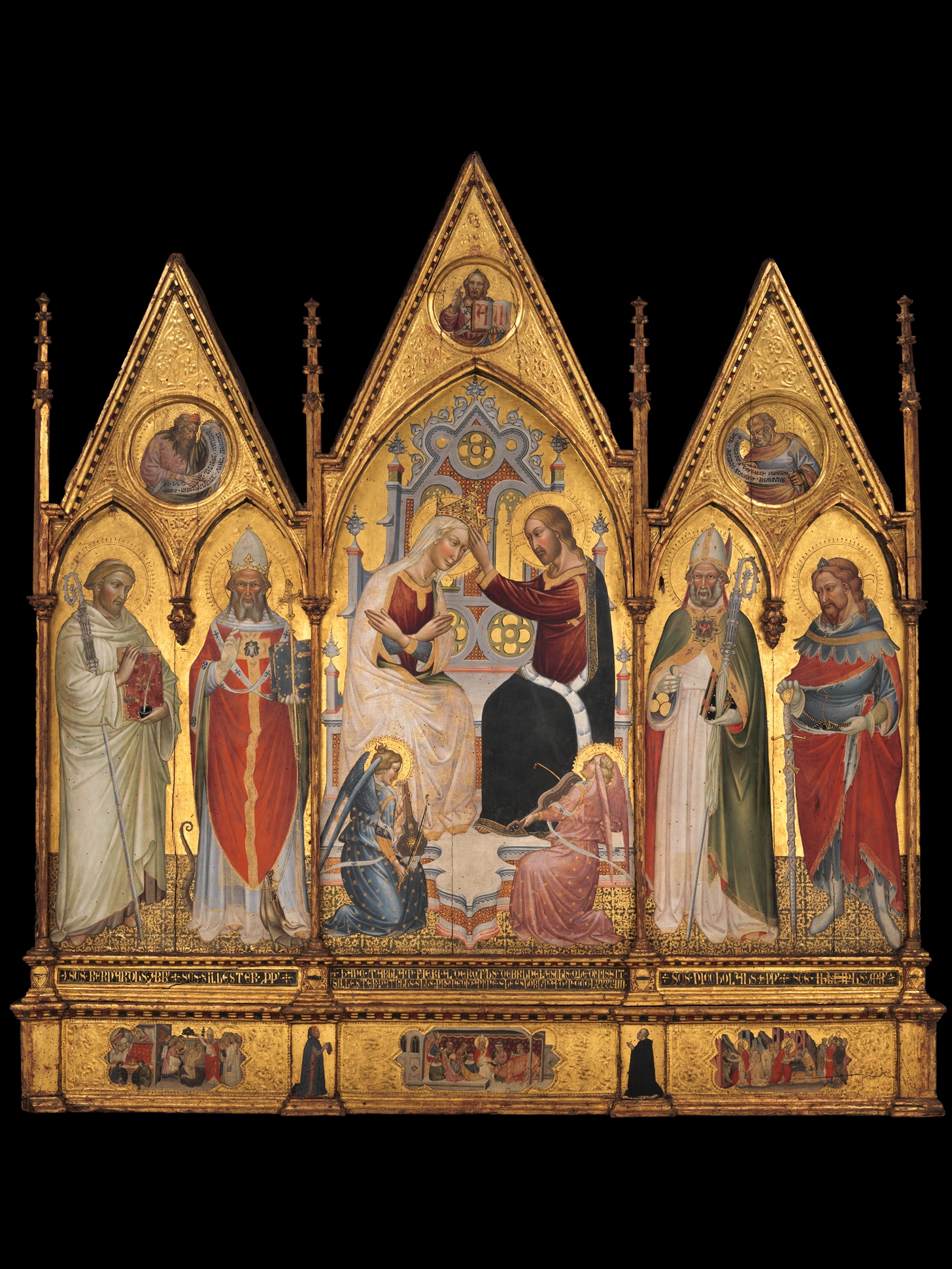
Altarpiece by Giovanni di Tano Fei depicting the Donation of Constantine on the predella. Photo from the website of the Metropolitan Museum of Art, altarpiece not currently on display.
When trying to decide the genre of La Commedia many scholars, including Giuseppe Mazzotta, make an argument that La Commedia is an encyclopedic work since it references many important classical works by authors such as Ovid and Homer as well as important biblical and historical events known to Dante. While reading on my iPad I have to have the footnotes of our copy open on a computer for quick reference and find myself frequently googling to find more information. Reading La Commedia is not just a poetic experience but also an intellectual journey through the classics and history. A short reference in Canto 19 to the Donation of Constantine reminded me of the encyclopedic style of La Commedia that I think is an excellent example of Dante’s style.
Canto 19 takes place in the third pouch of the eight circle of Hell which holds the simonists. Simony is the sin of selling church offices or indulgences placing monetary gain on the earthly realm over spiritual virtue. The contrapasso in this canto places sinners upside down in mock baptismal fonts with fire on their feet. The simonists are inverted in Hell because when they were living these sinners had their priorities inverted, placing monetary and political gain over the salvation of their mortal soul. A note in my copy mentions that the anointing of their feet with oil is a reference both to Jesus being anointed with oil in the gospels as well as to four of the seven sacraments which require being anointed with oils.
While there are many things I could write about this canto, I am going to focus on just one terzina found in Canto 19, lines 115-117 in which Dante writes:
Ah, Constantine, not your conversion, but that
dowry which the first rich father took from you, has
been the mother of so much evil.
This terzina, discussing the Donation of Constantine, was the first example of the encyclopedic nature of Dante’s Commedia I was introduced to and whose layers I find fascinating.
The Donation of Constantine was an event that was thought to have taken place in the 4th Century AD. The story was that the Emperor Constantine the Great had contracted leprosy and was healed by Pope Sylvester after being converted and baptized. Grateful to Pope Sylvester, Constantine gave the Church parts of his empire, including sites important to the Church such as Jerusalem and Rome with an imperial decree documenting this transfer of power.
Canto 19 lines 115-117 is not the only time Dante wrote about the Donation of Constantine. In an earlier uncompleted treatise on the nature of power titled De Monarchia (3.10.1) Dante writes extensively about whether the Catholic Church or the Empire should have supremacy over the other. Many scholars in Dante’s time used the Donation of Constantine as evidence why the Pope should have authority over the Emperor. Dante disagreed, arguing that the land was not Constantine’s to give nor Pope Sylvester’s to accept. The terzina quoted above is Dante holding Constantine responsible for the many evils done by Popes that were justified by the Donation of Constantine. In just these three lines, Dante references not just a historical event but also a current debate in his time. While one does have to know the background about the Donation of Constantine to truly understand the point Dante making, the multiple layers of reference still make La Commedia an encyclopedic work in my eyes.
During Dante’s lifetime, the Donation of Constantine was believed to be a true event that undoubtedly occurred. It was only in the 1400s when two priests, Lorenzo Valla and Nicholas of Cusa, analyzed the Latin used in the document and proved that the Latin was far too modern to have been written in the 300s when the Donation of Constantine was said to have taken place. Although Dante was proved right when he wrote that the Donation of Constantine did not give the Pope power over the Emperor, it was not for the reasons Dante argued but that the event did not actually happen.
Curiously, the placement of a reference to the Donation of Constantine in Canto 19 of Inferno is unintentionally perfect on Dante’s part. Virgil and Dante have just left sinners who commit violence using intellect or fraud in Canto 18 and are about to reach thieves in Canto 24. The forgery of the Donation of Constantine was an act that I would classify as violence using intellect or in a broader term fraud as well as a theft of power from those who held it by dishonest means. Putting a reference to the Donation of Constantine between those two types of sins is unintentionally genius since the forgery is a marriage of those two sins. Of course, Dante did not place this reference here knowingly since he believed that the Donation of Constantine happened. Regardless, I believe it is worth mentioning as an interesting observation even though it is undoubtedly without intent.
The image above is an altarpiece in the Metropolitan Museum of Art’s collection which is not currently on display but has been previously. The bottom of the three panels depict the events leading up to and including the Donation of Constantine. The altarpiece was recently on display and the details were much clearer when I saw it in person last year. Once it is back on display to the general public I would encourage anyone to go see it in person since the altarpiece is much larger than it appears in the photo and exquisitely detailed.


