Tag Archives: simony

The Donation of Constantine and an Unintended Mention of Fraud

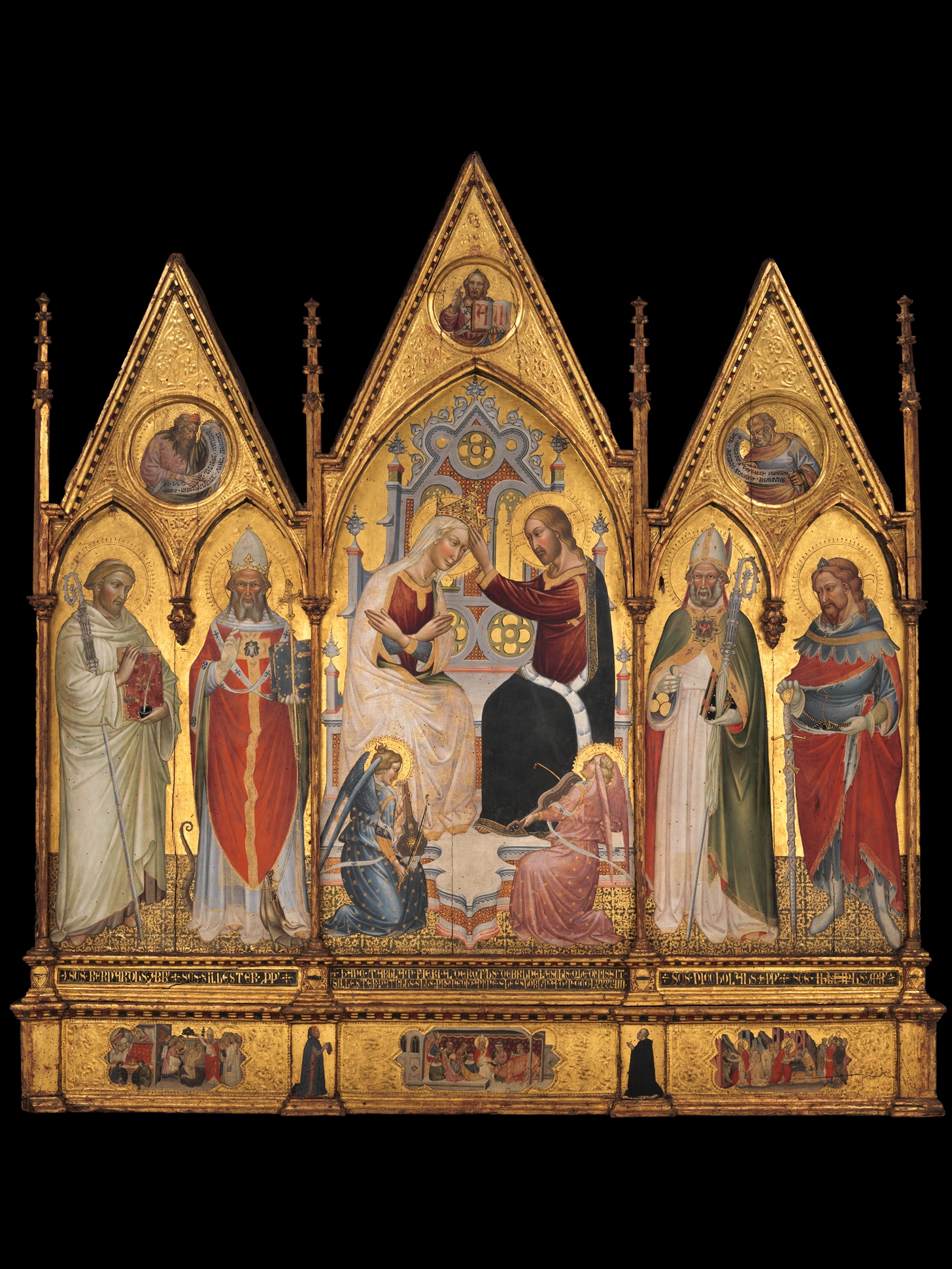
Altarpiece by Giovanni di Tano Fei depicting the Donation of Constantine on the predella. Photo from the website of the Metropolitan Museum of Art, altarpiece not currently on display.


When trying to decide the genre of La Commedia many scholars, including Giuseppe Mazzotta, make an argument that La Commedia is an encyclopedic work since it references many important classical works by authors such as Ovid and Homer as well as important biblical and historical events known to Dante. While reading on my iPad I have to have the footnotes of our copy open on a computer for quick reference and find myself frequently googling to find more information. Reading La Commedia is not just a poetic experience but also an intellectual journey through the classics and history. A short reference in  Canto 19 to the Donation of Constantine reminded me of the encyclopedic style of La Commedia that I think is an excellent example of Dante’s style.

Canto 19 takes place in the third pouch of the eight circle of Hell which holds the simonists. Simony is the sin of selling church offices or indulgences placing monetary gain on the earthly realm over spiritual virtue. The contrapasso in this canto places sinners upside down in mock baptismal fonts with fire on their feet. The simonists are inverted in Hell because when they were living these sinners had their priorities inverted, placing monetary and political gain over the salvation of their mortal soul. A note in my copy mentions that the anointing of their feet with oil is a reference both to Jesus being anointed with oil in the gospels as well as to four of the seven sacraments which require being anointed with oils.

While there are many things I could write about this canto, I am going to focus on just one terzina found in Canto 19, lines 115-117 in which Dante writes:

Ah, Constantine, not your conversion, but that

dowry which the first rich father took from you, has

been the mother of so much evil.

This terzina, discussing the Donation of Constantine, was the first example of the encyclopedic nature of Dante’s Commedia I was introduced to and whose layers I find fascinating.

The Donation of Constantine was an event that was thought to have taken place in the 4th Century AD. The story was that the Emperor Constantine the Great had contracted leprosy and was healed by Pope Sylvester after being converted and baptized. Grateful to Pope Sylvester, Constantine gave the Church parts of his empire, including sites important to the Church such as Jerusalem and Rome with an imperial decree documenting this transfer of power.

Canto 19 lines 115-117 is not the only time Dante wrote about the Donation of Constantine. In an earlier uncompleted treatise on the nature of power titled De Monarchia (3.10.1) Dante writes extensively about whether the Catholic Church or the Empire should have supremacy over the other. Many scholars in Dante’s time used the Donation of Constantine as evidence why the Pope should have authority over the Emperor. Dante disagreed, arguing that the land was not Constantine’s to give nor Pope Sylvester’s to accept. The terzina quoted above is Dante holding Constantine responsible for the many evils done by Popes that were justified by the Donation of Constantine. In just these three lines, Dante references not just a historical event but also a current debate in his time. While one does have to know the background about the Donation of Constantine to truly understand the point Dante making, the multiple layers of reference still make La Commedia an encyclopedic work in my eyes.

During Dante’s lifetime, the Donation of Constantine was believed to be a true event that undoubtedly occurred. It was only in the 1400s when two priests, Lorenzo Valla and Nicholas of Cusa, analyzed the Latin used in the document and proved that the Latin was far too modern to have been written in the 300s when the Donation of Constantine was said to have taken place. Although Dante was proved right when he wrote that the Donation of Constantine did not give the Pope power over the Emperor, it was not for the reasons Dante argued but that the event did not actually happen.

Curiously, the placement of a reference to the Donation of Constantine in Canto 19 of Inferno is unintentionally perfect on Dante’s part. Virgil and Dante have just left sinners who commit violence using intellect or fraud in Canto 18 and are about to reach thieves in Canto 24. The forgery of the Donation of Constantine was an act that I would classify as violence using intellect or in a broader term fraud as well as a theft of power from those who held it by dishonest means. Putting a reference to the Donation of Constantine between those two types of sins is unintentionally genius since the forgery is a marriage of those two sins. Of course, Dante did not place this reference here knowingly since he believed that the Donation of Constantine happened. Regardless, I believe it is worth mentioning as an interesting observation even though it is undoubtedly without intent.

The image above is an altarpiece in the Metropolitan Museum of Art’s collection which is not currently on display but has been previously. The bottom of the three panels depict the events leading up to and including the Donation of Constantine. The altarpiece was recently on display and the details were much clearer when I saw it in person last year. Once it is back on display to the general public I would encourage anyone to go see it in person since the altarpiece is much larger than it appears in the photo and exquisitely detailed.


Dante v.s. Pope Nicholas III

Dante and Virgil speak to a simonist, Title: Simonists, Illustration by Gustave Doré, Source: Danteworlds (UTexas)

The image above refers to canto 19 in which Dante and Virgil encounter the souls who have committed the sin of simony. Simony is defined as someone who uses material wealth to pay for a higher position and more influence in the church. In observing the image, Dante appears to be quite cautious in approaching the simonists while Virgil is smiling with pleasure at Dante’s reaction. There are souls trapped in holes all around Dante and Virgil with their legs being the only visible limbs. They appear to be flailing about because of the fire that burns them.

However, it also seems to illustrate the moment when Dante speaks to Pope Nicholas III. When the latter believes Dante is another pope, known as Boniface, he reacts in a confused manner, unsure of how to answer. After following Virgil’s instructions, Dante inquires about Nicholas’s reason for being in Hell. In a tone, unlike the tones present in previous cantos, Dante bluntly asserts that Pope Nicholas III is rightly punished for the sins he committed. Dante proclaims, “You have made gold and silver your god; and/ what difference is there between you and the idol-/worshipper, except that he prays to one, and you to a/ hundred?” (112-115, 295). Dante wishes to express here that in Nicholas’s living days, he makes wealth and bribery his main priority in order rise to the top of the church. Despite the fact that Nicholas serves a religious institution, similar to other religious members, this does not necessarily stop him from using money to his advantage. Simply because one works in a position of power that teaches people right from wrong does not signify that they are staying true to such prophecies when they are hidden from the public.

Furthermore, according to the catholic tradition, especially during this time, an idol-worshipper is considered as someone who follows an evil custom. It signifies that people devote themselves to a cult image such as a statue. In this quote, in order to emphasize the evil and immoral mindset of Pope Nicholas III, Dante compares him to idol-worshippers claiming that Nicholas is much worse because of his endless selfishness and greedy attraction to materialistic wealth. Dante’s reproach is ultimately harsh, blunt and straightforward. These characteristics are unlike the usual tone of Dante that travels through the ongoing circles of Hell. In past cantos, the majority of his reactions consist of sorrowful pity or fear. It is plausible that since this eighth circle is past the midpoint of inferno where Geryon brings them, Dante’s is experiencing a shift in mindset. He is becoming more aware of his connections to the souls in Hell, especially when they are connected to a political or religious background in which Dante participates. Usually this signifies that they come from the same city as he does, Florence, which immediately attracts Dante’s attention. Furthermore, Dante’s is shifting into a stronger and less distressed character who does not become alarmed as intensely as before at the torment that he witnesses. The reason for this is that since Dante and Virgil are descending further down into inferno, the punishments of the souls are becoming harsher and more terrifying. At this point, Dante is used to and no longer shocked at the extremity of the punishments.

In reference to the image, as mentioned before, Dante appears cautious when he recognizes the voice of Pope Nicholas III. However, this does not distract from the idea that he criticizes Nicholas with a sense of superiority. The cautiousness is present because of the dangerous situation apparent in front of him where there is an abundance of fire. Nevertheless, since this is the first time Dante admits to a soul that they are deserving of the punishment they receive, it is evident that he feels he has the upper-hand. This is not only because he is still alive, in obvious contrast to Pope Nicholas III, but also because he encounters an opportunity to condemn the corruption of the church that bothers him throughout his participation in politics. According to the notes (302) idolatry is a sin that is often criticized by Old Testament prophets whom Dante associates himself with. This gives an insight into Dante’s sense of identity because he feels confident in his opinion regarding Pope Nicholas III without any sense of insecurity about his sense of faith. Therefore, he is able to see what actions he must not commit in the future in order to avoid ending up in a damned position similar to Nicholas.

Lastly, Virgil’s reaction as shown in the artwork is clearly reflected in the text when Dante narrates, “I firmly believe that it pleased my leader, with/ such a contented smile he listened still to the sound/ of the true words I spoke,” (121-123, 295). This quote not only expresses a textual mirror of the image but also confirms Dante’s sense of superiority in two ways. Primarily, It is reassuring that his guide, who also happens to be a poet that Dante admires, approves of his statements towards Pope Nicholas III. When Dante states, “…the true words I spoke,” he is also affirming himself as well as the reader for speaking the truth, which pushes any further questions the reader or Virgil might have out of the way.

Dante Addresses to the Audience About Simonists

I have noticed that on Canto 19 Dante addresses towards the audience about how heinous it is to offer God’s grace for money.  At the start of this Canto Dante states, “O SIMON MAGUS, O forlorn disciples,/ Ye who the things of God, which ought to be/ The brides of holiness, rapaciously(Alighieri 1-3) I believe the author Dante Alighieri is conveying the gravity of lying to those who believe that they can buy God’s grace. The following stanza Dante offers a premonition to the audience about the severity of Simony: “For silver and for gold do prostitute, / Now it behoves for you the trumpet sound, /Because in this third Bolgia ye abide (Alighieri 4-6). Here the reader can anticipate that the sinner’s punishment is approaching “behoves for you the trumpet sound”. It is evident that the author Dante Alighieri has no remorse or pity for these sinners. Dante clearly sees these fools are guilty of fraud, for they are simply taking advantage of people by offering promises of divinity in exchange of money. To Dante, this is a form of fraud, and the way the punishment is painfully depicted: “The feet of a transgressor, and the legs/ Up to the calf, the rest within remained. / In all of them the soles were both on fire;/ Wherefore the joints so violently quivered(Alighieri 22-26); Dante feels that their punishment is justified.