Category Archives: Reflective post 2

Second reflective post (due May 1)

Reflection Post-2

Truthfully, these past few weeks has been informative. With the knowledge that I’ve learned, I feel as though my mind is ready to tackle these texts. There is so much to learn from the Divine Comedy. Sadly, the few weeks of classes were not enough to fully experience the whole journey with Dante. Now my time and energy is on focusing my final paper. I feel confident in translating my ideas and thoughts about the text into paper.

I’ve remembered all those past posts and those nights where I had no idea how to interpret or even understand the reading. Yet somehow, I managed. All these observations and theories from our class discussion has help me better understand Dante’s intention. My most memorable post was when we were assigned to analyze paintings and statues in the MET. What was most striking for me was the statue Ugolino and his sons. I know the symbolic meaning behind his sons grabbing his legs in concern for his well being, but Ugolino’s face is menacing and haunting. It feels like it is looming over you, judging you for actions you aren’t aware of. Anyways, I was spellbound by his enraged face. I look forward to find more art that incorporates fear and rage. Which is great, for this is the kind of theme i’m working on for my final paper.

Second Reflection Post

Since my first reflection post, I have only written two blog posts (along with detailed comments that I wrote instead of blog post 7). Regardless, reading over those two posts and thinking about my personal engagement with the text I have a few observations.

My first observation, which I could have included in the first reflection post, is that  I am very reluctant to write about works of art. I am much more comfortable analyzing literature since I have experience doing so. I struggle to analyze art, even in comparison to literature, since I don’t even know the correct vocabulary to do so. I seem to have made the unconscious decision to focus mostly on what Dante writes and then supplement it with a painting rather than focus on the painting alongside the poetry. While I am always an advocate of pushing oneself to try something more difficult, I also kept finding myself spending too much time trying to discover the meaning of the painting over the meaning of the text.

I did find the guided questions we had to answer about art at the Metropolitan Museum of Art to be very challenging and instructional. Having guided questions to focus on helped me, although I still felt very lost at some points trying to answer them. I ended up writing over a thousand words and still did not feel satisfied I had answered all of the questions in their entirety when I submitted the post. The post actually would have been a lot longer but I edited out any observations I made that did not directly relate to the questions being asked. After reading other peoples posts about their Met visits I am not sure if I made the right choice in doing so but it is the choice I made all the same.

My other major reflection isn’t so much related to the blog posts as it is related to how I am engaging with the text. I personally have been struggling to find the same deep interest I had with Inferno while reading the later two canticles. I am somewhat of a completionist, meaning I have a hard time skipping around and not studying things in their complete original order. My mom loves to poke fun at me for it. I have to read book series in order starting from the beginning even if there is no connecting plot between the books. I mention all of this seemingly unimportant information because I am still trying to discover why I am struggling so much to engage with the text and find ways to do so. In a perfect world, I would just read the parts we aren’t assigned but doing so initially left me with even more confusion. If anyone else has had this problem and has any suggestions I would love to try any ideas out.

Reflective Post 2

As I look back on my blog posts, I learned that I would summarize and analyze too much where I would repeat myself. However, I feel with each post I was able to successfully navigate through the canticles and make connections between various cantos. For example in blog post six I am able to discuss the different emotions between Dante and Virgil and identity the theme of Canto 24.  For my final paper, I hope to use all the skills I learned with blogging, which include being short and to the point, strong analysis, incorporating quotes when needed from The Divine Comedy as well as a thoroughly explained thesis. One blog post I feel proud of is the most recent: blog post 8 when I talked about the Garden of Eden, rather than spending hours on details I wrote the most important facts from that canto and a short analysis. I was also able to relate blog post 8 to the MET museum and a work of art which I feel is an important skill to have as a writer; being able to connect ideas even though they are different which is also part of the final paper.  Although it still has been difficult for me, I’ve been trying to stick to one topic rather than several because condensing my writing to one single idea is much better than several scattered ones. I’ve noticed that I write too many ideas not only for this class but for other writing intensive classes as well. I feel my strong point is that I am able to explain ideas thoroughly so someone else reading my work isn’t confused but I overelaborate to a certain point. My favorite blog post was the blog post from the MET, it was interesting to see different types of works of art face-to-face rather than on the computer and being able to relate them to Dante and the text was a fun interactive way of combining various works to get one main idea.


reflective post 2

In my first reflective post I set a goal for myself to try using more outside sources.  Before that post, I had only used an outside source once.  In my last three posts since then I have used at least one outside source.  I am happy with the quality of these posts over my previous posts and I am glad I chose this goal.

My first post after I set this goal was comparing the Inferno and the movie As Above So Below, which I knew had made various references to the Inferno, but I did not fully understand some of them until after we had finished reading it.  For this post, I first looked for images and other resources through our class site but nothing seemed to strike me as something I could write a lot about.  I had never written about artwork and literature before, but I had written about film and literature which is where I got the idea to connect these two works.  I really enjoyed writing about the movie and its connections to Dante’s poetry.  There were so many references to the Inferno that I only touched on a few in my post, which is why I am excited to write my final paper on the same topic so that I can include more of these connections and adaptations.

I had to write about artwork in connection to Dante’s poetry for the Met post.  I enjoyed going to the Met and seeing these pieces in relation to Dante.  My problem with writing on artwork in previous posts was that art based on the Inferno seemed to be so extensive and it was somewhat overwhelming while at the same time I was unsure of where to begin writing about it.  The questions we were given for this post and the fact that we had specific works of art to see and write about made it easier for me to understand how to write about art and its connection to literature.  Because I enjoyed this post and finally understood writing about art, I chose to write my last post on a piece of art.

Reflective Post 2

As I look back on my posts since my previous reflection, I have becomes more comfortable with fully analyzing images related to our readings. Prior to this, I would give a brief summary of our readings for the week. As I look at every element of the images, rather than just the obvious action, I was able to find small details I have not noticed before. In my 7th post, I chose to use two images, one for Dante and Virgil’s encounter with Satan, and another when they finally reach purgatory. I was still focusing on the narrative rather than truly analyzing the details of the images, which tells us a story of its own. After the met visit and answering the questions given, I learned to view art in a different perspective rather than seeing what’s on the surface. In post 8, I chose an image related to Dante finally meeting Beatrice again in Purgatory. In that post I briefly mentioned the fated meeting, and paid close attention to how the artist, John Flaxman, chose to depict the moving scene. Rather than just mentioning what was stated in the canto about Dante crying over the disappearance of Virgil, I also acknowledged Beatrice’s stance, and the figures in the background. I was able to understand that every aspect of the image contributes to how to artist chose to portray the scene. Although I have become more comfortable with analyzing, I still have difficulties grasping Dante’s symbolism for what he is telling us in his poetry.

The Woman and The Giant

Makeup for Blogpost 4

Giant and whore atop the transformed cart, John Flaxman, engraving.

Giant and whore atop the transformed cart, Gustave Doré, woodcut

John Flaxman and Gustave Doré both depict the same scene from canto 32 of Paradiso. At the end of the canto 32, the chariot which Beatrice had arrive on is transformed into a group of beasts. Dante sees “ungirt whore” sitting upon them (line 149).

Doré’s rendition, the giant has his hands placed on the woman, as if he is forcing her down. In Flaxman’s, she appears more of a willing participant, with the giant’s arm loosely around her waist, but without the forcefulness of Doré’s. In Flaxman’s, the giant wears a crown, carries a sword behind him. The woman wears a feathered hat on her head. This lends to a more regal look to the pair, than in Doré’s, where the giant is barely dressed, giving him the look of a savage and unkempt, more animal than man. The back of the chariot can still be seen in Flaxman’s depiction, and presumedly the transformation into the beasts has not fully taken place yet. However, for Doré’s work, the chariot has already completely disappeared from view.

Doré displays the beasts that the chariot has transformed in as looking straight forth, towards the audience of the artwork, whereas Flaxman’s beasts are looking to the side of the frame. The beasts looking forward appear more fearsome, because they can be seen as targeting the viewer.

Dante writes that the woman “turned her greedy, wandering eye towards” him, and the giant reacted in anger to this (line 154-159). Flaxman shows the giant and the woman looking at each other, albeit from the corner of their eyes. However, with Dante’s account in mind, she is most likely looking towards the poet, and the giant is looking at the woman in annoyance. In Doré’s depiction, the woman and the giant are both looking in the same general direction. The giant’s head is tilted downwards and to his right, away from the woman. Since Dante tells us the woman is looking at him, the giant’s gaze must also be on Dante.


Ferrying the Damned

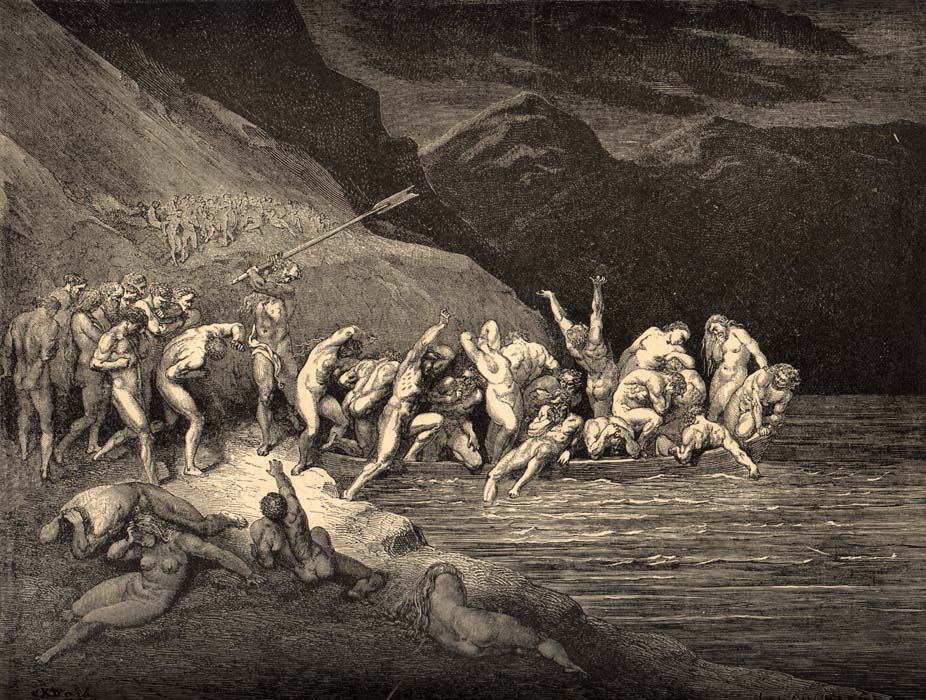
Illustration of “Charon Ferrying the Damned” by Gustave Dore

(Blog Post 1 make-up)

This work created by Gustave Dore which depicts Charon Ferrying the Damned has elements very similar to how Dante describes the scene in canto 3 of Inferno. In the work, we can easily see Charon as the figure with the oar which is how Dante has described him. Dante introduces this figure in Inferno as, “Charon the demon, with eyes like glowing coals, making signs to them, gathers them all in; he beats with his oar whoever lingers” (Inferno, 109-111). The work also shows Charon swinging back the oar as if he is about to whack the damned who are trying to squeeze themselves onto the boat. We can also tell that he might be close to striking the souls by the way the figure just behind Charon cowers and shrinks back in fear.

Another element of this work that is depicted similarly to how Dante describes it is the congregation of the damned souls. Dante describes the souls as, “… all of them together, weeping loudly, drew near the evil shore that awaits each one who does not fear God” (Inferno 3, 106-108). The pain and distress is depicted in work through the positioning of the bodies. Some reach up and out while other are stretched out in a helpless manner and other have their heads in their hands. When describing this scene Dante also mentions, “… over here again a new flock gathers” (Inferno 3, 119-120). This also depicted in the work with the group of souls just behind Charon and the congregation of souls we can faintly see in the background on the mountain side who will journey to the same fate. Through these elements it can be determined that Gustave Dore accurately depicted what Dante describes upon reaching the Acheron.


Next post (due April 29)

This is just a reminder that in this post you are free to analyze your own post, comment on the reading for this week (Purgatorio 32-33, Paradiso 1-2), analyze a picture.

In class you will present the topic of your paper very briefly to the class and in groups we will discuss the 4 cantos (be ready to select meaningful passages).

Enjoy the rest of the break!

Canto 6: Gluttony

Overview of Gluttons (3rd Circle of Hell)

Vellutello, Alessandro

Dante bases his definition of gluttony on his own experiences in Florence. While gluttony’s literal meaning is an excessive consumption of food and drinks, Dante broadens the definition to include an excessive acquirement of wealth and power that is obtained at the expense of the city’s civilians. Dante perceives wealthy politicians that exercise more power than what it rightfully allocated to them as guilty of neglecting their civic duties. Dante’s understanding of corruption pertains to his own experiences as political figure in Florence. He introduces his city’s political dynamics through Ciacco. The condemned soul claims that “your city is so full of envy that the sack already overflows” (lines 49-50). The soul is referencing his own experiences in Florence before Dante was born; they most likely refer to the class conflicts between the magnate and the plebeians. The magnate were the wealthy Italian merchants whereas, the plebeians were the commoners. During this time, the plebeians banned the magnate from holding a political position in society. The constant desire for each class to exert their dominance over the other in terms of wealth, prestige, and power frequently plagued Florence’s society, hence the city was already displaying symptoms of gluttony. Ciacco foreshadows the city’s absolute fall to gluttony and Dante’s own exile from Florence. He claims that “the citizens of the divided city” (line 61) will “come to blood, and they party from the woods will drive out the other with much harm” (lines 64-65). The “divided city” refers to the Black and White Guelphs fractions that formed after the Guelphs took control of Florence after defeating the Ghibellines. The Black guelphs approved of the Pope whereas, the White Guelphs including Dante, wanted more independence from the Pope ; hence they were categorized as “the heirs of the Ghibellines” (Museo Casa de Dante). The White Guelphs are “the party from the woods” that drive the Black Guelphs out of Florence after a blood batter which Dante also participates in. However, Ciacco claims that “Then later this party must fall within three suns and the other rise, with the power of one who now hugs the shore” (line 67). Ciacco foreshadows that after 3 years or “three suns,” the Black Guelphs will regain control of Florence while the White Guelphs, including Dante who was an active prior (White Guelph leader) will fall. Ciacco implies that Florence’s internal political turmoil is a manifestation of gluttony itself that will only be intensified when the Black Guelphs will conquer Florence. Ciacco even specifies that “Two are just” (line 73) in the war, which most likely refers to Dante himself and maybe one of his acquaintances. This further reiterates how Dante perceives himself as an anti-corrupt political figure whereas, anyone else who doesn’t govern in the same manner as him is immediately guilty of corruption and in broader terms- gluttony.

Dante uses food imagery as a metaphor for the political corruption that characterizes Florence. In Canto 6, there is a repetition of “heavy rain” (line 7, 32). The heavy rain is actually the physical food and drinks the souls consumed during their lifetime. These souls are most likely political figures who obtained these luxuries at the expense of their subjects. Since they were so greedy for these possessions, they’re raining down on them now. Ironically, the rain fulfills their human desire for materialistic possessions while simultaneously keeping their souls in hell under the heavy weight of their own desires. Ciacco’s status as a corrupt political figure is further reiterated when the word “heavy” is used again to describe an oppressive force. The Ghibellines were described as “Long will they hold their brows, keeping the others down under heavy weights, no matter how they weep or are shamed.” lines 70-71). While there is no implication that Ciacco was a Ghibelline, the word “heavy” is used twice in Canto 6, once to describe the corrupt behavior of politicians and the other to describe the rain, both are oppressive forces. The author is equating the heavy oppression and political injustice with heavy rain which serves as their punishment. This implies that Ciacco himself must’ve been a “heavy” oppressive force in Florence in order to be punished by the “heavy” rain. The rain parallels the nature of the oppressors. The oppressors didn’t care if the subjects “weep or are ashamed”, likewise, the rain doesn’t care if the souls weep or display shame with their “bent heads” (line 92). Moreover, the rain’s “rule and quality never change” (line 9) just like the politicians never changed the unjust way they governed society. Ciacco represents how corrupt political figures are punished on a microscopic scale. He asks Dante about Florence’s corrupt political figures such as Farinata, Tegghiaio, Iacopo Rusticucci, Arrigo, and Mosca. He uses food imagery to ask if “Heaven sweetens them or hell poisons them” (line 84). The sweetened food represents what the politicians earned while the poisoned food represents what they wrongfully consumed. This alludes to the Adam and Eve’s unlawful consumption of the apple in paradise which ultimately poisoned them and they fell through the ranks. Similarly, these political figures consumed what they weren’t supposed to and fell through the virtuous ranks into hell. Hence, Dante observes that all these souls have “the emptiness that seems a human body” (line 36) which means that their soul is empty because they always fed their body instead of their soul. Their empty human body is actually their empty stomach, it doesn’t have any food because they fed materialistic content to their body instead of substantial virtues and deeds to their soul. Thus, it becomes apparent that their gluttony left their souls hungry and their bodies eternally empty.

Citations:

“Florence at the Time of Dante Alighieri.” Museo Casa Di Dante, Firenze, www.museocasadidante.it/en/dante-alighieri/in-florence/.

Additional Information:  The image is from the University of Texas at Austin. The image depicts the 3rd circle of Hell where the “food” is raining down on the gluttons.