Author Archives: Salvatore DiBono

Refective Post 1

I noticed, upon rereading my older blog posts, that I am transfixed on the medieval context the text is set in. From notions of medieval dream sequences to the medieval notion of illness transmitting via smell and notions of queerness in the Middle Ages and how these themes play out in The Divine Comedy. I wanted to, and to some extent still do, center my understanding of the text as a porduct of the Middle Ages and apply literary theory to enhance my understanding of the text.


I noticed that my ideas after my first blog, especially my most recent, deploy some use of the theory in my background along side analysis of the sections of the text in question. This is because my topics have become more specialized to accomidate the use of theory and history from my training that is outside of the text. I am doing this inorder to find a topic or a range of subtopics within one topic to write my final paper on. I am considering developing my ideas on queerness and seeing sodomy in Dante’s visions of hell.


From reading, I also noticed how I can imporve in fleshing out my ideas more and expanding beyond a paragraph and possibly using some more in text evidence to allow for a lenghtier and indepth discussion of the text. This is something I will be working more towards in the future, espeically having a system of how to tackle my thought proccess in these blog posts. I could also imporve by using an image once in a while to imporve my arguement aswell as enrich it by using a more multi-media approach.

The Coding of “Violence Against Nature”

In Canto XV, Dante traverses the lowest part of the seventh circle of the Inferno, the subcircle of violence against nature. The term  of ‘voilence against nature’ is for the sin of sodomy, which is known as the, “unspeakable sin” by Carolyn Dinshaw throughout her book, Getting Medieval. This sin is coded as ‘unmentionable’ or the sin ‘against nature,’ as Dinshaw explains, is because agents of the church did not want to give people ideas as to what the sin is, but rather that any sin of the sexual nature falls under it (3-12). This codification of sodomy groups same sex interactions with those of premartial sex, beastiality, and any other form of sex without the intent of procreation. This grouping decenters the common notion of queer sex as being exclusively same sex in the Middle Ages, but also queers any form of sex outside of the sanctity of marriage, but even within this unoffical codification of sodomy there seems to be a heirarchy of sevarity, which is why same sex lovers are found in violence against nature rather than lust where adulterers can be found. Also note that men are the main inhabitants if not the only inhabtants of this subcircle. The reasoning for this is because it is an attack on God’s perfect image of what is ‘natural.’ For a man to give up his masculinity in the act of same sex interactions and is seen as a threat on the structures of the patriarchial societial structures sanctioned by those in power, may they be secular or clergy, who are given their authority by  God.


Works Cited:

Dinshaw, Carolyn. Getting Medieval: Sexualities and Communites, Pre- and Postmodern. Duke University Press (1999). Print.

Evil as Contagion in Canto XI

Before decending into the lower divisions of the Inferno, Dante and Virgil’s “descent will have to be delayed, so that [their] sense can become a little accustomed to the evil smell; and then [they] can disregard it” (Inferno XI: x-xii). This passage indicates two medieval concepts, the concept of Hell as an assult of the human senses and the concept of smell idiosyncratic  of contagion. The imagery through out Inferno up until this point has emphasized the exess of the senses being overstymulated by foulness, from deafening noise, hidious oders, to scenes of unspeakable violence to the human physicality. This is the notion that Hell is a display of corporial punishment on the soul for its sins when it once had a true physical form in life. The sense of smell in particular in Hell takes on a whole new layer beyond the notion of over stymulation. Smell in the Middle Ages was considered one of the main ways in which contagion is spread, which is why in the years of the plague the infamous image of plague doctor mask was prominant, because it was believed that smells took longer to travel in these masks and in the beak of the mask there would be sweet smelling herbs to block the foul smell of contagion. When looking at this opening passage in the Inferno (ad just Inferno as a whole) the sense of smell is brought to the center of the delay that Dante and Virgil must edure before their decent. This is because they do not want to be assulted and consequently corrupted by the contagion of evil. Evil, in the Middle Ages, was treated like a disease, which is why evil or unsavory people are usually portrayed as having a form of contagious  illness like leprasy or pox and in Dante’s Comedy this notion of evil as contagion, as displayed in this passage in Canto XI, is salient.

Post 1: Canto 1

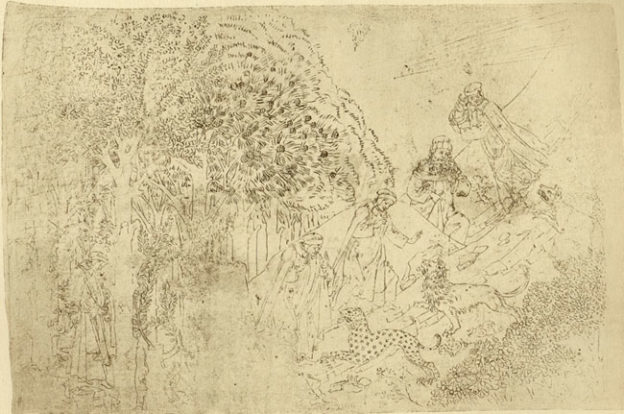
Image Creator: Botticelli, Sandro (c.1480-c.1495)

Source: The World Of Dante [ http://www.worldofdante.org/pop_up_query.php?dbid=I002&show=more ]

I came across this image in the Wrold of Dante link provided in the resoruces section of this site. The image portrays Dante and Virgil in the dark wood amongst the three beasts.  This section of the text along side this image spoke to me because they portray the medieval dream sequence trope so powerfully. The text stating, “I came to myself in a dark wood, for the straight way was lost” (1-2), introduces the reader to the medieval physicality of dreams/visions, which are also represented in texts such as the vita of Christina the astonishing and the vision of the monk of Eynsham. Another aspect besides the physicality of medieval dream/vision iterature is the notion of the dream guide. Lines 112 to 114 of Canto 1 depict Virgil offering his servaces as Dante’s guide through “an eternal place” (114), which is also depicted in the texts listed above of a guide taking the dreamer through the etherial landscape of their visions, which is typically hell and/or purgatory.

Also these lines introduces the reader to the medieval tropic imagery of the wood, which serves as a signifier of a mystical and allegorical venture in the wake of the characters. Examples of this trope can be found in Aurthruian romances and other courtly romances such as Eric and Enide. The image by Sandro Botticelli (c.1445-1510) represents the mystical and the allegorical dispositon of this text. The wood being the place where Dante encountered the three beasts who are allegroies of the three separations of hell appitite, violence and fraud; this is also where he encounters the dead Roman poet Virgil who will guide him, thus the mystical and allegorcal nature of the wood. Botticelli depicts the encounters sequentially and the wood surrounding the encounters, this is typical of late medieval/rennaisance art where all the events of a particular scene are represented in one image and , like in the literature the image reprsents, the wood serves as the signifier of the surreal in the image. The wood indicates that the image being represnted is a dreamscape.