Author Archives: Jacqueline Vargas

Ferrying the Damned

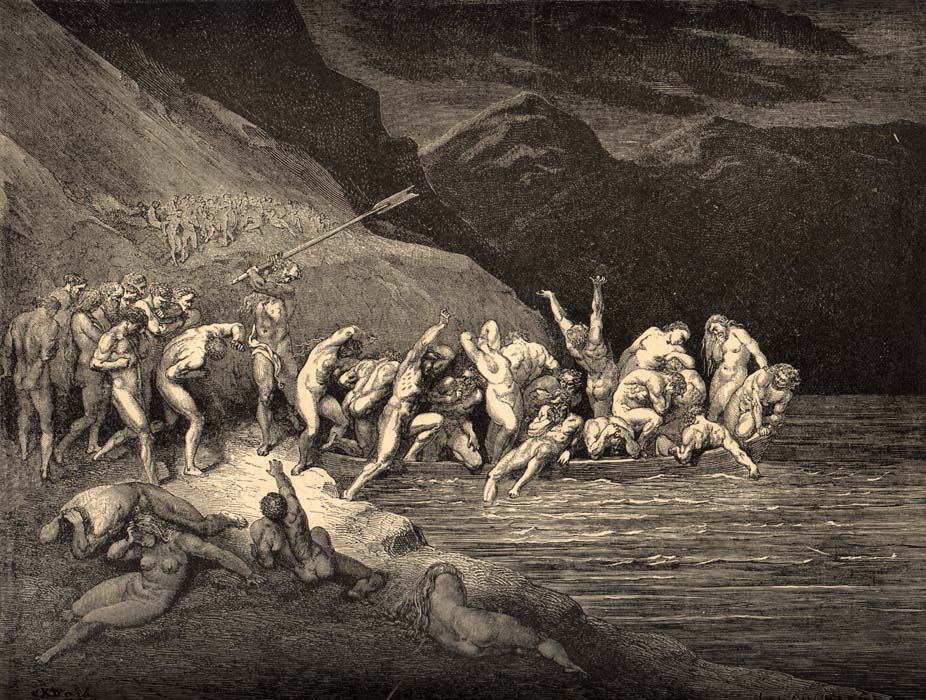
Illustration of “Charon Ferrying the Damned” by Gustave Dore

(Blog Post 1 make-up)

This work created by Gustave Dore which depicts Charon Ferrying the Damned has elements very similar to how Dante describes the scene in canto 3 of Inferno. In the work, we can easily see Charon as the figure with the oar which is how Dante has described him. Dante introduces this figure in Inferno as, “Charon the demon, with eyes like glowing coals, making signs to them, gathers them all in; he beats with his oar whoever lingers” (Inferno, 109-111). The work also shows Charon swinging back the oar as if he is about to whack the damned who are trying to squeeze themselves onto the boat. We can also tell that he might be close to striking the souls by the way the figure just behind Charon cowers and shrinks back in fear.

Another element of this work that is depicted similarly to how Dante describes it is the congregation of the damned souls. Dante describes the souls as, “… all of them together, weeping loudly, drew near the evil shore that awaits each one who does not fear God” (Inferno 3, 106-108). The pain and distress is depicted in work through the positioning of the bodies. Some reach up and out while other are stretched out in a helpless manner and other have their heads in their hands. When describing this scene Dante also mentions, “… over here again a new flock gathers” (Inferno 3, 119-120). This also depicted in the work with the group of souls just behind Charon and the congregation of souls we can faintly see in the background on the mountain side who will journey to the same fate. Through these elements it can be determined that Gustave Dore accurately depicted what Dante describes upon reaching the Acheron.


Biblical Meets Classical

In canto 28 Dante integrates the biblical world and the mythological world as he has done previously in Inferno. Dante enters earthly paradise in this canto and is astounded by the glorious things he sees such as the, “… divine forest, thick and alive” (Purgatorio 28, 2-3). He is met by a beautiful woman who goes by the name Matelda. Matelda explains to Dante that where they are is the Garden of Eden where humanity would have lived in eternal peace till the end of time had Eve not succumbed to sin. Matelda explains this by saying, “The highest Good, who alone pleases himself, made man good and for the good, and this place he gave as a token to him of eternal peace” (Inferno 28, 91-93). The Garden of Eden is no doubt one of the most famous biblical references. Without the creation of original sin by Eve, there would have been no journey for Dante the pilgrim. There are also two important streams mentioned in this canto and that is the Lethe and the Eunoe. Matelda explains the purpose of these streams by saying, “On this side it descends with the power to take away all memory of sin; on the other it gives back the memory of every good deed” (Purgatorio 28, 127-129). Lethe appears in Greek and roman mythology and is known as the “river of oblivion.” Dante takes the classical meaning of Lethe and molds it to fit the earthly paradise he seeks to recount. Along with the biblical and classical imagery used by Dante, he also adds his own contribution by the creation of Eunoe. The notes of Purgatorio state, “The name is a coinage of Dante’s, from Greek eu [well] and noesis [knowledge], meaning “knowledge of good”(Durling).

From Pitiful to Reverent

Dante the pilgrim continued to change throughout his journey through hell. Dante learns a little more about hell’s design and God’s intended justice with each encounter of different sinners. Dante’s journey through hell is successful because his response to the sinners throughout hell matures from pitiful to reverent.

To be able to recognize the change in attitude Dante has towards the sinners of Inferno one must analyze Dante’s initial attitudes at the very beginning of his journey with Virgil. In canto 5, Dante encounters the lustful sinners, Francesca and Paolo. Francesca and Paolo are adulterers who are now condemned to the circle of lust where they remain restless and stuck in the moment of their sin. Upon hearing Francesca’s story Dante is overcome with pity and grief. Dante genuinely feels sorry for the pair and this can be seen through the line, “While one spirit said this , the other was weeping so that for pity I fainted as if I were dying and I fell as a dead body falls” (Inferno 5, 139). This shows how faint-hearted Dante is at the beginning of his journey in response to the sinners. Dante is vulnerable to the emotion of pity and grief that it is too much to handle and he faints. Similarly, when Dante encounters Ciacco in the third circle of gluttony, Dante is also overcome by the emotions of pity and grief. Dante the pilgrim says, “Ciacco, your trouble weighs on me so that it calls me to weep…” (Inferno 6, 58). Dante’s reaction to Ciacco’s suffering is very similar to that of Francesca and Paolo. In these two encounters with sinners, Dante allows his emotions to dictate his judgement and attitude toward the sinners.

The initial change in Dante’s attitude towards sinners in hell can be found in canto 19. In the third bolgia of the eighth circle where simony is punished, Dante encounters Pope Nicholas III. Pope Nicholas III was guilty of selling indulgences and exercising overall corruption within the church. In this bolgia the former pope is face down in a hole, feet up and exposed to be burnt by flames that rain down like snow. In response to Pope Nicholas III’s story of how he ended up in hell, Dante the pilgrim says, “Therefore stay here, for you deserve your punishment; and be sure to keep your ill-gotten coin, which made you bold against Charles” (Inferno 19, 97). This line shows that Dante agrees with the punishment bestowed upon the pope and he comes to realize God’s intended justice for sinners such as Pope Nicholas III. Th reverence in Dante’s attitude toward sinners solidifies in canto 33 with the encounter of Ugolino in the ninth circle of hell. Ugolino betrayed the city of Pisa and in return he was locked in a tower with his two sons to starve. Ugolino watched his sons die of starvation and it is rumored that he also ate his sons but that part of the story is made unclear. Ugolino hopes to evoke pity from Dante when Ugolino says, “You are surely cruel if you do not already grieve… and if you are not weeping, about what do you usually weep?” (Inferno 33, 40). Dante the pilgrim does not weep for Ugolino and instead uses his tragic story to criticize the city of Pisa. In regard to the city of Pisa, Dante states, “… let Capraia and Gorgona move and make a barrier at the mouth of Arno, so that it may drown every person in you!” (Inferno 33, 82). Here we see that Dante the pilgrim has completely transformed his attitude toward sinners to be more reverent rather than pitiful. He does not weep nor pity Ugolino because he has come to realize that his punishment is just as meant by God.

Reflective Post 1

After reading all my posts I noticed that a common thread among my posts is the discussion of the sinners and how their sins are related to their punishment in hell. I focus on how their punishments reflect their sins and vice versa. I think I’m so fixated on this topic because understanding the different sins and their equal punishments throughout hell, for Dante, is part of his journey and necessary in understanding Hell’s design and Hell’s intended purpose by God. This understanding is a very crucial take away from Dante’s journey and I like to talk myself through it by analyzing how Dante reacts to the sinners he encounters along the way. In blog post 2 I mention Dante’s encounter with Ciacco and say, “The reality for those not in heaven weighs heavier on Dante’s conscience because he has witnessed Ciacco’s pain.” Dante’s exposure to Ciacco’s suffering allows him to formulate his own opinion about Ciacco’s situation and in response Dante feels bad for him although Ciacco is a sinner and is receiving his just punishment. In my fifth blog post I explain a change in Dante’s view on sinners and their equal punishments when Dante encounters Pope Nicholas III. Dante does not pity Pope Nicholas III and completely agrees with his designated punishment that carries out God’s justice. This change shows growth in Dante the pilgrim as he comes to better understand God’s design and purpose for Hell.
Some things I would like to better in my future posts would be to over all dive a little deeper into the topics I wish to discuss and use more support from notes both in the book and outside sources such as Barolini’s commentary. I think that sometimes I take the very surface meaning of events that occur in Inferno and miss key ideas that I would have noticed had I read a little more carefully and intuitively. Sometimes I find myself formulating my own ideas of what events mean and get so excited that I write my posts on my ideas alone without searching outside commentaries that could take my idea a little bit further as well as support my ideas. Finding solid support would not only validate and explain my ideas but would also help other students reading my posts better understand the ideas I’m trying to express if maybe the way I have worded something isn’t as clear as it could be. In that case they will have something to refer to, worded in a different way they may grasp better. I think I try to keep my posts simple but in doing so I leave things out and dig deeper in my explanations. I would also like to use images to guide my way through the upcoming cantos because when I read other students posts using images that represent each canto, it helps me pick up on ideas I had missed and over all gives me a better understand of what is going on. I think it would be an effective way for me to make sense of the text when I get lost. I would also like to respond to other posts in the future like I did for my second blog post. In my opinion, it is a great way to give one’s post a set idea and keep the post focused while building off the original post and dissecting it altogether. Lastly, I would like to organize my posts a little better by giving them more of structured feel. I want to focus on one idea and formulate a hypothesis that can be supported by outside commentary and images instead of just rambling on about an idea I came up with on my own aimlessly because I don’t think that’s very effective. I am definitely guilty of doing this, but I would like to change this in my future posts.

Demons Inevitable Betrayal, Aesop’s prediction

In Canto 23, Virgil and Dante the pilgrim are traveling alongside 10 demons instructed by Malacoda to safely take Virgil and the pilgrim to an unbroken bridge spanning the sixth bolgia. Virgil and Dante did not know in Canto 21 that there wasn’t an unbroken bridge when Malacoda said, “… let these be safe until the next ridge that goes undamaged over the pits” (Inf.21 , 125-26). As stated in Barolini’s commentary, “Malacoda was effectively telling his devils that they will soon be authorized to attack the travelers.”
Dante then relates his and Virgil’s situation with the devils to a fable by Aesop about a frog and a mouse. The fable states that, “… a frog offers to swim a mouse across a body of water, intending to drown him; the frog ties his leg to the mouse’s; when the frog tries to drown the mouse their struggles attract a hawk, who seizes them; the frog’s leg being tied to the mouse makes escape impossible for both of them”(Durling, Martinez). Barolini proposes that one of the possible scenarios is, “Dante and Virgil as mouse, devils as frog, with the sometime addition of Ciampolo as kite.” Kite in this case is interchangeable with hawk. Ciampolo was one of three souls Dante, Virgil and the devils crossed paths with in Canto 22. The allusion to Aesop’s fable is effective because Virgil and Dante blindly trusted the demons to guide them when in reality their intentions were evil just as the frog in the fable. Ciampolo as the kite, benefited by both Virgil, Dante and the devils because he was able to trick the devils into letting him escape their additional torture. In other words, Ciampolo was bale to manipulate the situation that brought Dante, Vigil, and devils together to his advantage. Dante’s use of Aesop’s fable enforces the fraudulent and deceptive behavior punished in the fifth bolgia.

A Change in Dante

In canto 19 Dante the pilgrim makes a switch from pitying the damned souls he comes across to accepting and agreeing with God’s punishment for them. Now in the eighth circle of Hell Dante and Virgil travel to the third “trench” within this circle to see those who chose in life to make wealth and power their God. Their heads and torsos are in these holes in the trench while their legs and feet are exposed to be burned by fire. One soul Dante the pilgrim notices is burned more than the others is Pope Nicholas III. He was the Pope when Dante was a young boy. Dante for once agrees with God’s punishment for souls like Pope Nicholas III and feels entirely sure with Gods justice. This is a very different change from previous cantos where Dante would pity over souls in other parts of hell. In Canto 5, where Dante is met with Francesca and Paolo, he pities their current state and almost feels to blame because their adulterous act occurred after they had read romantic poetry together. Virgil notices this change in Dante and is pleased with Dante’s progress in understanding Gods justice and plan in Hell. After all, Dante’s understanding of Hell is necessary for his journey onto the right path that eventually will lead him back to heaven.

Capaneous and Hells Design

As Virgil and Dante the pilgrim lower into the third ring of the seventh circle they are met with the damned souls who committed violence directly against God. It is a sandy terrain with no vegetation in which flames fall like snow from the sky (Inferno 14, 28). The souls are scattered about some moving around constantly, some crouched down, and some lying flat on their backs. The soul who sticks out to Dante the pilgrim is Capaneous who does not seem bothered by the flames like the rest. In response to Capaneus’ loud rambling, Virgil replies, “O Capaneus, since your pride is not extinguished, you are punished more; no punishment, other than your rage, would be suffering of a measure with your fury” (Inferno 14, 63). In other words, Capaneus’ rightful torment is that of his own creation because only he can create a hell that matches his own sins as a blasphemer. This idea is also supported in Barolini’s commentary with the quote by Capaneus stating, “As I was alive, so am I dead” (Inferno 14, 51). This line by Capaneus supports the notion that, “…we are our own hell” (Barolini). Capaneus’ special damnation supports this notion and helps Dante the pilgrim realize even more about the design of hell that God intended as he goes about his journey onto the right path.

Fraud and the Nature of Love

I was struck by the the focus of the distinction between malice that is intentional and incontinence. To be honest I didn’t know what incontinence meant but the Merriam-Webster definition states it as the, “inability of the body to control the functions of urination or defecation.” This definition very well explains the, “horrible excess of stench” explained at the very beginning of the canto (Inferno 11, 3). It seems a little odd that this punishment of essentially being immersed in ones own waste because of the lack of control would be given to those who have committed fraud, which to my understanding is a choice. I believe Dante did this on purpose. By doing this he created an ironic parallel between the sin and the punishment of these damned souls. This ties in with the fact that fraud is an even greater sin than violence in God’s eyes (Inferno 11, 25). Committing fraud means the manipulation of another’s blind trust that stems from love which, “…seems to cut solely into the bond of love that Nature makes”( Inferno 11, 55). Nature in this case signifies God and we can notice this in the intentional capitalization of “N”. And this all comes full circle to validate why Dante is worthy of going on this journey in the first place by the line, “…your art follows Nature as much as it can, as a disciple follows the master; so that your art is almost God’s grandchild”(Inferno 11, 103). Dante’s romantic poetry is almost like a sign of devotion to God in its own right.
