Author Archives: Irini Belitsis

The Ascension of Dante and Beatrice

“Dante and Beatrice Ascending”, Giovanni di Paolo, 1444-50, Parchment/Body Color  


In this illustration, depicting Paradiso, Dante and Beatrice have just left Earth from the top of the mountain of Purgatory. They and are flying towards heaven together. While they ascend, Beatrice’s eyes are “fixed on the eternal wheels” (1.64). Through bright and serene colors Giovanni di Paolo illuminates the ascension into the fiery light described in Canto 1 of Paradiso.

Beatrice, Dante’s spiritual guide, must explain the situation to an awestruck and perplexed Dante. She tells the pilgrim that the universe is a hierarchy of being and Heaven awaits them. This portrayal of the physical structure of the universe expresses the balance of theology and science during the Middle Ages. Beatrice describes to Dante his departure from Earth saying, “It would be a marvel in you if, free from impediment, you had remained below” (1.139-140). In other words, Beatrice tells Dante that because he has fully completed his purification process in Purgatory the only natural next step is the ascent to God.

Canto 1 sets the tone for the themes Dante the poet will convey throughout Paradiso. The Canto begins with “The glory of Him who moves all things penetrates through the universe and shines forth”, meaning God’s light is everywhere in his universe. The entire focus of Paradiso concentrates on God. God is the main subject from the start of the Canto, not Dante the pilgrim. Continuing, Dante describes the difficulty of conveying all that he sees on his way to Paradise. Dante states, “I have seen things that one who comes down from there cannot remember and cannot utter” (1.5-7). It is compelling to note the distinction in Dante the poet’s use of language in Paradiso versus in Inferno and Purgatory. We see already in the first canto of Paradiso Dante has trouble putting into words what he sees. Dante calls upon Apollo, the god of poetry, to help him explain what he sees in Paradise.
Canto 33: Further Progression in Dante’s Callousness towards Sinners

             In Canto 33, we find Dante and Virgil pass through the 9th circle of Hell, where traitors to their country, guests, and hosts are punished. Canto 33 is a continuation of Canto 32. Betrayal is the major theme of Canto 33 and because of how deep these sinners are placed in Hell, it is evident how deeply Dante, the author, feels towards those capable of deception.

              Dante sees Count Ugolino, another historical figure, savagely eating Archbishop Ruggieri’s head, an image of cannibalism. Ugolino was a political nobleman in Pisa whose politics went wrong. Ugolino tells Dante his account of the past. Dante finds out that Ugolino was imprisoned for treason along with his sons and grandsons. Ugolino plotted to take over Pisa, an act of betrayal against his hometown. But Ruggieri betrays the betrayer, Ugolino. Ruggieri punishes Ugolino and his family and denies them food, so the sons die of starvation. Ugolino must watch his sons die for his crimes. It is not fully clear if Ugolino eats his sons or not but he states “Then hunger proved more powerful than grief”, which can indicate Ugolino actually eating his dead children. While this interpretation is certainly viable, Dante, the poet, does not necessarily place Ugolino there for eating his children, but because of the selfish betrayal of his hometown. As we have seen throughout Inferno, according to Dante, the writer, the place a person comes from is an incredibly important characteristic and makes that person who he or she is. Therefore, Dante, the writer, finds that the betrayal of one’s hometown must be severely punished.

As Dante and Virgil continue, they meet Fra Alberigo and Bronca. They live on Earth but their souls were sent to Hell, another example of duality in Inferno. Fra Alberigo invited his brother over for dinner and had his family assassinated. Branca’s sin is similar to Alberigo’s because he killed his father-in-law. These sinners are cold enough to kill family members, therefore they must eternally be frozen. They are punished by laying on freezing ice on the river Cocytus and when they cry, their tears freeze. This type of imprisonment is compelling because Hell is constantly represented with fire. The harsh freezing ice can symbolize the callousness of the sinners. Fra asks Dante to “stretch out your hand and open my eyes” but Dante gladly refuses to help him remove the frozen tears so he can cry some more. Dante, the writer, states, “I did not open them for him; and it was courtesy to treat him boorishly” (148-149), meaning being hostile towards this sinner was like a gift to Dante. Dante’s refusal to wipe away the tears mirrors the themes of betrayal and disloyalty in this Canto. Dante, the pilgrim, promises Alberigo that he will wipe away his tears when he states, “If you wish me to help you, tell me who you are” (115) but he is misleading because he readily does not fulfill those words.

It is important to pay attention to Dante’s lack of empathy in the final cantos. As he gets closer to reaching God, Dante’s comprehension of sins is stronger and he is gratified to let the sinners hurt in hell for eternity. From the start of Inferno, Dante, the pilgrim, is on a journey where his attitudes change as he progresses through Hell. He feels compassion and pity for sinners like Francesca, but as the sins grow in severity Dante, the pilgrim feels apathy and hatred towards the sinners. Dante certainly feels no empathy for sinners like Ugolino and Fra Alberigo because of the magnitude of their sins, according to Dante the poet. As Dante reaches the end of his journey in Hell, his pity lessens with each ensuing sinner he encounters. At the beginning of Inferno, empathy overcomes Dante, and he cries and literally faints for many hurting sinners, but by the end of Inferno, he does not even allow the sinners to cry for themselves.

Reflective Post 1

After rereading my posts, I noticed similarities and differences in my writing and responses. I included images for half of my posts. I think including artwork sometimes helped me understand the Cantos better and therefore respond better. My first two posts contained more summary than they contained analysis. With each consecutive post following the first two, I believe I progressed in my ability to make better connections, analysis, and find a theme within the Canto.

When looking through my work, I think my post entitled “Canto 11 – A Brief Break to Explain the Organization of Hell/The Presence of the Number 3 and The Importance of Nature” was done the most properly. To begin, I like how thorough and clear the title is as it sets up exactly what I focused on in the post. This was the first post I was able to notice a recurring technique of Dante the poet’s, in which he pauses to have Dante the pilgrim asks Virgil for clarity and the pilgrim’s confusions echo similar questions the reader probably has. I briefly gave a summary and dedicated the rest of my post to analysis. I think this is my first successful post because  I did a thorough analysis and I primarily focused on a theme of the importance of nature and God for Dante the poet. I also think this post is good because of its clarity. I separated it into 4 concise paragraphs in which I analyzed instead of just summarizing. The post that followed my Canto 11 post is “Canto 15: An Unexpected Encounter between a Teacher and Student.” I also like this title. I think this post is also good it mimics the structure of the preceding post. I gave a pretty thorough analysis of the connections between God, sodomy, and violence. I also included how Canto 15 ties to Canto 11. My analysis was presented well when I wrote, “In the third ring, a fiery rain falls on the sinners, which represents an unnatural phenomenon, like sodomy. Whereas regular rain replenishes the Earth, a fiery rain does the opposite since sodomizers also do not replenish Earth with new life.” I think it displays my comprehension of Canto 15.

In my future posts, I should use more outside resources. I also think I can dedicate more time to proofreading to avoid grammar mistakes. I have used quotes in my posts but I think I can include more. Lastly, I would like to make more connections to previous cantos. 

Canto 24: Reptilian Thievery and The Symbol of Snakes and Rebirth

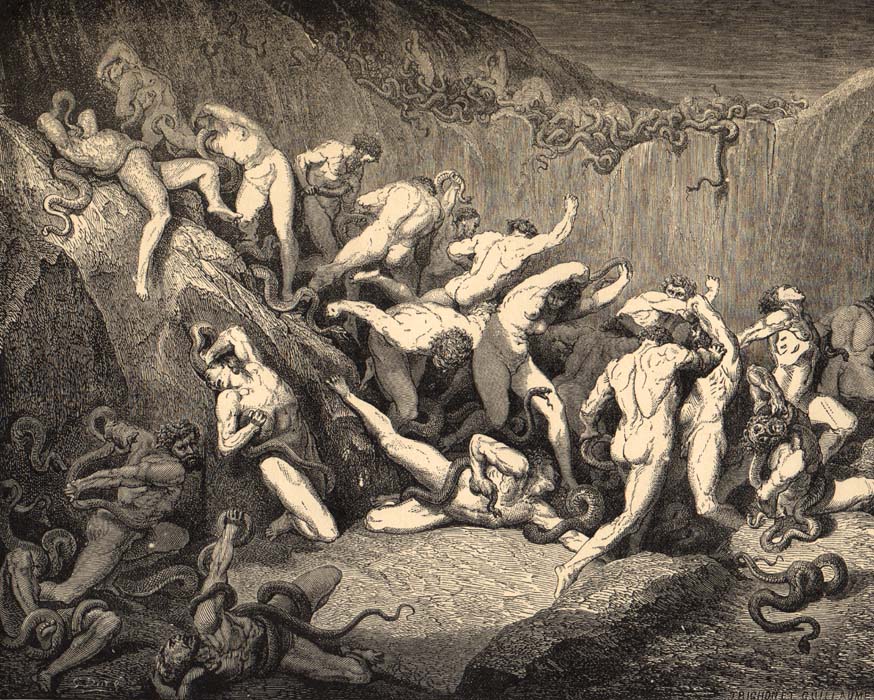
Gustave Doré, “Thieves”, Date: 1890, Medium: engraving

http://danteworlds.laits.utexas.edu/gallery11.html

Canto 24 begins like Canto 22 with a lengthy simile. In Canto 24, Dante and Virgil reach the seventh bolgia of the eighth circle. They find a ruined bridge and must climb rocks in order to reach the next level of hell. Dante is quite anxious, but Virgil helps Dante by carrying him and guiding him in what to do. Dante describes Virgil’s wisdom by comparing him to “one who uses judgment as he acts” (Canto 24, Line 24). Dante pauses for a rest from the difficult climb and Virgil advises him that “one does not gain fame sitting on down cushions,” meaning recognition does not come to those who are lazy. This advice seems to be an indication of Dante the poet’s life outside of Inferno.

Next, Dante and Virgil approach the sinners of Canto 24, thieves. Dante notices a “terrible crowding of serpents” (81). As shown in the Blake medium, the thieves are naked and chased by serpents. Once the snakes catch the sinners they bind their legs and hands. When the sinners are bitten, they catch fire, burn, and are reborn. Dante alludes to the Phoenix when he describes the fate of the thieves as they rise from the ashes like a Phoenix. It is both compelling and fitting that Dante, the poet, using snakes in the punishment for thieves. Snakes are often the symbol of rebirth. They shed their skin, transform, and represent immortality. Historically, snakes also act as bearers of secrets. In a religious context, snakes can represent deceit for it was a serpent who deceives Eve into eating a forbidden fruit. The serpents in Canto 24 punish thieves, people who hide massive secrets by stealing and trying to get away with their crime. It seems as though these thieves are snakes but instead of positive renewal they are forced to burn, die, and be reborn only to have to continue that process for eternity. As thieves they stole, therefore as sinners, they are infinitely having their livelihoods stolen from them as they are bitten by snakes. In Blake’s medium, it is evident by their expressions that the sinners are in pure agony as they are entangled by serpents.

Dante and Virgil encounter a sinner and Virgil asks him who he is. The sinner replies with, “I rained down from Tuscany” (121). Again the person Dante confronts introduces himself not by name but by the place he is from, signifying that one’s hometown is the strongest identity marker and truly makes him who he is. The sinner continues and states his name as Vanni Fucci. He is there because he stole from the church and blamed it on someone else. Fucci is among the unique sinners that Dante meets. He is one who truly does not want to be seen as he is in Hell. He states, “It pains me more to be caught in the wretchedness where you see me than when I was taken from the other life” (133-134). Fucci feels the shame and embarrassment of his crime. He is more focused on his place in Hell unlike other sinners, like Francesca, who are so stuck in a moment and fixated on what they were in life.


Canto 19: Dante Condemns the Catholic Church

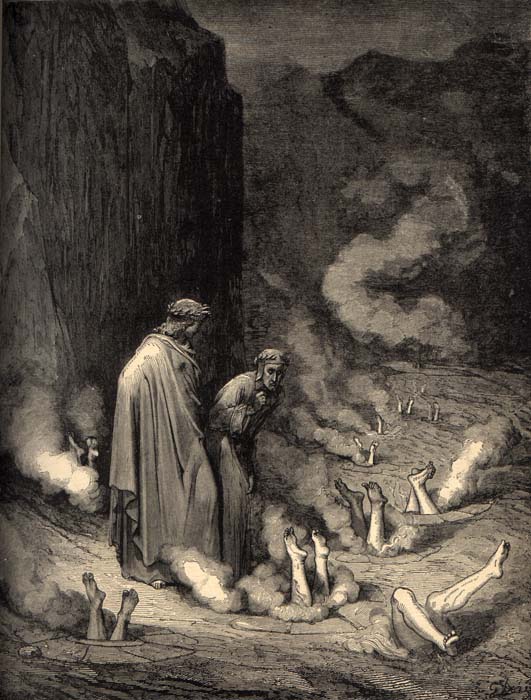
“Simonists” by Gustave Doré (http://danteworlds.laits.utexas.edu/gallery10.html)

In Canto 19, Dante and Virgil arrive in the Third Bolgia of the Eighth Circle. The sinners there are Simoniacs, corrupt clergy who bought or sold sacred heavenly services for money. From the very start of the Canto, Dante immediately angrily criticizes the Simoniacs saying, “You who the things of God, that should be brides of goodness, rapaciously adulterate for gold and for silver.” (Canto 19, Lines 1-4).

Canto 19 solidifies just how important God means to Dante the writer and Dante the pilgrim. The canto also displays how strongly Dante feels towards those who are disloyal and disrespectful to God. Dante, the pilgrim, does not feel sympathy nor pity for the Simoniacs as he has felt for sinners in previous Cantos. Instead, he feels content with their punishment. Dante tells Pope Nicholas, “Therefore stay here, for you deserve your punishment.” (97). He continues and states, “You have made gold and silver your god.” (112). Dante’s tone throughout Canto 19 is pure rage and intensity against those who chose money as their god and therefore did not worship the right God. His hatred for the Simoniacs shows how passionate and how serious God means to him. Dante finds that those who did not take God seriously deserve eternal punishment. Dante adds, “And were it not that I am forbidden by my reverence for the highest keys, which you held in happy life, I would use still heavier words” (100-103), meaning that Dante’s respect for the papacy is keeping him from insulting the Simoniacs even more. Virgil is pleased with Dante’s angry speech towards the Simoniacs. As Virgil was proud of Dante in his interaction in Canto 15 with Brunetto Latini, the pilgrim again believes his leader is pleased “with such a contented smile he listened” (120). 

As shown in the Gustave Doré artwork, God has punished the Simoniacs by stuffing their greedy heads and bodies into holes in the ground with their legs and feet hanging out. In Doré’s work Dante seems to be speaking to Pope Nicholas and if you zoom closely into Dante he has a facial expression of disgust and revulsion. Dante compares the holes in the ground to “places for the baptizers” (17). It is compelling that the sinners are stuffed into the ground head first as oppose to their body first like during a baptism. I think this punishment for Simoniacs fits with the unorthodox and sacrilegious decisions they made during their lives.

Canto 15: A Unexpected Encounter between a Teacher and Student

In Canto 15 Dante and Virgil continue their journey through the Third Ring of the Seventh Circle of Hell where the “literary sodomites” and others violent against nature are punished. As we read in Canto 11, sodomy is considered a sin of violence. Dante, the poet, views sodomy as a crime against God because it goes against nature. In Inferno, sodomy contradicts the natural will of life, therefore harming God. In the third ring, a fiery rain falls on the sinners, which represents an unnatural phenomenon, like sodomy. Whereas regular rain replenishes the Earth, a fiery rain does the opposite since sodomizers also do not replenish Earth with new life.

As Dante and Virgil walk passed a “band of souls” (Inferno 15, 16), Dante, the poet, writes “each was gazing at us as in the evening people gaze at one another (16-17).  I interpreted this as alluding to the way men may look at each other in a sexual manner. Dante says, “I was recognized by one, who seized me by the hem” (22). Dante has some difficulty recognizing the soul because of his “baked appearance” (26) from being burnt from the fire. Dante finally realizes who it is and with surprise asks, “Are you here, ser Brunetto?” Dante asks this with a great shock and sorrow that Brunetto could end up where he is. Dante holds respect for Brunetto, an old mentor and teacher, who he feels indebted to. Dante keeps a “kind paternal image” of Brunetto (83). It’s compelling that both Dante the poet and pilgrim have much admiration for Brunetto. But evidently, Dante, the poet, places Brunetto where he does in such a painful place in Hell based on his sin and regardless of how much praise and affection he has for him. This displays that one can commit sins and be punished but still be seen with great influence, like how both Dante’s view Brunetto.

Brunetto explains to Dante his future. Dante hears the same prophecy again. I found this compelling because it’s possibly the third time that Dante heard his prophecy and again the number 3 could be used by Dante, the writer. It’s also unusual that there was not much interaction between Dante and Virgil in Canto 15. Dante spends most of the Canto talking to Brunetto. Dante informs Brunetto that he is prepared for what Fortune has in store for him. Virgil is pleased with his student’s courage and approves of his careful listening saying, “He listens well who takes note” (98). I think this displays a strong trust and confidence Virgil has grown to have in his student and pilgrim, Dante.

Canto 11 – A Brief Break to Explain the Organization of Hell/The Presence of the Number 3 and The Importance of Nature

Canto 11 reminded me of previous cantos where Virgil and Dante pause because Dante, the pilgrim, needs explanations and clarity from Virgil. This is a recurring technique of Dante, the writer, in which he allows the readers to mirror his character and gain answers to similar confusions that the pilgrim himself is experiencing.

While Virgil and Dante are resting, Virgil explains the organization of Hell in more depth. The organization also enables the reader to note how Dante, the poet, classifies the severity of certain sins over others. I thought it was compelling that the religious presence of the number three appears again in this Canto. First, Virgil tells Dante there are three smaller circles. Hell is separated into three parts. The first circle in middle hell is also divided into three subcircles where the sinners are separated into three groups based on the gravity of violence either committed against others, against oneself, and the worst, which is violence against God.

I was a little confused as to why Dante punishes sodomy as a worse punishment than the crimes committed by the lustful in Circle 2/Canto 5. But, when I reread Virgil’s explanations to Dante I gained more clarity. It is important to note that sodomy is a sin of violence. This means that Dante, the writer, does not punish sodomizers for their morality but more so because he views it as unnatural to the world. Dante the poet defines crimes against God as the most violent because they go against the natural will of life. Virgil states that sodomy and those who harm God scorn “nature and its goodness.” (Canto 11, Line 47). For Dante, something that contradicts nature is far worse and violent than engaging in lust. Above all, God is the most important, therefore going against him and harming what he created is worse than harming others.

Lastly, Dante, the writer, punishes the fraudulent at a lower place in Hell. Virgil tells the pilgrim that fraud, “seems to cut solely into the bond of love” and “forgets the love that Nature makes” (Canto 11, Lines 52-58). It is clear again how severe defying nature is to Dante, the poet. When one is fraudulent and deceitful, he is going against the natural trust and love people are meant to have for one another. Dante ranks fraud worse than violence because it directly contradicts natural trust.

The Gluttonous Politics of Florence

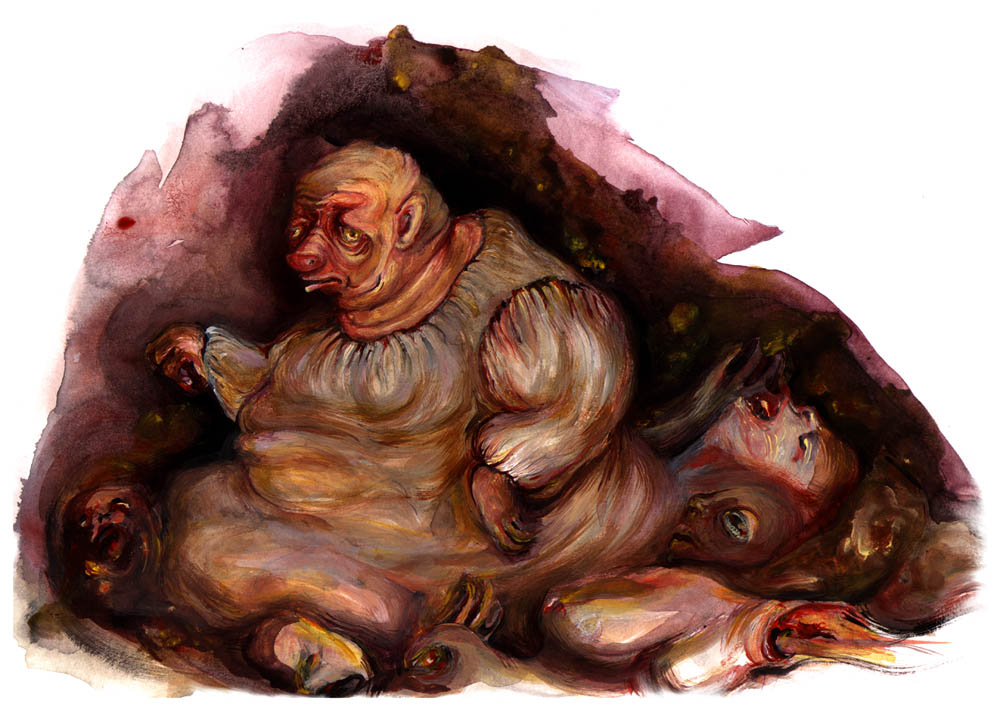
“Ciacco” – Suloni Robertson (http://danteworlds.laits.utexas.edu/gallery05.html)

In Canto 6, Dante awakens in the third circle of hell. He finds himself surrounded by suffering spirits who are punished by an “eternal, cursed, cold, and heavy rain” (7) because of their indulgences and greed. Dante encounters Cerberus, the mythological three-headed dog-like demon beast, who continuously barks at the cursed souls. Then, Dante comes across a soul who asks him, Dante, to “recognize me if you can.” Dante cannot recognize him because the soul no longer looks like his living self but he is Ciacco of Florence who is punished in the third circle of hell for his sin of gluttony. According to UTexas’ Dante Worlds, Ciacco may be a derogatory reference to “pig” in the Florentine dialect of Dante’s day which is probably why Suloni Robertson depicts Ciacco as a stuffed pig in her painting. The pig is used as a metaphor for the excessive greed politicians often use for their own personal gains. Ciacco explains to Dante that there all the others in the third circle also “endure similar punishment for similar guilt” (55-56). Dante weeps again for Ciacco’s suffering and troubles but once he realizes who is speaking to he wants to know the future of Florentine politics. Dante asks Ciacco if worthy men are in heaven or hell and Ciacco responds, “They are among the blacker souls” meaning despite their certain good actions in life their selfishness punished them in the deeper circles of hell.

Canto 6 shows how massively important the politics of Florence are to both Dante the writer and Dante the character. Florence is something that personally affects Dante and this is the first place in Inferno where politics are thoroughly introduced and the focus is what is going to happen to Florence.


Assignment 1 – Canto 5

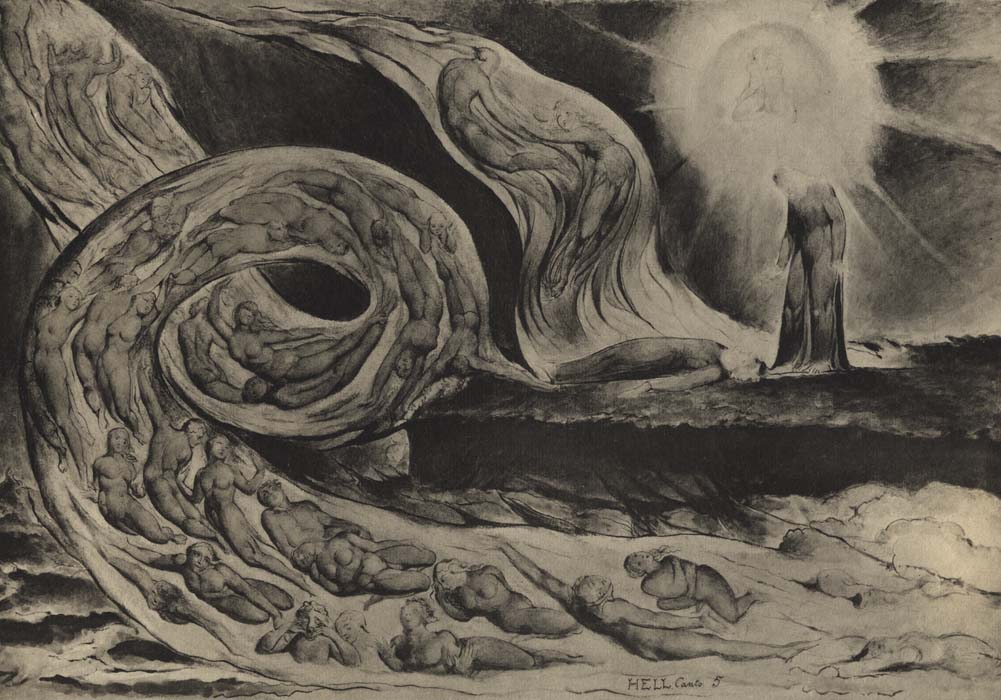
William Blake – “Dante Faints”

http://danteworlds.laits.utexas.edu/gallery04.html

I found this image from the resource site Danteworlds (UTexas). It is found in the site’s Circle 2 Gallery.  The art is by William Blake and it is entitled “Dante Faints” referring to the end of Canto 5.

Dante entered the Gate of Hell with his guide, Virgil, and passed through the first circle. This painting refers to Dante’s presence in the second circle, where lovers guilty of lust are in an “infernal whirlwind which never rests” (31) that endlessly punishes and tortures them. The painting displays souls trapped in this hellish wind. Dante encounters many famous historical and mythical women being blown in the wind including Cleopatra, Helen of Troy, and Francesca. Love, lust, and desire all led these women to their demise and suffering in the second circle of hell.

The painting refers to the entire canto but most specifically to lines 31-43 and lines 115-142. Lines 31-43 describe the restless wind that these sinners are stuck in. As Dante and Virgil encounter the women, Virgil explains to Dante what acts of love brought them to hell. Dante is especially interested in Francesca’s romance. Francesca had an affair with her husband’s younger brother Paolo and Francesca’s husband murdered them. Dante tells Francesca that her sufferings make him “sad and piteous to tears” (115-116). Dante was so moved by Francesca that he fainted as he says “so that for pity I fainted as if I were dying” (139-140). On the right side of the painting, Dante is pictured having fainted flat on his back as Virgil stands over him.