
After reading Canto 24, I’ve wondered about the theory of Eternal Recurrence and the nature of the seven pouch. For those who are unfamiliar with this theory, it’s a thought experiment about whether every detail life is meant to endlessly repeat itself; a loop. Famously, there is a symbol that goes hand in hand with this theory, Ouroboros; a snake eating itself. Friedrich Nietzsche used this as a formula for human greatness. With that in mind, the Sinners are punished by giant serpents binding them. So, we can associate these serpents with the symbol Ouroboros. As these serpents bind sinners, they are caught on fire and turned into ashes. Then these ashes are reborn into human form again. The punishment repeats itself. Just like the theory of eternal recurrence stated, these sinners are dealing with the same pain over and over again. According to Friedrich Nietzsche, how can these sinners achieve human greatness. In Canto 24, Virgil states that a person has control of their thoughts and impulses, “raise thee up, o’ercome the anguish/ With spirit that o’ercometh every battle,/ If with its heavy body it sink not”(Alighieri 52-54). Perhaps to reach enlightenment, Sinners must be aware of the temptations to which they are always recurring and present, and learn to control these impulses. Although, now that I contemplate about the sinner’s circumstance, they are in hell; therefore they must forever feel torment. At least in this case, the looping element from the Eternal Recurrence would apply here.
Tag Archives: serpents
Canto 24: Reptilian Thievery and The Symbol of Snakes and Rebirth
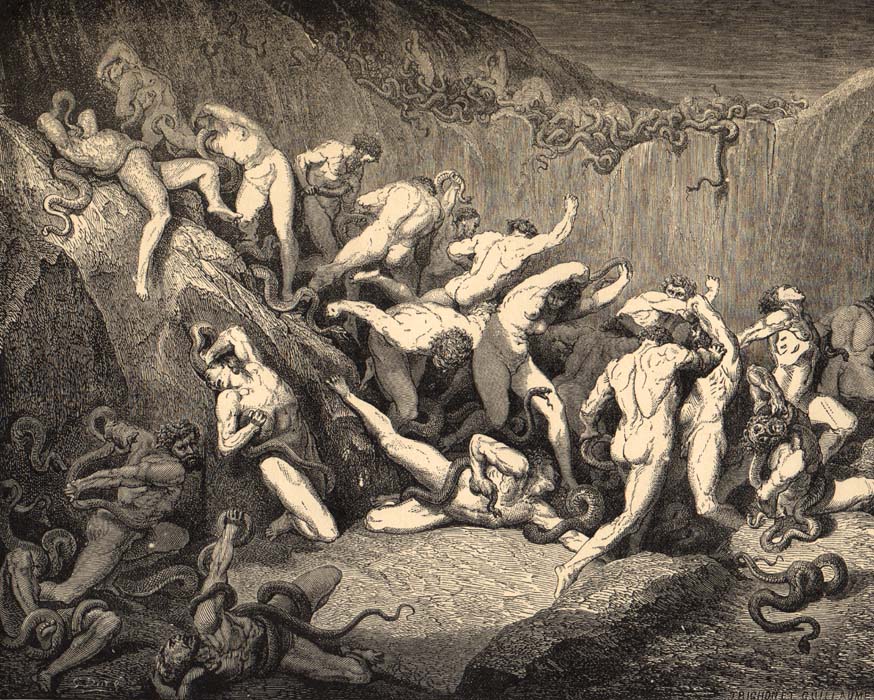
Gustave Doré, “Thieves”, Date: 1890, Medium: engraving
http://danteworlds.laits.utexas.edu/gallery11.html
Canto 24 begins like Canto 22 with a lengthy simile. In Canto 24, Dante and Virgil reach the seventh bolgia of the eighth circle. They find a ruined bridge and must climb rocks in order to reach the next level of hell. Dante is quite anxious, but Virgil helps Dante by carrying him and guiding him in what to do. Dante describes Virgil’s wisdom by comparing him to “one who uses judgment as he acts” (Canto 24, Line 24). Dante pauses for a rest from the difficult climb and Virgil advises him that “one does not gain fame sitting on down cushions,” meaning recognition does not come to those who are lazy. This advice seems to be an indication of Dante the poet’s life outside of Inferno.
Next, Dante and Virgil approach the sinners of Canto 24, thieves. Dante notices a “terrible crowding of serpents” (81). As shown in the Blake medium, the thieves are naked and chased by serpents. Once the snakes catch the sinners they bind their legs and hands. When the sinners are bitten, they catch fire, burn, and are reborn. Dante alludes to the Phoenix when he describes the fate of the thieves as they rise from the ashes like a Phoenix. It is both compelling and fitting that Dante, the poet, using snakes in the punishment for thieves. Snakes are often the symbol of rebirth. They shed their skin, transform, and represent immortality. Historically, snakes also act as bearers of secrets. In a religious context, snakes can represent deceit for it was a serpent who deceives Eve into eating a forbidden fruit. The serpents in Canto 24 punish thieves, people who hide massive secrets by stealing and trying to get away with their crime. It seems as though these thieves are snakes but instead of positive renewal they are forced to burn, die, and be reborn only to have to continue that process for eternity. As thieves they stole, therefore as sinners, they are infinitely having their livelihoods stolen from them as they are bitten by snakes. In Blake’s medium, it is evident by their expressions that the sinners are in pure agony as they are entangled by serpents.
Dante and Virgil encounter a sinner and Virgil asks him who he is. The sinner replies with, “I rained down from Tuscany” (121). Again the person Dante confronts introduces himself not by name but by the place he is from, signifying that one’s hometown is the strongest identity marker and truly makes him who he is. The sinner continues and states his name as Vanni Fucci. He is there because he stole from the church and blamed it on someone else. Fucci is among the unique sinners that Dante meets. He is one who truly does not want to be seen as he is in Hell. He states, “It pains me more to be caught in the wretchedness where you see me than when I was taken from the other life” (133-134). Fucci feels the shame and embarrassment of his crime. He is more focused on his place in Hell unlike other sinners, like Francesca, who are so stuck in a moment and fixated on what they were in life.

