Tag Archives: Virgil

Virgil & Beatrice

Throughout the Inferno, Dante is scolded by his guide Virgil. Similarly, in Purgatorio, Dante is scolded like a mother to a child by his lover, Beatrice. Dante is scolded by two of the most important people to him. In canto 30 of the Inferno, Dante is watching Sinon and Master agrue and go back and forth. Virgil comes and hits Dante in the back of his head and tells him to stop watching this shameful argument. In lines 130-136:

I was all intent to listen to them, when my master

said to me: “Now keep looking, for I am not far from

quarreling with you!”

When I heard him speak to me angrily, I turned

toward him with such shamethat it dizzies me in

memory.

Dante hangs his head in shame and Virgil after seeing this takes him under his arm and forgives him. Just as a mother scolds her child and the child is ashamed; the mother feels bad and shows affection to her child. In canto 30 of the Purgatorio, the moment everyone has been waiting for: the appearance of Dante’s beloved Beatrice. When she first appears, Dante is taken back by her beauty and like a scared child turns to Virgil for answers. Virgil was gone. Dante starts panicking wondering where Virgil could’ve gone and as he is about to cry Beatrice scolds him. Beatrice foreshadows that Dante will encounter another terrible wound so he should save his tears. Without mercy, she scolds him for crying in the earthly paradise; the place where men are supposed to be happy. Dante hangs his head in shame and then sees his shameful reflection in the stream. Beatrice is compared to scolding Dante as her child. As shown in lines 73-81:

“Look at us well! Truly I am, truly am

Beatrice. How have you designed to approach thee

mountain? Did you not know that here mankind is

happy?”

My eyes fell down to the clear spring, but,

seeing myself there, I turned them to the grass,

such shameweighed down my brow:

so as a mother seems severe to her son as she

seemed to me, for bitter is the flavor of

compassion still unripe.


The Punishment of Satan/The Contrapasso of Lucifer

Dante and Virgil Encounter Lucifer in Hell, 1923 Giclee Print by Henry John Stock

In Canto 34, Dante is introduced to Satan, “the creature who had once been beautiful.” (17-18) Dante’s descriptions of Satan are haunting, so haunting that Dante pauses the dialogue to engage the reader stating: “I became frozen and feeble, do not ask reader, for I do not write it, and all speech would be insufficient.” (22-24) But Satan’s real punishment isn’t just his eternal fate in hell. He’s doomed to forever be one with hell, punishing not only Judas, Brutus, and Cassius, but also the other members of the 9th circle with the cold beats of his bat-like wings. In other words, he’s reduced to a mechanism of hell, equivalent to other beasts and lower forms we’ve seen in other Cantos, like Cerberus or Plutus from upper hell.

The contrapasso of Lucifer is very evident. Not only through his punishment, but Dante’s descriptions of Lucifer. Almost without exception Dante refers to Satan’s prior perfection, literally a “light-bearer,” the translation of Lucifer: “If he was as beautiful then as now he is ugly, when he lifted his brow against his Maker.” (34-35) This further develops the idea of his punishment. A rebel against God, he is now doomed to forever remain a mechanism of God’s divine justice. A punishment to others who also violated God’s divine authority.

Lucifer’s physical punishment also reflects this contrapasso. Massive in size, but rooted in ice, Lucifer is both incredibly intimidating but at the same time utterly docile. This is further illustrated by his utter silence throughout the canto, forced to continue God’s will and chew sinners for eternally with three mouths, a parallel to the trinity.

I think that the geology of lower hell is very interesting, especially in reference to Satan. As Virgil and Dante leave the 9th circle to exit hell, Dante describes how “I raised my eyes, thinking to see Lucifer as I had left him, and I saw that he extended his legs upward.” (88-89) I like to think that this is a reference to the 8th circle, 3rd Bolgia, in which the feet of simonists are engulfed in flame. In a certain way, Satan too used his position in a different context for personal gain.

Ultimately, I think that the punishment of Lucifer is a poetic and powerful transition into Purgatorio. I think that because of Lucifer’s silence in the Canto and his diminished state as a mechanism of hell reflects the punishment of sinners in the Anti-Inferno, who aren’t recognized at all. While Satan is recognized, he isn’t glorified or even dignified by speech, as other sinners have been. He’s simply condemned to his fate and eternally frozen in the absence of God’s light, and warmth.

Reflection Post 1


After reading all my posts about the Inferno, I noticed numerous similarities and distinctions throughout them. My first four blog posts were more like summaries rather than reflective posts. They all included images with a short description of them but, I mostly summarized what the canto was about. However, my blog posts five and six had more connections, comparisons, similarities and changes in style. These two posts didn’t include images but made various connections between all the cantos we have read so far.

In my blog post 2 about gluttony, cerberus, and ciacco, my style was repetitive and colloquial. I included an image and a terzina but simply summarized what Canto 13 was about. I tried to include some imagery in my post but did it very poorly; I did the same thing with my first blog post. My first post included a picture of Virgil and Beatrice in paradise which I have not read at all but I thought it was related to Canto 2. I introduced who Beatrice was and how important she was to Dante. Moreover,  in my first two blog posts I  had countless grammar mistakes such as punctuation and fragmentation. In my fourth blog post, I was trying to use imagery to best describe Geryon but it sounds like a huge summary. For example, “ Dante was struck with horror when Virgil requested a ride from the monster. As he climbed on Geryon he saw countless sinners suffering from above and was scared the entire time”. Instead of summarizing what Canto 17 was about I should have made more comparisons and similarities with Geryon and the other beasts introduced in the Inferno. Also, I should try to include more outside resources rather than just quoting from the Inferno to support my posts. Lastly, my lack of present tense is evident throughout my posts but gets better toward my most recent post.

My most recent blog posts five and six are my most clear and concise posts so far. My fifth blog post I compared how Dante has treated the sinners and how Virgil has treated Dante from this throughout the Inferno. I made good comparisons and similarities between Cantos 5, 8, 13, 15, 19,  and 20. For instance, “ Like in Canto 19, Virgil is very pleased with Dante’s attitude towards these sinners because it is showing him not to sympathize with them anymore. He joyously hugs and kisses him in Canto 8 and happily carries him like a baby across the bridge in Canto 19”. Additionally, in my most recent blog post I wrote about how Virgil babies and reassures Dante like a mother throughout the Inferno. I made countless clear and concise similarities among Cantos 2, 8, 19, 23, and 24. I used many quotes to support my theme about Virgil and Dante; also, my writing style is not as repetitive as before.

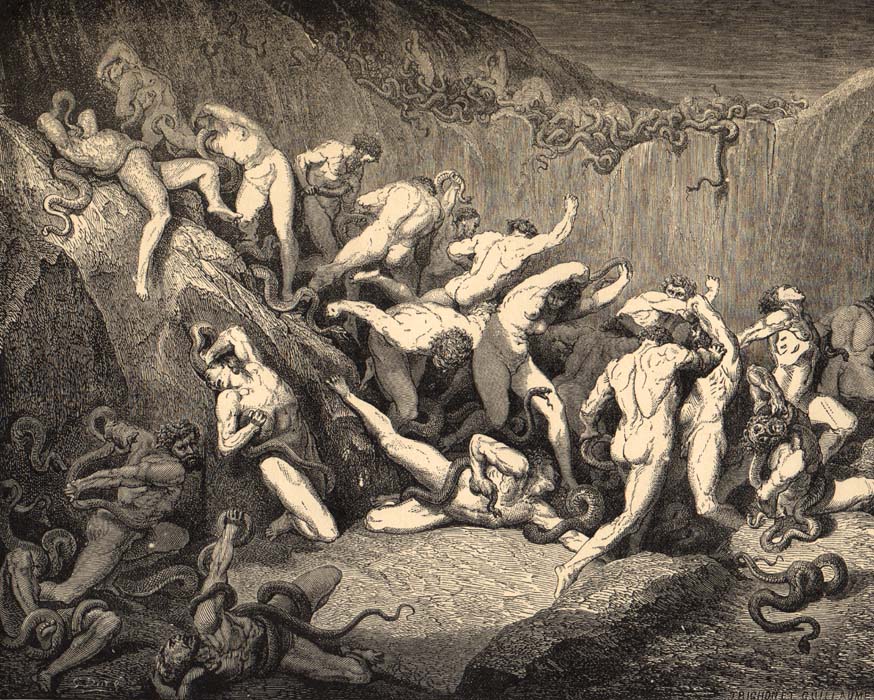
Canto 24: Reptilian Thievery and The Symbol of Snakes and Rebirth

Gustave Doré, “Thieves”, Date: 1890, Medium: engraving

http://danteworlds.laits.utexas.edu/gallery11.html

Canto 24 begins like Canto 22 with a lengthy simile. In Canto 24, Dante and Virgil reach the seventh bolgia of the eighth circle. They find a ruined bridge and must climb rocks in order to reach the next level of hell. Dante is quite anxious, but Virgil helps Dante by carrying him and guiding him in what to do. Dante describes Virgil’s wisdom by comparing him to “one who uses judgment as he acts” (Canto 24, Line 24). Dante pauses for a rest from the difficult climb and Virgil advises him that “one does not gain fame sitting on down cushions,” meaning recognition does not come to those who are lazy. This advice seems to be an indication of Dante the poet’s life outside of Inferno.

Next, Dante and Virgil approach the sinners of Canto 24, thieves. Dante notices a “terrible crowding of serpents” (81). As shown in the Blake medium, the thieves are naked and chased by serpents. Once the snakes catch the sinners they bind their legs and hands. When the sinners are bitten, they catch fire, burn, and are reborn. Dante alludes to the Phoenix when he describes the fate of the thieves as they rise from the ashes like a Phoenix. It is both compelling and fitting that Dante, the poet, using snakes in the punishment for thieves. Snakes are often the symbol of rebirth. They shed their skin, transform, and represent immortality. Historically, snakes also act as bearers of secrets. In a religious context, snakes can represent deceit for it was a serpent who deceives Eve into eating a forbidden fruit. The serpents in Canto 24 punish thieves, people who hide massive secrets by stealing and trying to get away with their crime. It seems as though these thieves are snakes but instead of positive renewal they are forced to burn, die, and be reborn only to have to continue that process for eternity. As thieves they stole, therefore as sinners, they are infinitely having their livelihoods stolen from them as they are bitten by snakes. In Blake’s medium, it is evident by their expressions that the sinners are in pure agony as they are entangled by serpents.

Dante and Virgil encounter a sinner and Virgil asks him who he is. The sinner replies with, “I rained down from Tuscany” (121). Again the person Dante confronts introduces himself not by name but by the place he is from, signifying that one’s hometown is the strongest identity marker and truly makes him who he is. The sinner continues and states his name as Vanni Fucci. He is there because he stole from the church and blamed it on someone else. Fucci is among the unique sinners that Dante meets. He is one who truly does not want to be seen as he is in Hell. He states, “It pains me more to be caught in the wretchedness where you see me than when I was taken from the other life” (133-134). Fucci feels the shame and embarrassment of his crime. He is more focused on his place in Hell unlike other sinners, like Francesca, who are so stuck in a moment and fixated on what they were in life.


Evil Tail’s Clever Deceit

In Canto 21, Dante and Virgil encounter a group of devils collectively referred to as Evil Claws. The meeting that ensues portrays Virgil as being an overly confident master who takes the word of a devil despite being in a subcircle of the circle of fraud and the inherent evil nature of the beast-like creature. Virgil questions one of the devils: ” ‘Do you think, Evil Tail, that you see me here,’/said my master, ‘once already safe from all your tricks,/without God’s will and favorable fate? Allow us/ to walk on, for it is willed in Heaven that I guide/ someone on this savage journey,’ ” (79-83, 323). In other words, Virgil reminds the devil that he has already journeyed on this path through Hell on his own without the trickery or deceptions of the devils harming or affecting him in any manner. He is able to get past them and does not imagine how or why it should happen otherwise this time. Virgil also wishes to express that part of the reason he is traveling through Hell with the pilgrim and must be allowed to continue to do so, is because God is allowing it to happen through His own will. Virgil’s bold demeanor appears to be effective for the time being when Evil Tail lets his guard down, orders the rest of his group not to abuse Virgil or Dante in any manner and to guide them on through their next path.

This reaction that Evil Tail presents seems to be a positive sign on the surface. However, the reality of the situation is that Evil Tail is deceiving Virgil by allowing the latter to believe that Evil Tail is bowing down to Virgil’s reasoning and self-assured tone. Barolini elaborates on this point by claiming, “Malacoda [Evil Tail] weaves truth with falsehood into a perfectly designed trap, giving instructions and information that seem straightforward and helpful to Virgilio but that his troops can decode as deceitful and hostile,” (Barolini). The escorts that Evil Tail sends along with the two travelers have evil intentions in mind and are aware that they are allowed to carry them out because of Evil Tail’s clever manner of speaking with Virgil. The ‘trap’ that Barolini mentions refers to the deceiving approach Evil Tails uses in making his three statements. The first and the third one are true while the second one, claiming that there’s an unharmed bridge that will ease Virgil and Dante’s path, is the false statement. As Barolini points out, this cleverness of throwing in a false statement in between two true ones effectively distracts Virgil from the fact that he is being deceived thanks to the self-assurance present in Virgil’s attitude.

Such deception supports the idea that Virgil’s ability to reason with the demons of Hell is not always successful as Virgil, and especially, Dante hopes. Dante’s lack of trust and his overwhelming fear of the demons is influenced by a moment in canto 8 where Virgil is unable to carry out his word. Virgil takes an assertive stance against a group of demons that protect the gates of the city of Dis. He fails to sway their stubbornness in any which way resulting in Virgil and Dante inability to cross the gates. This, in turn, discourages Virgil immensely. Consequently, Dante marks this as a significant failure that must be kept in mind throughout the rest of the journey. Although Dante has faith in Virgil’s intelligence and ability to deal with the creatures of Hell, he does not wish to forget this moment for the sake of eluding danger which Virgil fails to do so in canto 21. Furthermore, Virgil fails to recognize the idea that simply because Evil Tail complies with his demands, this does not signify that Evil Tail will stay true to his word. After all, as mentioned before, in a circle that contains sinners of fraud, it should be remembered that the demons, though they punish those sinners, are not restrained themselves and are free to carry out their evil nature as they please. Virgil must also keep in mind that it is self-centered to believe that he is incapable of failure in his dealings with demons. There is obvious evidence otherwise which justifies Dante’s dread of the situation and it should be taken seriously, especially in an environment where it is understandable to have such sentiments.

Secondary Source: https://digitaldante.columbia.edu/dante/divine-comedy/inferno/inferno-21/

Virgil’s reassurance towards Dante

Throughout the Inferno, Virgil always helps, reassures, and gives Dante confidence in any given circumstance. Virgil also tends to baby Dante when Dante does something to please him. In Canto 23, Virgil and Dante managed to slip away from Barbariccia and the other demons that were distracted by the demons Calcabrina and Alinchino fighting. Virgil and Dante saw this as their final opportunity to leave but Dante is terrified that the demons will come and look for them since they slipped away. Virgil reassures Dante by carrying him across. In lines 37-43, Dante says “ My leader seized me quickly, like a mother who is awakened by the noise and sees the flames burning close by, who takes up her son and flees, caring more ofr him than for herself, not stopping even to put on her shift:”. Virgil reassures Dante that nothing is going to happen to them by showing him this kind of affection. Similarly, in Canto 24, Virgil pushes Dante to get moving and helps him down the rocky bank. Dante mentions that if it weren’t for Virgil, he probably would’ve given up by now. In lines 23-27 “… he opened his arms and took hold of me. And like one who uses judgement as he acts, always seeming to look ahead, so, carrying me up to the top…”, Virgil carries him again to get to the summit of the bridge. Without Virgil being there, Dante would have been completely lost and hopeless throughout each circle of hell. Additionally, in Canto 19, Virgil also happily carries Dante like a baby across the bridge. Virgil was proud of him for not sympathizing with the sinner Pope Nicolas III. Evidently, there is a recurring theme of Virgil carrying Dante in these three cantos. Nonetheless, Virgil’s reassurance is shown in the beginning of the Inferno in Cantos 2 and 8. In Canto 2, Virgil reassures Dante that everything will be okay in his journey by telling him that he was sent by his beloved Beatrice. In lines 133-136, Dante says “Oh full of pity she who has helped me! And you courteous, who have quickly obeyed the true words she offered you!”. Dante is eternally grateful to have received Virgil as his master and guide throughout his journey. Furthermore, in Canto 8, thousands of enraged sinners try to bar Dante from getting into the city of Dis because of his “alive-ness”. Virgil reassures Dante that they will get into the city of Dis. Virgil at first fails but then succeeds in the beginning of Canto 9. In lines 121-123 of Canto 8, Virgil tells Dante “And to me he said: “You, though I am angered, do not be dismayed, for I will overcome this test, however they scurry about inside to prevent it”. Virgil’s ego does take over here, but he was successful either way when they both got into the city of Dis. Thus, Virgil’s reassurance and encouragement has helped Dante face numerous obstacles throughout the Inferno.

Canto 24: Dante’s body mass is problamatic, Virgil controls his emotions & Dante still relies on Virgil

Canto 24 begins with the “simile of the villanello” as noted in the Digital Dante notes for canto 24. The villanello demonstrates Virgil’s changing expression as well as the emotional state both Virgil and Dante face. Virgil is angry but his anger is not directed to Dante. Virgil is like a farmer who is running low on food and can’t maintain his animals so he needs his animals to graze and is appalled by the sight of frost because the grass will be covered by snow. This is shown when Dante writes, “when on the ground the frost copies the image of her white sister, but her pen retains its temper only briefly, the peasant, his provisions running short, rises to look, and sees the fields all white; and he strikes his thigh…” (Canto 24, lines 4-19). But the frost disappears quickly in the morning sun, therefore the grass can be seen and the farmer (Virgil) is suddenly overpowered with joy. Realizing how treacherous the bridge is, Virgil takes some time to consult himself and study the ruin of the bridge well. Then Virgil helps Dante across, lifting him up onto various boulders and teaching Dante to find secure places where he can put his feet to push himself up. When they finally make it across, Dante says “My breath was so milked from my lungs when I arrived there that I could go no further, but rather sat down as soon as we arrived” (canto 24, lines 43-46). Dante is dependent upon his master not only for physical help, but also for spiritual guidance and moral support. Similar to previous cantos, Dante gains reassurance from Virgil because Virgil’s actions and words can make Dante feel serene because Dante feels the same security in Virgil as when he first met him. Instantaneously when Virgil’s anger vanishes so does Dante’s anxiety. Once Virgil gains his composure, he reveals he is capable of measuring an amount of control over his emotions. This contrasts with the way in which most of the sinners in Hell are prey to their emotions and physical desires such as anger, lust, greed, and so forth. Although Virgil is in one circle of Hell, he is only there because he is not a Christian; he is a pagan. Virgil, however, uses his willpower to master his emotions. Throughout the poem, the ability to master emotions is seen to be a uniquely human characteristic that identifies with human ability.


Virgil congratulates Dante on his efforts and tells him “And therefore stand up; conquer your panting with the spirit that conquers in every battle, if it does not let the heavy body crush it down” (canto 24, lines 52-54). The climb to the next bridge presents problems. Virgil is weightless, but he has to give very careful directions for Dante because Dante has body mass so he needs test each rock before he puts his entire weight on it because the bridge can collapse. Here, as seen in other cantos, the body is considered to be an impediment, because the body represents a physical weight that the spirit must carry around and that threatens at times to overcome the spirit. Similarly, as noted in canto 8 when Dante the pilgrim states “My leader stepped down into the boat and then had me enter after him; and only when I was aboard did it seem laden. As soon as my leader and I were in the bark, the ancient prow set forth, cutting more of the water than it does with others” (canto 8, lines 27-30). Dante tries to cross the Styx river by boat but at first is denied by Phlegyas because Dante is still alive and therefore his body remains with him throughout his journey. Only Dante the pilgrim has a body weight to the boat and therefore the boat sinks lower into the water because of his weight index.


Dante v.s. Pope Nicholas III

Dante and Virgil speak to a simonist, Title: Simonists, Illustration by Gustave Doré, Source: Danteworlds (UTexas)

The image above refers to canto 19 in which Dante and Virgil encounter the souls who have committed the sin of simony. Simony is defined as someone who uses material wealth to pay for a higher position and more influence in the church. In observing the image, Dante appears to be quite cautious in approaching the simonists while Virgil is smiling with pleasure at Dante’s reaction. There are souls trapped in holes all around Dante and Virgil with their legs being the only visible limbs. They appear to be flailing about because of the fire that burns them.

However, it also seems to illustrate the moment when Dante speaks to Pope Nicholas III. When the latter believes Dante is another pope, known as Boniface, he reacts in a confused manner, unsure of how to answer. After following Virgil’s instructions, Dante inquires about Nicholas’s reason for being in Hell. In a tone, unlike the tones present in previous cantos, Dante bluntly asserts that Pope Nicholas III is rightly punished for the sins he committed. Dante proclaims, “You have made gold and silver your god; and/ what difference is there between you and the idol-/worshipper, except that he prays to one, and you to a/ hundred?” (112-115, 295). Dante wishes to express here that in Nicholas’s living days, he makes wealth and bribery his main priority in order rise to the top of the church. Despite the fact that Nicholas serves a religious institution, similar to other religious members, this does not necessarily stop him from using money to his advantage. Simply because one works in a position of power that teaches people right from wrong does not signify that they are staying true to such prophecies when they are hidden from the public.

Furthermore, according to the catholic tradition, especially during this time, an idol-worshipper is considered as someone who follows an evil custom. It signifies that people devote themselves to a cult image such as a statue. In this quote, in order to emphasize the evil and immoral mindset of Pope Nicholas III, Dante compares him to idol-worshippers claiming that Nicholas is much worse because of his endless selfishness and greedy attraction to materialistic wealth. Dante’s reproach is ultimately harsh, blunt and straightforward. These characteristics are unlike the usual tone of Dante that travels through the ongoing circles of Hell. In past cantos, the majority of his reactions consist of sorrowful pity or fear. It is plausible that since this eighth circle is past the midpoint of inferno where Geryon brings them, Dante’s is experiencing a shift in mindset. He is becoming more aware of his connections to the souls in Hell, especially when they are connected to a political or religious background in which Dante participates. Usually this signifies that they come from the same city as he does, Florence, which immediately attracts Dante’s attention. Furthermore, Dante’s is shifting into a stronger and less distressed character who does not become alarmed as intensely as before at the torment that he witnesses. The reason for this is that since Dante and Virgil are descending further down into inferno, the punishments of the souls are becoming harsher and more terrifying. At this point, Dante is used to and no longer shocked at the extremity of the punishments.

In reference to the image, as mentioned before, Dante appears cautious when he recognizes the voice of Pope Nicholas III. However, this does not distract from the idea that he criticizes Nicholas with a sense of superiority. The cautiousness is present because of the dangerous situation apparent in front of him where there is an abundance of fire. Nevertheless, since this is the first time Dante admits to a soul that they are deserving of the punishment they receive, it is evident that he feels he has the upper-hand. This is not only because he is still alive, in obvious contrast to Pope Nicholas III, but also because he encounters an opportunity to condemn the corruption of the church that bothers him throughout his participation in politics. According to the notes (302) idolatry is a sin that is often criticized by Old Testament prophets whom Dante associates himself with. This gives an insight into Dante’s sense of identity because he feels confident in his opinion regarding Pope Nicholas III without any sense of insecurity about his sense of faith. Therefore, he is able to see what actions he must not commit in the future in order to avoid ending up in a damned position similar to Nicholas.

Lastly, Virgil’s reaction as shown in the artwork is clearly reflected in the text when Dante narrates, “I firmly believe that it pleased my leader, with/ such a contented smile he listened still to the sound/ of the true words I spoke,” (121-123, 295). This quote not only expresses a textual mirror of the image but also confirms Dante’s sense of superiority in two ways. Primarily, It is reassuring that his guide, who also happens to be a poet that Dante admires, approves of his statements towards Pope Nicholas III. When Dante states, “…the true words I spoke,” he is also affirming himself as well as the reader for speaking the truth, which pushes any further questions the reader or Virgil might have out of the way.

Dante’s tone towards sinners

In Canto 19, Dante and Virgil have reached the third pouch of the eighth circle called the simonists. Dante considers these sinners the worst kind because these corrupt clergy fornicate for gold and silver. The simonists are punished by being buried upside down in holes the size of baptism basins; their feet also protrude only to be burnt by eternal flames. In lines 103-105, Dante says “I would still use heavier words; for your avarice afflicts the world, trampling the good and raising up the wicked”. If Dante did not have respect for the papal office, he would have many more negative things to say regarding the simonists. Throughout the Inferno, Dante’s tone has varied with different sinners. In this particular canto, he feels no pity or sympathy towards Pope Nicholas II and unconsciously takes the role of a friar at a religious confession. Pope Nicholas II is unaware of this and thinks it’s his successor but Dante later on reveals himself. Dante’s attitude toward this sinner is nothing but rage; he does not sympathize with him whatsoever. Similarly, in Canto 8, Dante does not sympathize with the sinner At Filippo Argenti who was an enemy of Dante in the real world. He becomes infuriated with his ambiguous answer regarding why the sinner has become so ugly and pushed him back into the river. Like in Canto 19, Virgil is very pleased with Dante’s attitude towards these sinners because it is showing him not to sympathize with them anymore. He joyously hugs and kisses him in Canto 8 and happily carries him like a baby across the bridge in Canto 19. Nevertheless, Dante does sympathize with some such as the sinners in Canto 20 whose heads are on backwards and they are forced to walk without seeing anything in front them or their future. Likewise, Farinata the heretic in Canto 10, who can dive into the future but know nothing about the present state of human affairs. This fourth pouch consists of diviners, astrologers, and magicians who all cry as they walk while tears trickle down their buttocks. Dante feels so much pity for them while Virgil only feels scorn for the sinners. Dante wept as he did for Francesca and Paolo in Canto 5 who both suffered from lust. Additionally, Dante sympathizes with Pier Della Vigna in Canto 13 who committed suicide due to nasty rumors and Brunetto Latini, his former mentor and sodomite, in Canto 15. Thus, Dante’s attitude toward the sinners in the different circles has varied depending on what sin they committed and who they mean to him.