Dante Alighieri’s Inferno has a wide variety of violence which is displayed throughout his journey in many forms. The journey appears to be a never-ending learning experience for Dante as he progresses onward to darker depths. As Dante and his master Virgil travel through inferno, the harshness and level of pain that sinners endure also increases. Here I plan to discuss the theme of the 9 circles and how it relates to scenes from inferno and multiple scenes from the Harry potter versions. The main theme that I will be discussing is the theme of justice throughout the divine comedy.
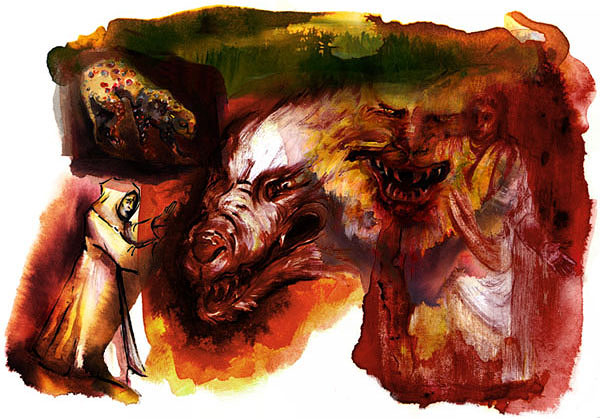
In order to discuss a comparison between the two works, I’ll briefly summarize the canto in which Cerberus was first introduced. We are now in Canto 6 of Inferno and in this canto Dante and Virgil are surrounded by sinners who are there for gluttony. The scene of this canto is described to always be raining. The first description of Cerberus is also introduced in this canto “Cerberus, cruel, monstrous beast, with three throats barks doglike…his eyes are red, his beard greasy and black, his belly large”(Inferno, canto 6) however, one thing to take note is that Cerberus himself is considered a glutton. It is safe to assume that Cerberus is a glutton because Virgil picked up earth and threw it at Cerberus. One depiction of violence in this canto is that Cerberus mauls and chews upon the souls in this part of hell. This creature helps fulfill and deliver the punishment upon the sinners.
In J.K. Rowling’s Harry Potter, there is also a Cerberus-like creature that has an uncanny resemblance to the image in Dante’s Inferno. In her book, Cerberus is also known as “Fluffy” who guards a chamber that protects a stone. As soon as I read Dante’s description of Cerberus, I immediately thought about Fluffy. Canto 6 is very closely depicted in this book; Firstly because the gluttons are the Dursleys (those who adopted harry potter). An example of them being a glutton is when Dudley(Mr.Dursley’s son) eats Harry’s birthday cake without any permission. I believe that Albus Dumbledore is similar to that of Virgil because he is always guiding Harry throughout his life.
To help you better understand what I mean to explain, here is an example:
Click here for an image of fluffy from harry potter
The way that Cerberus or “Fluffy” is depicted in the film of Harry Potter and the Philosophers stone is almost exactly the same as the description from Inferno. The only difference is that the eyes aren’t red, however the gnarling teeth is a dead giveaway. Also in this example, we can interpret Harry, Hermione, and Ron to be the sinners because Hogwarts follows a house points rule:
“Points are given or taken away to reward or punish the behavior of students. Points are accumulated over the course of the school year, at the end of which a House Cup is awarded to the house with the most. Giant hourglasses set in niches along one wall in a corner of the entrance hall record the points for all to see; Gryffindor’s is filled with rubies, Ravenclaw’s with sapphires, Hufflepuff’s with diamonds, and Slytherin’s with emeralds. As a teacher or other authorized party speaks the words awarding or deducting points, the appropriate hourglass or hourglasses are automatically updated (Harry Potter Lexicon, 1”
With that being said, the house point rule is another reason why I believe that J.K Rowling took inspiration from Dante in order to create the harry potter series. The way I interpreted this is that the teachers and faculty at Hogwarts are given the same role that Dante and Virgil have, which is judging those sinners and punishing them based on what they’ve done. The sinners being the students and the punishment being the amount of points that have been deducted.
Here I will discuss a few brief similarities between Inferno and Harry Potter. The first is that the character Argus Filch seems to be stuck in limbo. I believe this is true because he is seen as a character that is neither good nor bad, he simply exists. Argus in some ways is similar to Virgil because he has the role of caretaker in Hogwarts which in relation to the Divine comedy, Virgil is like a caretaker to Dante. The theme of justice can be seen in the movies because Argus is seen trying to ensure that everything that happens in the school is running smoothly. He is the authority that justifies whether or not people deserve to be punished.
One doesn’t have to wonder very much to realize that the divine comedy is filled with metaphors. Something that has come to my attention while studying the divine comedy is the realism that is within Dante’s works such as inferno, Purgatorio, and Paradiso. Dante’s imagination is self-evident where he expresses themes of corrections and punishments towards individuals who he has encountered sometime throughout his life. Some people that he has mentioned as part of the “sinners” group as I like to call include; Pope Boniface VIII, Farinata.
To compare, the character’s from the Divine comedy and Harry potter in my opinion is something that was obvious in the sense that they are the same. I’ll start by firstly discussing how Harry himself is the same as Dante. All of the comparisons that I’ll talk about are from the Harry potter films rather than the books because I believe that they have a higher interpretation than the print version. As I read inferno throughout the semester, I couldn’t help but notice that Dante is always in some kind of journey just like harry. The subject of mortality also came to my mind when Dante mentions in canto 1 lines 58-59 “I did not endure it long, yet not so little that I did not see it emitting sparks all around”, here he is telling us (the reader) that he is a mortal however he does claim that he knows more than the average mortal. Dante reveals his desire to transcend his own mortality and this is similar to Harry’s character because he also seeks to become a greater wizard and is also on a journey with his friends. Despite this similarity, there is also another thing that is significantly different about Harry’s journey that separates it from the journey of Dante. Dante was initially prevented from crossing a river by his distinguishable attribute, only to be rescued by divine will. Contrarily, Harry’s attribute is exactly what allowed him to cross the river in the film.
Another main character that I’d like to compare to Dante’s Divine comedy is professor Snape. If I were to place him in Dante’s comedy, I would place him in the second circle along with a couple of notable characters from history such as Tristan, Helen of Troy, Cleopatra. In this second circle of inferno, Dante and his master Virgil find some people who were overcome by the sin of lust as Dante thinks:
“Here Dante explores the relationship–as notoriously challenging in his time and place as in ours–between love and lust, between the ennobling power of attraction toward the beauty of a whole person and the destructive force of possessive sexual desire. The lustful in hell, whose actions often led them and their lovers to death, are “carnal sinners who subordinate reason to desire” (Inf. 5.38-9). From the examples presented, it appears that for Dante the line separating lust from love is crossed when one acts on this misguided desire.”(Danteworlds).
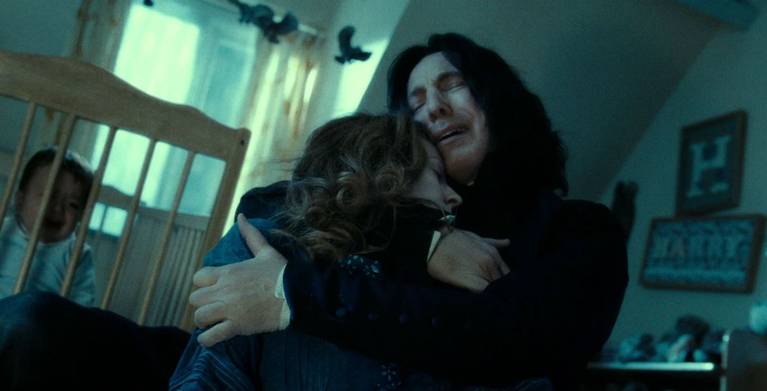
In one of the harry potter films, it is revealed to the audience that Snape loved Lilly who was harry potters mother. Although harry, Hermione, and Ron all looked at professor Snape as something of a villain, he actually had a bit of love towards harry but for the wrong reason. It is because he had both love and lust for his mother that he felt the need to somewhat care for him since he lost the relationship between himself and Lilly when he called her a “mudblood”. To conclude this character, he belongs in Dante’s inferno because his actions led Lilly to die back when Harry was a baby and led to his own death in the end of the Deathly Hallows.
Click here for image of Snape holding Lilly
Here in this image we can see Snape’s self-proclaimed love for Lilly which made him somewhat of a secret guardian to harry.
Another character that I’d like to place in Dante’s inferno is Lucius Malfoy. I wouldn’t simply place him because he was obviously evil and followed the “dark lord” as most would refer him to. But more specifically, I would place him in the 4th circle which pertains to avarice and greed. In this circle, you can picture the souls of people who jousted over their earthly possessions. In this circle, Dante says to see many clergymen which include the popes and cardinals such as Lucius Malfoy who is a cardinal for lord Voldemort. I think that Lucius belongs in this specific circle of hell because his hunger for desire, wealth and power turn him to the dark side. This backfires back to him because when he saw that the dark lord was being defeated and saw that his son may have perished, you can see the fear in his face which is strange since he always seemed like a strong and confident character.
In the next circle of hell which would be the 5th, I would place the character Bartemius Crouch JR. the following is a brief definition from the danteworlds website:
“Like the fourth circle of hell, the fifth circle–presented in Inferno 7 and 8–contains two related groups of sinners. But whereas avarice and prodigality are two distinct sins based on the same principle (an immoderate attitude toward material wealth), wrath and sullenness are basically two forms of a single sin: anger that is expressed (wrath) and anger that is repressed (sullenness).”
Bartemius was sent to Azkaban by his own father Barty SR. He was sent to Azkaban would could be the contrapasso for him in this scenario for torturing the Longbottoms. Barty jr’s hatred for his father and the world is what drove him to release his anger with evil with the help of the dark lord. The repressed hate that he has for his father is the reason why he becomes wrathful and eventually place him in the 5th circle in my opinion.
Finally, the last character that I’d like to discuss is Belatrix Lestrange. This character is probably by far the most cruel and violent character throughout the whole series of harry potter. She is the cousin of Sirius Black who ironically is Harry’s godfather. I would easily place her in the 7th circle of hell. I say that she belongs there because the 7th circle is indeed where the violent sinners go. She is the kind of character who enjoys, loves, and craves to torture her poor victims and pain is her pastime. Another way we can view her is by being the dark lords most loyal, evil, violent, and destructive supporter.
I think it’s amazing that I was the first one in the class that noticed the relationship between the harry potter movies and Dante’s divine comedy. There were plenty more relationships that I could’ve paired up such as linking peter Pettigrew with betrayal and ending with lord Voldemort himself with treachery. To conclude, knowing Harry potter films and to have read the books is in my opinion very helpful for understanding Dante and his inferno, Purgatorio, and Paradiso because I now can link some of the images to a few scenes.
sources
Dante’s Inferno – Circle 2 – Canto 5, danteworlds.laits.utexas.edu/circle2.html.
Gibbons, David. “Alimentary Metaphors in Dante’s ‘Paradiso.’” The Modern Language Review,
vol. 96, no. 3, 2001, pp. 693–706. JSTOR, www.jstor.org/stable/3736739.
Z., Amy, et al. “House Points – The Harry Potter Lexicon.” The Harry Potter Lexicon, www.hp-lexicon.org/thing/house-points/.