Author Archives: Manya Gaver

Dante et le Donne: A Comparison of the Treatment of Women between Dante Alighieri and Christine de Pizan

Dante et le Donne: A Comparison of the Treatment of Women between Dante Alighieri and Christine de Pizan

            The representation of women by the Italian poet Dante Alighieri in his Divine Comedy can be said to be lacking substance. Dante has no trouble creating interesting and complex men throughout the three canticles, such as his nuanced portrayal of Ulysses or the ambiguity of which he has Ugolino tell his story. While the episode with Francesca da Rimini in Canto V of The Inferno has been the inspiration for artists and writers since it’s appearance in The Divine Comedy, there are few fully fleshed out women in the work afforded the opportunity to speak for themselves. Thomas Goddard Bergin claims that “the range of female characters in the Comedy is limited because the range of a woman’s activities in Dante’s time was limited” (Bergin 85). While Bergin is not incorrect about the limitations put upon women during Dante’s time, I disagree when he says that “we should give thanks rather for the few [fleshed out female characters] we do have” for which he lists five and then proceeds to posit that these five are “as varied a group as a medieval poet could have given us”. He finishes the chapter by claiming that Dante could include more fleshed out female characters if he wrote today [Bergin was writing in the late 1960s] but then ended on the rhetorical question “can a woman’s world produce a Divine Comedy?” (Bergin 86). I obviously take umbrage with this idea and how easily Bergin “lets Dante off the hook” for his lack of female representation in The Divine Comedy. Dante mentions a fair number of women, but he does not take the time he could have to write them as fully realized human beings in the same way he does with the men. Bergin’s excuse that women in Dante’s time did not lead lives that would not translate well into fictional representations does not hold water. Using The Book of the City of Ladies by Italian writer Christine de Pizan, I will give three examples of where Dante Alighieri had the opportunity to create fully realized female characters but chose to overlook them. I will also observe the similarities and differences between the way that the two authors write about these same women.

Christine de Pizan was born in Venice in 1365, exactly 100 years after the birth of Dante Alighieri, meaning that the two were obviously not contemporaries. They are connected through the poet Boccaccio who wrote De Mulieribus Claris which Pizan directly references throughout The Book of the City of Ladies. Christine de Pizan grew up in the French court of Charles V where her father was an astrologer. She was afforded access to an extraordinary education and became one of the first professional female writers in the western hemisphere after the deaths of her father and husband. We know for certain that Christin de Pizan knew about Dante and had read at least part of The Divine Comedy because she directly refers to Dante’s first meeting with Virgil in her poem Chemin de long estude (The Book of the City of Ladies xliii). The Book of the City of Ladies is her defense of women in reaction to the multitude of manuscripts that go out of their way to vilify all women. Pizan gives examples of many virtuous women within the book and also finds ways to acquit some of the most infamous women found in history and mythology history. Many of these women are also mentioned by Dante without that same depth afforded to them. While neither Pizan nor Dante creates a situation where these women are allowed to speak for themselves, the ways in which they write about their stories, or don’t write, about their stories are vastly different.

The first woman I would like to look at is Arachne, a weaver who according to myth challenged Minerva to a weaving contest and was turned into a spider for her hubris. Dante puts her at fault when he writes:

oh mad Arachne, so I saw you, already half a

spider, sitting wretched on the shreds of the work

you made to your own ruin! (Purgatorio 12.43-45)

Dante does not see any reason not to question Minerva’s punishment of Arachne nor does he afford her the opportunity to speak about the unjustness of her fate. Dante does allow other characters from mythology to speak, such as Ulysses, so the problem isn’t that her story involved a pagan religion. On the other hand, Christine de Pizan calls Arachne’s story a fable but also claims that she “was the first to invent the art of dyeing woolens in various colors and of weaving art works into cloth, like a painter, according to the ‘fine thread’ technique of weaving tapestry” (Pizan 81). Pizan then goes on to defend Arachne against authors such as Bocaccio who claimed that the world would have been better off without a knowledge of weaving by saying that Jesus Christ’s use of robes proved that weaving was a good and lawful occupation. Although I don’t know if the debate about the merits of weaving existed during Dante’s time, I still think that the comparison between the brief mention of Arachne where he blames her for her fate verses the praise and validation that Pizan grants her speaks volumes about the difference in their relationships with women.

The absence of Dido in The Divine Comedy is fairly conspicuous considering how large a role she plays in The Aeneid.  How interesting would it have been to have Virgil come face to face with Dido, whose story he immortalized? Instead, Dido is relegated to a passing mention in Canto V of The Inferno where she is oddly placed in the circle of Lust even though she committed suicide. Bergin also raises this question, since the general logic in The Divine Comedy is that people are put in the circle that corresponds with their worst sins. Bergin asserts that

Dante saw the three Oriental queens [Dido, Cleopatra, and Semiramis] as lustful creatures first and foremost because it in was the love relationship, and that alone, that he thought of women. … we find the souls of women only in the circles of lust, flattery, and soothsaying. (Bergin 70-71)

On this point I don’t disagree with Bergin. I think that he is right to say that Dante only sees women in their context with men and the ways that they can manipulate them. It seems almost irrational that Dante would put Dido in the circle of lust instead of the forest of suicides since doing so could create a dramatic situation like no other. In comparison, Christine de Pizan speaks for a considerable amount of time about how wise and clever Dido was, giving the readers a few examples including her trick of acquiring the land for Carthage by cutting a cow hide into a very thin strip. Christine de Pizan claims that “because of her prudent government, they changed her name and called her Dido, which is the equivalent of saying virago in Latin, which means ‘the woman who has the strength and force of a man’ (Pizan 95). It is only later that Christine de Pizan mentions Dido’s time with Aeneas and subsequent suicide. She does not reduce this strong and wise Queen to a lovesick woman who was driven only by her carnal desire. How powerful could it have been to have another tree alongside Pier della Vigne to show the fate of those who commit violence against themselves?

The oddest mention of a woman I am going to discuss today is the way that talks about, or rather doesn’t talk about, Medea. Her name is mentioned once in the eighteenth canto of The Inferno when it is said that Jason is being punished in part for his crimes against her. Medea is mostly known for killing the children that she had with Jason, but she is not found in the deepest circles of hell alongside those who murder family members. I haven’t been able to discern why she would be absent from that group of people. It is possible that the version of her story that Dante knew did not include her murder of her children since not all of them did. I wish I had more time to investigate this glaring omission since it raises so many questions. Christine de Pizan also handles Medea in an interesting way. She praises Medea for her wisdom and knowledge of herbs and medicine, along with mentioning the assistance she renders Jason during his quest for the Golden Fleece but also omits the small fact that she killed her children. Like with Dante, it is possible that the version of Medea’s story that Christine de Pizan knew did not include that detail. With Christine however, I am more inclined to believe that this is a lie of omission rather than a difference in story version. There are a few points within The Book of the City of Ladies where Christine will not mention the more unsavory details of the lives of the women that she is defending. Regardless, thinking over this question has made me curious about the other ways Medea has been represented in literature throughout human history.

After comparing the ways Dante Alighieri and Christine de Pizan discuss the same women in their works, I find myself almost mourning The Divine Comedy we could have had. In omitting women as much as he did, Dante did himself and his life work a disservice. Including women in the full compacity of which he included men would have made The Divine Comedy an even better work. I wish that I had a strong point to make as a solid conclusion to this paper, but it was almost impossible for me to find something to argue. Instead, I decided to question how Dante addressed women compared with another medieval writer I was interested in. I think that there is more work to be done in this area that was just outside of the scope of my paper and hope that I may end up being the one to continue the investigation.


Works Cited

Alighieri, Dante. The Divine Comedy of Dante Alighieri. Edited by Robert M. Durling et al., Oxford University, 1996.

Bergin, Thomas Goddard. A Diversity of Dante. Rutgers University Press, 1969.

Pizan, Christine de. The Book of City of Ladies. Edited by Earl Jeffrey Richards and Marina Warner, Persea Books, 1982.


Second Reflection Post

Since my first reflection post, I have only written two blog posts (along with detailed comments that I wrote instead of blog post 7). Regardless, reading over those two posts and thinking about my personal engagement with the text I have a few observations.

My first observation, which I could have included in the first reflection post, is that  I am very reluctant to write about works of art. I am much more comfortable analyzing literature since I have experience doing so. I struggle to analyze art, even in comparison to literature, since I don’t even know the correct vocabulary to do so. I seem to have made the unconscious decision to focus mostly on what Dante writes and then supplement it with a painting rather than focus on the painting alongside the poetry. While I am always an advocate of pushing oneself to try something more difficult, I also kept finding myself spending too much time trying to discover the meaning of the painting over the meaning of the text.

I did find the guided questions we had to answer about art at the Metropolitan Museum of Art to be very challenging and instructional. Having guided questions to focus on helped me, although I still felt very lost at some points trying to answer them. I ended up writing over a thousand words and still did not feel satisfied I had answered all of the questions in their entirety when I submitted the post. The post actually would have been a lot longer but I edited out any observations I made that did not directly relate to the questions being asked. After reading other peoples posts about their Met visits I am not sure if I made the right choice in doing so but it is the choice I made all the same.

My other major reflection isn’t so much related to the blog posts as it is related to how I am engaging with the text. I personally have been struggling to find the same deep interest I had with Inferno while reading the later two canticles. I am somewhat of a completionist, meaning I have a hard time skipping around and not studying things in their complete original order. My mom loves to poke fun at me for it. I have to read book series in order starting from the beginning even if there is no connecting plot between the books. I mention all of this seemingly unimportant information because I am still trying to discover why I am struggling so much to engage with the text and find ways to do so. In a perfect world, I would just read the parts we aren’t assigned but doing so initially left me with even more confusion. If anyone else has had this problem and has any suggestions I would love to try any ideas out.

Dante and Beatrice on Earth and in the Earthly Paradise

Dante’s first known work, Vita Nova or New Life, heavily centers around the relationship, or lack thereof, between Dante and Beatrice. As I mentioned in a previous post, my first academic encounter with Dante was Vita Nova. I was, and still am, fascinated by the one-sided relationship Dante seems to have with Beatrice in Vita Nova which seems to expand into more of a reciprocal relationship in Purgatorio. I say this because in Vita Nova Dante and Beatrice only have a few interactions of little to no consequence other than in Dante’s mind. I remember wondering last year if Beatrice would have even known who Dante was or just vaguely recognized his face if they passed by each other on the street.

When Beatrice finally comes to Dante’s side for the first time in La Commedia, I immediately found my copy of Vita Nova* to see what comparisons I could find. I decided not to immediately read the Purgatorio footnotes for Canto 30 since I wanted to see what I could come up with organically, almost like a small test of my analyzing skills.

Both times Dante sees Beatrice for the “first” time (the true first time on Earth and the first time during his journey outside the earthly realm) he almost immediately describes her clothing. After three very long sentences in Vita Nova, amounting to about half a page, where Dante uses astrological terms to explain how old he and Beatrice are at the time of this first sighting, in the fourth he writes:

“She appeared, dressed in a very stately color, a subdued and dignified crimson, girdled and adorned in a manner that was fitting for her young age” (page 3).

In Purgatorio, Dante again immediately describes her clothing before he talks about her effect on him, writing:

“her white veil girt with olive, a lady appeared to me, clothed, beneath a green mantle, in the color of living flame” (lines 31-33).

Both times Dante sees Beatrice she is clothed in red. I have a note handwritten in my copy of Vita Nova that I am almost sure was information Professor Van Peteghem told us in class explaining that crimson was linked to grief after death during Dante’s time. If that is true, it juxtaposes the two shades of red perfectly. The first is linked to death and the other to the living flame.

The second time Dante sees Beatrice in Vita Nova he once again describes her clothing, writing that the “marvelous lady appeared to me dressed in pure white, between two gracious women, both of whom were older than she” (page 4). This white is again seen in the description of her veil in Purgatory. The two gracious women that Dante sees Beatrice accompanied by in this quote sparked my interest as well. In Canto 2 of Inferno, I had found it very odd that it took two intermediaries, St Mary and St Lucy, to intercede with Beatrice on Dante’s behalf so that she would ask Virgil to help him. It is a possibility in both cases that Dante has the total be three women due to the holiness of the number three, however, I am curious if there might be a link between the two women Dante sees Beatrice with in Vita Nova and the two women that are intermediaries to Beatrice in Inferno.

Unfortunately, I could not find any mention of the color green in Vita Nova which makes this comparison fall just a little short. I went as far as to find a digital copy and keyword search everything I could think of, including mentions of olives and leaves, which was to no avail. Never the less, I am still satisfied with the comparisons I did find between Vita Nova and Purgatorio.

*All quotations from Vita Nova are from the Andrew Frisardi edition published in 2012.

Paper Idea: I would like to examine the similarities and differences between any women represented by both Dante and Christine de Pizan if you think it is a good idea for a paper.

First Reflection Post

After reading through my previous posts I’ve noticed that I tend to bring bits of information I learned in previous classes into my observations about The Inferno. Having already taken a class on Dante I do have some relevant knowledge to draw upon, as seen in posts 1, 3, and 5. For post 2 I drew upon a class I took on Greco-Roman mythology where we discussed the gorgons in depth. Post 4 is alone in that it does not directly draw upon a class I had taken before this semester. Instead, I referenced a book that I have been reading alongside The Inferno which is fairly similar to referencing previously learned information.

I’ve also observed that I tend to have more to say if I focus in on just one terzina and explore the background and meaning of those three lines in depth. Having a small moment to focus on makes it much harder for me to devolve into generalities that I can’t find textual support for. There are so many layers to La Commedia that a small portion of text has many different facets to be observed and commented upon.

In the future, I would like to focus on connecting my comments and observations on the current weeks reading with what we have read in the past. While I don’t necessarily want to stop focusing on the smaller details I would like to take my observations a step further and try to connect them to the larger text.

The Donation of Constantine and an Unintended Mention of Fraud

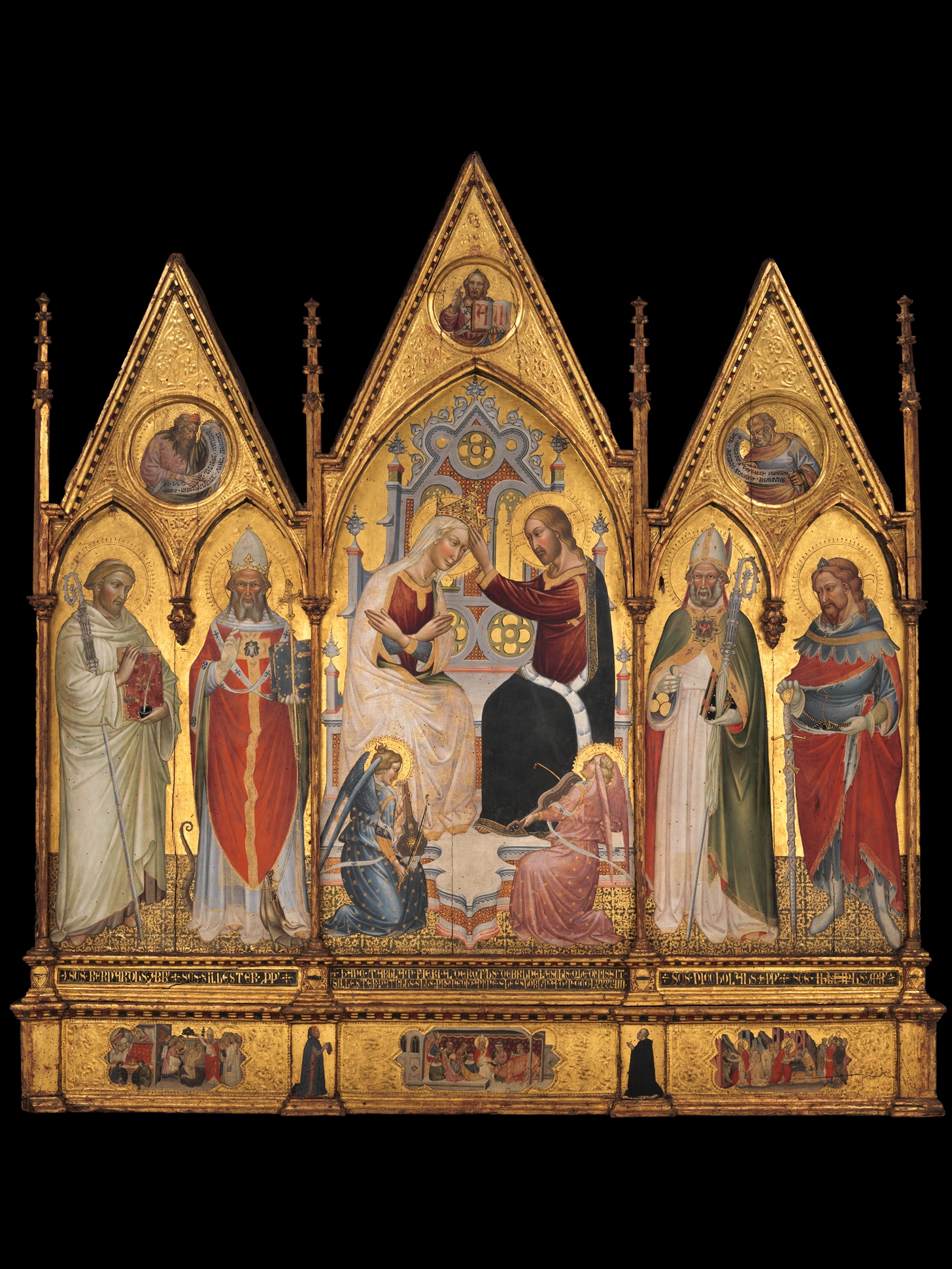
Altarpiece by Giovanni di Tano Fei depicting the Donation of Constantine on the predella. Photo from the website of the Metropolitan Museum of Art, altarpiece not currently on display.


When trying to decide the genre of La Commedia many scholars, including Giuseppe Mazzotta, make an argument that La Commedia is an encyclopedic work since it references many important classical works by authors such as Ovid and Homer as well as important biblical and historical events known to Dante. While reading on my iPad I have to have the footnotes of our copy open on a computer for quick reference and find myself frequently googling to find more information. Reading La Commedia is not just a poetic experience but also an intellectual journey through the classics and history. A short reference in  Canto 19 to the Donation of Constantine reminded me of the encyclopedic style of La Commedia that I think is an excellent example of Dante’s style.

Canto 19 takes place in the third pouch of the eight circle of Hell which holds the simonists. Simony is the sin of selling church offices or indulgences placing monetary gain on the earthly realm over spiritual virtue. The contrapasso in this canto places sinners upside down in mock baptismal fonts with fire on their feet. The simonists are inverted in Hell because when they were living these sinners had their priorities inverted, placing monetary and political gain over the salvation of their mortal soul. A note in my copy mentions that the anointing of their feet with oil is a reference both to Jesus being anointed with oil in the gospels as well as to four of the seven sacraments which require being anointed with oils.

While there are many things I could write about this canto, I am going to focus on just one terzina found in Canto 19, lines 115-117 in which Dante writes:

Ah, Constantine, not your conversion, but that

dowry which the first rich father took from you, has

been the mother of so much evil.

This terzina, discussing the Donation of Constantine, was the first example of the encyclopedic nature of Dante’s Commedia I was introduced to and whose layers I find fascinating.

The Donation of Constantine was an event that was thought to have taken place in the 4th Century AD. The story was that the Emperor Constantine the Great had contracted leprosy and was healed by Pope Sylvester after being converted and baptized. Grateful to Pope Sylvester, Constantine gave the Church parts of his empire, including sites important to the Church such as Jerusalem and Rome with an imperial decree documenting this transfer of power.

Canto 19 lines 115-117 is not the only time Dante wrote about the Donation of Constantine. In an earlier uncompleted treatise on the nature of power titled De Monarchia (3.10.1) Dante writes extensively about whether the Catholic Church or the Empire should have supremacy over the other. Many scholars in Dante’s time used the Donation of Constantine as evidence why the Pope should have authority over the Emperor. Dante disagreed, arguing that the land was not Constantine’s to give nor Pope Sylvester’s to accept. The terzina quoted above is Dante holding Constantine responsible for the many evils done by Popes that were justified by the Donation of Constantine. In just these three lines, Dante references not just a historical event but also a current debate in his time. While one does have to know the background about the Donation of Constantine to truly understand the point Dante making, the multiple layers of reference still make La Commedia an encyclopedic work in my eyes.

During Dante’s lifetime, the Donation of Constantine was believed to be a true event that undoubtedly occurred. It was only in the 1400s when two priests, Lorenzo Valla and Nicholas of Cusa, analyzed the Latin used in the document and proved that the Latin was far too modern to have been written in the 300s when the Donation of Constantine was said to have taken place. Although Dante was proved right when he wrote that the Donation of Constantine did not give the Pope power over the Emperor, it was not for the reasons Dante argued but that the event did not actually happen.

Curiously, the placement of a reference to the Donation of Constantine in Canto 19 of Inferno is unintentionally perfect on Dante’s part. Virgil and Dante have just left sinners who commit violence using intellect or fraud in Canto 18 and are about to reach thieves in Canto 24. The forgery of the Donation of Constantine was an act that I would classify as violence using intellect or in a broader term fraud as well as a theft of power from those who held it by dishonest means. Putting a reference to the Donation of Constantine between those two types of sins is unintentionally genius since the forgery is a marriage of those two sins. Of course, Dante did not place this reference here knowingly since he believed that the Donation of Constantine happened. Regardless, I believe it is worth mentioning as an interesting observation even though it is undoubtedly without intent.

The image above is an altarpiece in the Metropolitan Museum of Art’s collection which is not currently on display but has been previously. The bottom of the three panels depict the events leading up to and including the Donation of Constantine. The altarpiece was recently on display and the details were much clearer when I saw it in person last year. Once it is back on display to the general public I would encourage anyone to go see it in person since the altarpiece is much larger than it appears in the photo and exquisitely detailed.

The Father Figures of Dante

Canto 15 of The Inferno focuses on the third part of the second circle of Hell, those who commit crimes against God. In this part of Hell Dante and Virgil find Brunetto Latini who was a very important teacher to Dante in his youth. The shade of Latini refers to Dante as his son twice, on lines 31 and 37, and Dante refers to the shade of Latini as a “kind paternal image” on line 83 further cementing their father/son relationship. Although it may seem odd that Dante would put such a revered father figure in Hell, Latini is not the first father figure Dante comes across on his journey. In Canto 10 Dante and Virgil find Cavalcante de’ Cavalcanti in the sixth circle of hell among the heretics. As the father of Dante’s first friend, Guido Cavalcanti, there is a subtitle father/son dynamic underscoring their meeting although I have not been able to isolate a good quote to definitively prove that.

The appearance of two father figures of Dante in Inferno begs the question, where is Dante’s biological father? Nowhere. Neither of Dante’s parents are mentioned in his works which is curious since so many important people in his life to appear throughout The Commedia. Why would Dante omit his parents?

Reading Dante by Giuseppe Mazzotta gives the interesting and tantalizing fact that Dante’s father, Alighiero di Bellincione, was accused of usury but is not found among the usurers. While it is important to note that Dante’s mother, Bella degli Abati, is also not mentioned in his works she also died when Dante was around 5 or 6 years old, meaning it is very possible that Dante had few memories of her. Given that Dante’s father died when Dante was 18 years old, the combination of Dante’s condemnation of usury, a crime that, according to Mazzotta, was used by other poets as a way to slander Dante and imply that he did not come from a good family could be seen as a strong condemnation of his father. A very common theme in all of Dante’s works is an anxiety about how others think of him and how his fame will survive once he is gone. For someone so concerned with what other people think of him and who values the worlds memory of himself so much that being remembered is one of the things Dante takes away from those who are in Hell, it is not a baseless hypothesis to suggest that Dante would be very bothered by the insinuations against himself and his family. Dante might not have wanted to admit to the world openly that his father was guilty of usury but could not resist severely condemning others guilty of the same crime to separate himself and his fame from that of his father.

The end of Canto 16 has a passage that has caused many debates between scholars as mentioned in the notes of our book. Lines 106-114 detail a moment where Dante unties a chord which he gives to Virgil to use as a tool to help them descend lower into the inferno. This moment seems to be unrelated to the discussion about Dante and his father above but our notes give the additional context that early commentators thought that the chord Dante unties represents fraud, mentioning that it could be either the inclination to commit or history of committing fraud. Given that Dante’s father was accused of usury, a form of fraud, could this be an admission by Dante that the accusations against his father were not only true but also that Dante himself assisted in that fraud? Or could it symbolize Dante freeing himself from the shame he felt due to his father’s crimes since the sins of the father should not fall upon the son?

The conspicuous absence of Dante’s biological father paired with the way that Dante highlights father figures in his life throughout his works begs a question about the relationship the two men had. This is a question that probably will never be satisfyingly answered but I plan on looking for other representations of the father figure throughout The Commedia to see what there is to find.


Bleeding trees and the dehumanization of those who commit suicide.

Gustave Doré, The Inferno, Canto 13 from Wikimedia Commons

One terzina that struck a chord with me is from Dante’s Inferno Canto 13 lines 37-39. Dante and his guide, Vergil, have reached the second subcircle of the seventh circle of hell which is reserved for those who commit violence against themselves. Dante the pilgrim is confused by the dark woods that surround him which seem to bleed and cry. Dante assumes that there are people hiding in the bleeding trees and that the voices he hears are coming from the people hiding. Vergil urges Dante to break a twig off of one of the plants since doing so will allow the tree to answer Dante’s question of where the voices are coming from. The pain that Dante causes to the tree leads to one of my favorite moments this far in the Inferno when the tree questions why Dante would cause him such pain. The tree tells Dante and Vergil that:

We were men, and now we have become plants:

truly your hand should be more merciful had we

been the souls of serpents.” (Canto 13 lines 37-39)


I’ve been meditating on these lines for a few days trying to look through the layers Dante the writer placed on this verse. Our commentary mentions that to Dante there are three separate levels of living creatures. The lowest are plants which are living creatures with only vegetative abilities. Above plants are animals which have both vegetative abilities and what the notes call animal the animal abilities which include movement and senses. The highest form of living creature is humanity. Humans have all the abilities of animals but also have intelligence and the possibility of rational thought.

In the tree lines quoted above, Dante the poet has the tree take the soul of a suicide victim through the three levels of living creatures. First we are reminded that these trees were once men, the highest of all living creatures. In the same line it is reinforced that they have become trees, the lowest of all living creatures. In the next two lines, Dante the writer through the voice of the tree, reminds the reader that there is a middle level of living creature which is the animal.

In mentioning all three levels of living creatures within three lines, Dante the writer is making a point that the souls of those who commit violence against themselves become the lowest of all living creatures. The point is made crystal clear by Dante mentioning the middle level of living creature, the animal, showing that the souls of suicide victims don’t just go down one level but are placed at the lowest level. This is a clear indictment by Dante the writer of those who commit violence against themselves.


Dante’s Lack of Sympathy in Cantos 6-9

I am struggling a bit with this prompt because I don’t find that Dante has much sympathy to give the damned in Cantos 6-9. Perhaps I am misreading the text but compared to the sympathy I perceived him to have for Francesca and Paolo, to the point where he fainted after witnessing their plight, the under current of emotional reaction is missing in my readings of these canto. Unfortunately, it is hard to find textual examples of a lack of emotion so instead I will focus more generally on his depiction of the Gorgons (or Erinni, they are described as Gorgons but labeled as Erinni elsewhere), found in Canto 9 lines 37-57. The story of Medusa and her sisters, found mostly in Ovid’s Metamorphosis 4.606-5.249 is heartbreaking in my opinion although apparently not to Dante. The story is basically that Neptune, God of the Sea, raped Medusa in the temple of Minerva. This angered Minerva causing her to punish the rape victim instead of her uncle the rapist by turning her into a woman with snakes for hair who could turn anyone who looked her in the eye into stone. She is later slain by Theseus who is assisted by the Gods. The mention of Medusa, who does not make an appearance in this canto, implies that she is in Hell suffering for her “crimes”. Unlike Francesca and Paolo, whose “crimes” were also sexual in nature and who Dante has the upmost sympathy for, there is no weeping or fainting over Medusa. While I understand Dante is told by Virgil to fear Medusa it is possible to both fear and pity someone. We can almost certainly say that Dante (the Poet) was very familiar with the works of Ovid since he references them countless times and therefore must have known the story of Medusa. The concept of rape has changed over time and neither Ovid nor Dante (the Poet) may have considered Medusa a rape victim. However, this isn’t the only instance of Dante’s lack of sympathy in Cantos 6-9. I will be paying closer attention to who Dante sympathizes with throughout Inferno and who he condemns.


Inferno Canto 9 Verse 46. Engraving by Gustave Doré found in an edition of the Divine Comedy on Project Gutenberg. Both book and artwork are in the public domain.


Dante and Beatrice the Love that never was Assignment 1

Note: I could not find a good picture of Dante and Beatrice in Inferno. Instead of choosing a representation from Purgatorio or Paradiso I decided to use a painting depicting a scene from the Vita Nova for reasons I hope will become apparent in my post.

Last spring I took a course on the “minor works” of Dante which basically means everything but the Commedia. I wouldn’t call them minor works since they were some of the most challenging and fascinating things I had read at the time.

Our first work, Dante’s Vita Nova, especially captured my attention due to its focus on his unrequited love for Beatrice. I wont go into too much detail here but in summery her greeting of him is a blessing which at one point she denies him. This is depicted in the painting I decided to attach to this post. Eventually Beatrice dies tragically sending Dante on an introspective journey. I highly recommend the book to anyone who likes the Commedia.

Beatrice Meeting Dante at a Marriage Feast, Denies Him Her Salutation by Dante Gabriel Rossetti

The relationship, or lack there of, between Dante and Beatrice captured my attention and interest. I was fascinated by his idealization of this woman who he really hardly knew. So, when she appeared in the second canto of Inferno I paid very close attention to her.  From lines 43-142 in Canto 2, Beatrice describes how she came to assist Dante (the Pilgrim) in the start of his journey.

What captured my interest about this passage to the point of reflecting on it in my post is that Beatrice did not come on her own volition. There were two intermediaries that inspired Beatrice to go to the man that so idealized her. The Virgin Mary heard of Dante’s sufferings and fears. She spoke to St. Lucia who then went to Beatrice to ask her to help Dante (the Pilgrim)  throughout his journey. While I recognize that the number three is important in the Christian world and especially the works of Dante (the Poet) I can’t help but be curious about the Poet’s choice to not have Beatrice come directly to his aid but rather require the Virgin Mary and St Lucia to ask her to assist him. I think that a parallel could be drawn between her not giving him the salutation (and by extension blessing) during Vita Nova and her not originally intending to give him her assistance (or blessing him with aid) during Canto 2.

About above photo: Painted in 1855 by the appropriately named Dante Gabriel Rossetti who painted many scenes from the Vita Nova. This particular scene, which takes place in section 10 of Vita Nova, depicts Beatrice and Dante meeting at a marriage feast which she denies him her greeting which is akin to a benediction/blessing in Dante’s eyes. I found the water color, which is in the public domain, on Wikimedia Commons.
