Tag Archives: fraud

The Donation of Constantine and an Unintended Mention of Fraud

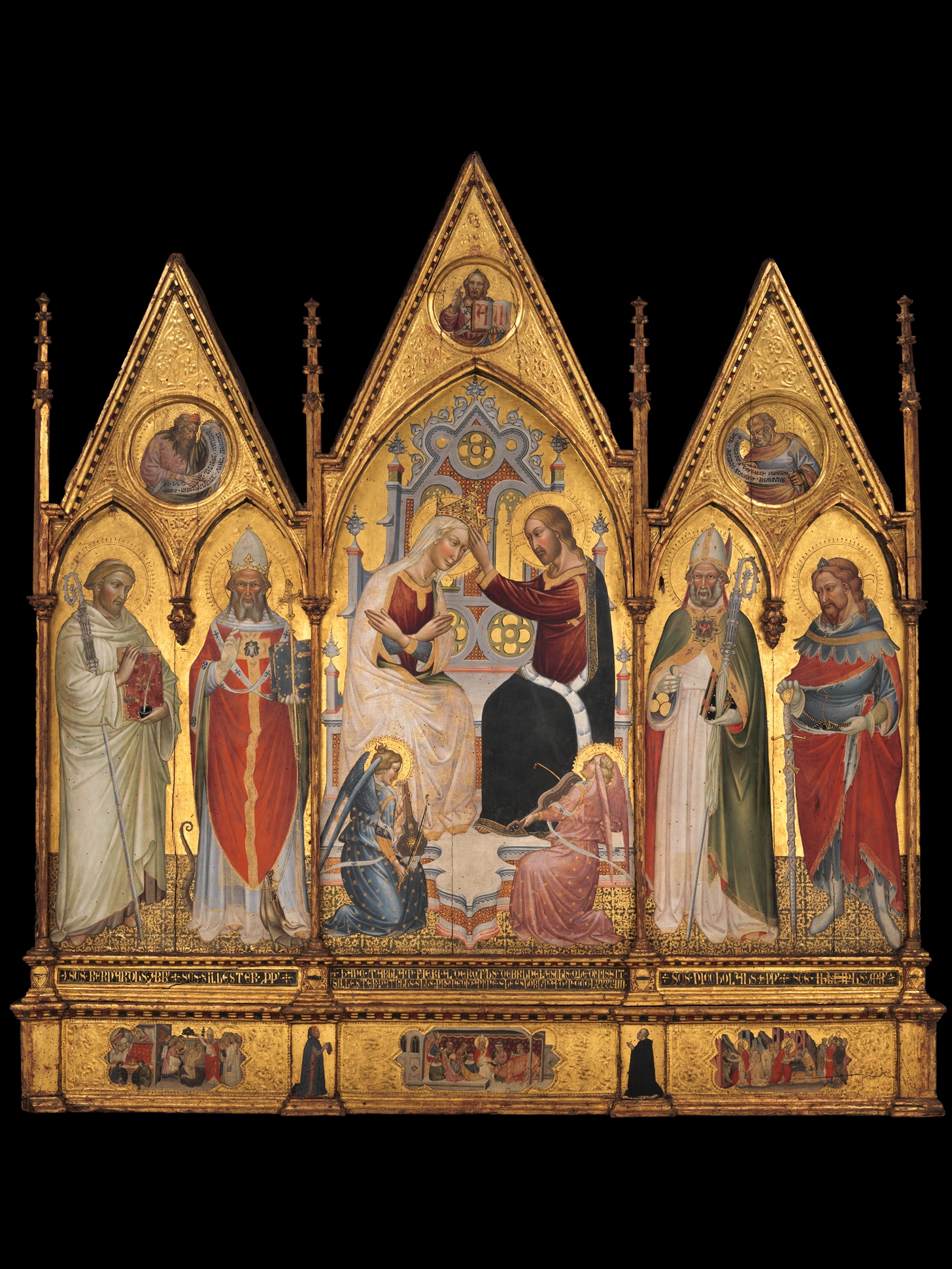
Altarpiece by Giovanni di Tano Fei depicting the Donation of Constantine on the predella. Photo from the website of the Metropolitan Museum of Art, altarpiece not currently on display.


When trying to decide the genre of La Commedia many scholars, including Giuseppe Mazzotta, make an argument that La Commedia is an encyclopedic work since it references many important classical works by authors such as Ovid and Homer as well as important biblical and historical events known to Dante. While reading on my iPad I have to have the footnotes of our copy open on a computer for quick reference and find myself frequently googling to find more information. Reading La Commedia is not just a poetic experience but also an intellectual journey through the classics and history. A short reference in  Canto 19 to the Donation of Constantine reminded me of the encyclopedic style of La Commedia that I think is an excellent example of Dante’s style.

Canto 19 takes place in the third pouch of the eight circle of Hell which holds the simonists. Simony is the sin of selling church offices or indulgences placing monetary gain on the earthly realm over spiritual virtue. The contrapasso in this canto places sinners upside down in mock baptismal fonts with fire on their feet. The simonists are inverted in Hell because when they were living these sinners had their priorities inverted, placing monetary and political gain over the salvation of their mortal soul. A note in my copy mentions that the anointing of their feet with oil is a reference both to Jesus being anointed with oil in the gospels as well as to four of the seven sacraments which require being anointed with oils.

While there are many things I could write about this canto, I am going to focus on just one terzina found in Canto 19, lines 115-117 in which Dante writes:

Ah, Constantine, not your conversion, but that

dowry which the first rich father took from you, has

been the mother of so much evil.

This terzina, discussing the Donation of Constantine, was the first example of the encyclopedic nature of Dante’s Commedia I was introduced to and whose layers I find fascinating.

The Donation of Constantine was an event that was thought to have taken place in the 4th Century AD. The story was that the Emperor Constantine the Great had contracted leprosy and was healed by Pope Sylvester after being converted and baptized. Grateful to Pope Sylvester, Constantine gave the Church parts of his empire, including sites important to the Church such as Jerusalem and Rome with an imperial decree documenting this transfer of power.

Canto 19 lines 115-117 is not the only time Dante wrote about the Donation of Constantine. In an earlier uncompleted treatise on the nature of power titled De Monarchia (3.10.1) Dante writes extensively about whether the Catholic Church or the Empire should have supremacy over the other. Many scholars in Dante’s time used the Donation of Constantine as evidence why the Pope should have authority over the Emperor. Dante disagreed, arguing that the land was not Constantine’s to give nor Pope Sylvester’s to accept. The terzina quoted above is Dante holding Constantine responsible for the many evils done by Popes that were justified by the Donation of Constantine. In just these three lines, Dante references not just a historical event but also a current debate in his time. While one does have to know the background about the Donation of Constantine to truly understand the point Dante making, the multiple layers of reference still make La Commedia an encyclopedic work in my eyes.

During Dante’s lifetime, the Donation of Constantine was believed to be a true event that undoubtedly occurred. It was only in the 1400s when two priests, Lorenzo Valla and Nicholas of Cusa, analyzed the Latin used in the document and proved that the Latin was far too modern to have been written in the 300s when the Donation of Constantine was said to have taken place. Although Dante was proved right when he wrote that the Donation of Constantine did not give the Pope power over the Emperor, it was not for the reasons Dante argued but that the event did not actually happen.

Curiously, the placement of a reference to the Donation of Constantine in Canto 19 of Inferno is unintentionally perfect on Dante’s part. Virgil and Dante have just left sinners who commit violence using intellect or fraud in Canto 18 and are about to reach thieves in Canto 24. The forgery of the Donation of Constantine was an act that I would classify as violence using intellect or in a broader term fraud as well as a theft of power from those who held it by dishonest means. Putting a reference to the Donation of Constantine between those two types of sins is unintentionally genius since the forgery is a marriage of those two sins. Of course, Dante did not place this reference here knowingly since he believed that the Donation of Constantine happened. Regardless, I believe it is worth mentioning as an interesting observation even though it is undoubtedly without intent.

The image above is an altarpiece in the Metropolitan Museum of Art’s collection which is not currently on display but has been previously. The bottom of the three panels depict the events leading up to and including the Donation of Constantine. The altarpiece was recently on display and the details were much clearer when I saw it in person last year. Once it is back on display to the general public I would encourage anyone to go see it in person since the altarpiece is much larger than it appears in the photo and exquisitely detailed.


” The Filthy image of Fraud”

A wood engraving of Geryon by Gustavo Doré.

Towards the end of canto 16, Dante notices a monster that rises from the depths of the water and this is Geryon. In Canto 17, Geryon is introduced as the monster, the “filthy image of fraud”. Geryon is a personification of fraud, (lines 10-15) “Its face was that of a just man, so kindly seemed its outer skin, and the rest of its torso was that of a serpent; it had two paws, hairy to the armpits; it had back and breast and both sides with knots and little wheels: …” He is described as a hideous beast that is used as the image of fraud. Dante uses a metaphor and compares him to a beaver because during medieval times the biologists thought that beavers caught fish by sticking their tails in the water and secreting some oily substance that the fish were fond of. Geryon is secreting “fraud” or in the words of Dante “Behold the one that makes the whole world stink!” (line 3) “Fraud makes all physical barriers and defenses (mountains, walls, and armor) useless”. It poisons the world with venom and humans do grow fond of fraud and end up committing it. People convince one another to commit fraud by promising that they will end up rich and live extravagantly and use deception for personal gain.

Geryon’s body represents the “chronological sequence of a fraudulent deal”.  Geryon’s initial appearance represents trust, the bright colors of his torso can confuse and by the end of the ordeal comes the sting which is either death or of loss. Geryon’s colorful torso is also related to the leopard’s painted skin that represents fraud.  In lines 25-27 Geryon is compared to a scorpion “In the emptiness all its tail was wriggling, twisting, upward the poisoned fork that armed it tip like a scorpion’s”.  Certain scorpions with rose tails symbolize a “double-edged sword” meaning that they can sting immensely or be pleasant. Both scorpions and Geryon have very venomous tails. In other words, Geryon can sting by deceiving someone with his honest face for his own personal interests or he can be somewhat helpful. In this canto, Geryon did help Virgil and Dante by taking them around the waterfall of the river Phlegethon down to the Circle of Fraud. Dante was struck with horror when Virgil requested a ride from the monster. As he climbed on Geryon he saw countless sinners suffering from above and was scared the entire time. Moreover, in Canto 3, Cerberus was introduced was a three-headed dog but is also “the great worm”; like Geryon they are both part snake. In Genesis 3, serpents are considered the first deceivers.

Canto 11 – A Brief Break to Explain the Organization of Hell/The Presence of the Number 3 and The Importance of Nature

Canto 11 reminded me of previous cantos where Virgil and Dante pause because Dante, the pilgrim, needs explanations and clarity from Virgil. This is a recurring technique of Dante, the writer, in which he allows the readers to mirror his character and gain answers to similar confusions that the pilgrim himself is experiencing.

While Virgil and Dante are resting, Virgil explains the organization of Hell in more depth. The organization also enables the reader to note how Dante, the poet, classifies the severity of certain sins over others. I thought it was compelling that the religious presence of the number three appears again in this Canto. First, Virgil tells Dante there are three smaller circles. Hell is separated into three parts. The first circle in middle hell is also divided into three subcircles where the sinners are separated into three groups based on the gravity of violence either committed against others, against oneself, and the worst, which is violence against God.

I was a little confused as to why Dante punishes sodomy as a worse punishment than the crimes committed by the lustful in Circle 2/Canto 5. But, when I reread Virgil’s explanations to Dante I gained more clarity. It is important to note that sodomy is a sin of violence. This means that Dante, the writer, does not punish sodomizers for their morality but more so because he views it as unnatural to the world. Dante the poet defines crimes against God as the most violent because they go against the natural will of life. Virgil states that sodomy and those who harm God scorn “nature and its goodness.” (Canto 11, Line 47). For Dante, something that contradicts nature is far worse and violent than engaging in lust. Above all, God is the most important, therefore going against him and harming what he created is worse than harming others.

Lastly, Dante, the writer, punishes the fraudulent at a lower place in Hell. Virgil tells the pilgrim that fraud, “seems to cut solely into the bond of love” and “forgets the love that Nature makes” (Canto 11, Lines 52-58). It is clear again how severe defying nature is to Dante, the poet. When one is fraudulent and deceitful, he is going against the natural trust and love people are meant to have for one another. Dante ranks fraud worse than violence because it directly contradicts natural trust.

Fraud and the Nature of Love

I was struck by the the focus of the distinction between malice that is intentional and incontinence. To be honest I didn’t know what incontinence meant but the Merriam-Webster definition states it as the, “inability of the body to control the functions of urination or defecation.” This definition very well explains the, “horrible excess of stench” explained at the very beginning of the canto (Inferno 11, 3). It seems a little odd that this punishment of essentially being immersed in ones own waste because of the lack of control would be given to those who have committed fraud, which to my understanding is a choice. I believe Dante did this on purpose. By doing this he created an ironic parallel between the sin and the punishment of these damned souls. This ties in with the fact that fraud is an even greater sin than violence in God’s eyes (Inferno 11, 25). Committing fraud means the manipulation of another’s blind trust that stems from love which, “…seems to cut solely into the bond of love that Nature makes”( Inferno 11, 55). Nature in this case signifies God and we can notice this in the intentional capitalization of “N”. And this all comes full circle to validate why Dante is worthy of going on this journey in the first place by the line, “…your art follows Nature as much as it can, as a disciple follows the master; so that your art is almost God’s grandchild”(Inferno 11, 103). Dante’s romantic poetry is almost like a sign of devotion to God in its own right.