Tag Archives: Virgil

Canto 19: Dante Condemns the Catholic Church

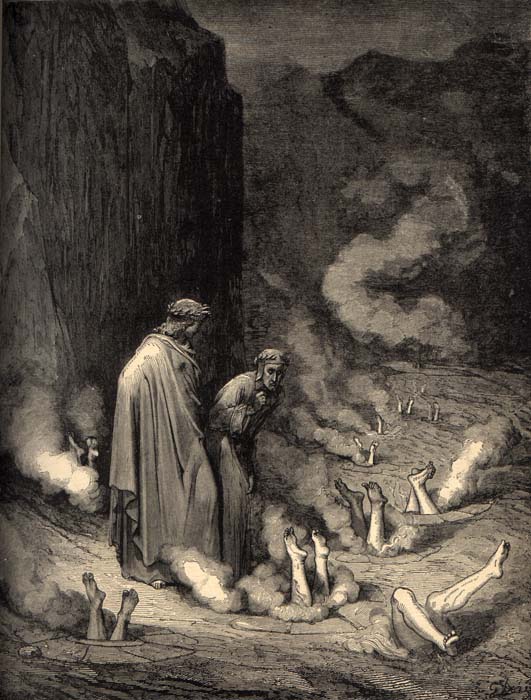
“Simonists” by Gustave Doré (http://danteworlds.laits.utexas.edu/gallery10.html)

In Canto 19, Dante and Virgil arrive in the Third Bolgia of the Eighth Circle. The sinners there are Simoniacs, corrupt clergy who bought or sold sacred heavenly services for money. From the very start of the Canto, Dante immediately angrily criticizes the Simoniacs saying, “You who the things of God, that should be brides of goodness, rapaciously adulterate for gold and for silver.” (Canto 19, Lines 1-4).

Canto 19 solidifies just how important God means to Dante the writer and Dante the pilgrim. The canto also displays how strongly Dante feels towards those who are disloyal and disrespectful to God. Dante, the pilgrim, does not feel sympathy nor pity for the Simoniacs as he has felt for sinners in previous Cantos. Instead, he feels content with their punishment. Dante tells Pope Nicholas, “Therefore stay here, for you deserve your punishment.” (97). He continues and states, “You have made gold and silver your god.” (112). Dante’s tone throughout Canto 19 is pure rage and intensity against those who chose money as their god and therefore did not worship the right God. His hatred for the Simoniacs shows how passionate and how serious God means to him. Dante finds that those who did not take God seriously deserve eternal punishment. Dante adds, “And were it not that I am forbidden by my reverence for the highest keys, which you held in happy life, I would use still heavier words” (100-103), meaning that Dante’s respect for the papacy is keeping him from insulting the Simoniacs even more. Virgil is pleased with Dante’s angry speech towards the Simoniacs. As Virgil was proud of Dante in his interaction in Canto 15 with Brunetto Latini, the pilgrim again believes his leader is pleased “with such a contented smile he listened” (120). 

As shown in the Gustave Doré artwork, God has punished the Simoniacs by stuffing their greedy heads and bodies into holes in the ground with their legs and feet hanging out. In Doré’s work Dante seems to be speaking to Pope Nicholas and if you zoom closely into Dante he has a facial expression of disgust and revulsion. Dante compares the holes in the ground to “places for the baptizers” (17). It is compelling that the sinners are stuffed into the ground head first as oppose to their body first like during a baptism. I think this punishment for Simoniacs fits with the unorthodox and sacrilegious decisions they made during their lives.

Bleeding trees and the dehumanization of those who commit suicide.

Gustave Doré, The Inferno, Canto 13 from Wikimedia Commons

One terzina that struck a chord with me is from Dante’s Inferno Canto 13 lines 37-39. Dante and his guide, Vergil, have reached the second subcircle of the seventh circle of hell which is reserved for those who commit violence against themselves. Dante the pilgrim is confused by the dark woods that surround him which seem to bleed and cry. Dante assumes that there are people hiding in the bleeding trees and that the voices he hears are coming from the people hiding. Vergil urges Dante to break a twig off of one of the plants since doing so will allow the tree to answer Dante’s question of where the voices are coming from. The pain that Dante causes to the tree leads to one of my favorite moments this far in the Inferno when the tree questions why Dante would cause him such pain. The tree tells Dante and Vergil that:

We were men, and now we have become plants:

truly your hand should be more merciful had we

been the souls of serpents.” (Canto 13 lines 37-39)


I’ve been meditating on these lines for a few days trying to look through the layers Dante the writer placed on this verse. Our commentary mentions that to Dante there are three separate levels of living creatures. The lowest are plants which are living creatures with only vegetative abilities. Above plants are animals which have both vegetative abilities and what the notes call animal the animal abilities which include movement and senses. The highest form of living creature is humanity. Humans have all the abilities of animals but also have intelligence and the possibility of rational thought.

In the tree lines quoted above, Dante the poet has the tree take the soul of a suicide victim through the three levels of living creatures. First we are reminded that these trees were once men, the highest of all living creatures. In the same line it is reinforced that they have become trees, the lowest of all living creatures. In the next two lines, Dante the writer through the voice of the tree, reminds the reader that there is a middle level of living creature which is the animal.

In mentioning all three levels of living creatures within three lines, Dante the writer is making a point that the souls of those who commit violence against themselves become the lowest of all living creatures. The point is made crystal clear by Dante mentioning the middle level of living creature, the animal, showing that the souls of suicide victims don’t just go down one level but are placed at the lowest level. This is a clear indictment by Dante the writer of those who commit violence against themselves.


Canto 15: A Unexpected Encounter between a Teacher and Student

In Canto 15 Dante and Virgil continue their journey through the Third Ring of the Seventh Circle of Hell where the “literary sodomites” and others violent against nature are punished. As we read in Canto 11, sodomy is considered a sin of violence. Dante, the poet, views sodomy as a crime against God because it goes against nature. In Inferno, sodomy contradicts the natural will of life, therefore harming God. In the third ring, a fiery rain falls on the sinners, which represents an unnatural phenomenon, like sodomy. Whereas regular rain replenishes the Earth, a fiery rain does the opposite since sodomizers also do not replenish Earth with new life.

As Dante and Virgil walk passed a “band of souls” (Inferno 15, 16), Dante, the poet, writes “each was gazing at us as in the evening people gaze at one another (16-17).  I interpreted this as alluding to the way men may look at each other in a sexual manner. Dante says, “I was recognized by one, who seized me by the hem” (22). Dante has some difficulty recognizing the soul because of his “baked appearance” (26) from being burnt from the fire. Dante finally realizes who it is and with surprise asks, “Are you here, ser Brunetto?” Dante asks this with a great shock and sorrow that Brunetto could end up where he is. Dante holds respect for Brunetto, an old mentor and teacher, who he feels indebted to. Dante keeps a “kind paternal image” of Brunetto (83). It’s compelling that both Dante the poet and pilgrim have much admiration for Brunetto. But evidently, Dante, the poet, places Brunetto where he does in such a painful place in Hell based on his sin and regardless of how much praise and affection he has for him. This displays that one can commit sins and be punished but still be seen with great influence, like how both Dante’s view Brunetto.

Brunetto explains to Dante his future. Dante hears the same prophecy again. I found this compelling because it’s possibly the third time that Dante heard his prophecy and again the number 3 could be used by Dante, the writer. It’s also unusual that there was not much interaction between Dante and Virgil in Canto 15. Dante spends most of the Canto talking to Brunetto. Dante informs Brunetto that he is prepared for what Fortune has in store for him. Virgil is pleased with his student’s courage and approves of his careful listening saying, “He listens well who takes note” (98). I think this displays a strong trust and confidence Virgil has grown to have in his student and pilgrim, Dante.

Capaneus’s Hell

In canto 14, Dante and Virgil encounter a soul called Capaneus, through which the reader is introduced to a new concept. Barolini describes it: “Hell is a condition in which the soul is permanently oneself as one was on earth- unrepentant and unameliorated, with no hope of change or growth,” (Barolini). In other words, instead of considering Hell as a place for souls that are forced to pay for their sins in eternal anguish, Barolini refers to it as a “condition”. A condition is defined as a mindset, in this case, untouched and unaffected by the circumstances in which the soul dwells. Despite the horrific punishment Capaneus endures, his pride and confidence in himself as a warrior is unshaken. There is no possibility that his outlook will succumb to the ongoing pressure to repent. The eternal suffering, presence of demons and the cries of the anguished do not seem to bother Capaneus in the slightest. As Capaneus bluntly puts it, “…As I/ was alive, so am I dead,” (50-51). This arrogant demeanor is a clear example that when someone does not show evidence of guilt or remorse for any transgression they commit in their living days, it cannot be expected of them to do so when they descend into Hell.

In response to this superior attitude, Virgil retorts, ” ‘O Capaneus, since your pride is not extinguished, you are punished more; no punishment, other than your rage, would be suffering of a measure with your fury,” (62-5). Virgil wishes to express here that as long as Capaneus’s pride is still intact, this, in itself, is punishment enough for the soul. The anger and fury that embodies Capaneus because of his stubborness and possible belief that he does not belong in Hell will keep him in distress for all eternity. Therefore, Capaneus must be forced to deal with his crimes for all of eternity. Barolini summarizes this point by stating that the soul “…is stuck with its self”. Furthermore, he considers, “If the motto of the sinners here is that they are now what they always were, then in effect these sinners create their own Hell”. Capaneus’s perspective on his position in Hell entails the likelihood that all sinners are exactly as they were in the living world. With this in mind, the souls are making an illusion of a Hell that solely belongs to them. Although this does not exclude them from punishment, it seems far less cruel than the punishments forcefully inflicted upon them because they are choosing to remain as they have always been and as a result, are choosing their own destinies in Hell. This is especially appealing for the souls of the third subcircle within the seventh circle, where Capaneus dwells, because their sins pertain to violence against God. If their unchanging personas allow for a fabricated Hell, this, in turn, signifies that they’re evading and going against God’s punishments which He deems appropriate for the souls and are being punished by their own terms.

Dante and Virgil meet Capaneus, Title: Capaneus, Illustration by William Blake, Source: Danteworlds (UTexas)

Canto 11 – A Brief Break to Explain the Organization of Hell/The Presence of the Number 3 and The Importance of Nature

Canto 11 reminded me of previous cantos where Virgil and Dante pause because Dante, the pilgrim, needs explanations and clarity from Virgil. This is a recurring technique of Dante, the writer, in which he allows the readers to mirror his character and gain answers to similar confusions that the pilgrim himself is experiencing.

While Virgil and Dante are resting, Virgil explains the organization of Hell in more depth. The organization also enables the reader to note how Dante, the poet, classifies the severity of certain sins over others. I thought it was compelling that the religious presence of the number three appears again in this Canto. First, Virgil tells Dante there are three smaller circles. Hell is separated into three parts. The first circle in middle hell is also divided into three subcircles where the sinners are separated into three groups based on the gravity of violence either committed against others, against oneself, and the worst, which is violence against God.

I was a little confused as to why Dante punishes sodomy as a worse punishment than the crimes committed by the lustful in Circle 2/Canto 5. But, when I reread Virgil’s explanations to Dante I gained more clarity. It is important to note that sodomy is a sin of violence. This means that Dante, the writer, does not punish sodomizers for their morality but more so because he views it as unnatural to the world. Dante the poet defines crimes against God as the most violent because they go against the natural will of life. Virgil states that sodomy and those who harm God scorn “nature and its goodness.” (Canto 11, Line 47). For Dante, something that contradicts nature is far worse and violent than engaging in lust. Above all, God is the most important, therefore going against him and harming what he created is worse than harming others.

Lastly, Dante, the writer, punishes the fraudulent at a lower place in Hell. Virgil tells the pilgrim that fraud, “seems to cut solely into the bond of love” and “forgets the love that Nature makes” (Canto 11, Lines 52-58). It is clear again how severe defying nature is to Dante, the poet. When one is fraudulent and deceitful, he is going against the natural trust and love people are meant to have for one another. Dante ranks fraud worse than violence because it directly contradicts natural trust.

Farinata’s Attitude in Hell

The following terzina in canto 10 is the moment when Dante sets his eyes upon Farinata or the head of the Florentine political faction Ghibellines. Dante narrates, “I had already fixed my eyes in his; and he was/ rising up with his breast and forehead as if he had/ Hell in great disdain,” (34-37). The translator notes that Dante focuses on Farinata’s breast and forehead because they represent courage and foresight. The presence of courage goes hand in hand with confidence and pride which is the attitude with which Farinata rises from his tomb. Since Dante primarily notices his breast and forehead, this implies that Farinata rises with his head held high and also puffs out his chest in a robustly confident manner. However, this is very uncommon for a soul suffering eternal torment. Despite his circumstances, throughout the entire canto, Farinata’s demeanor is calm and collected unlike Dante’s past encounters in which the souls are either sorrowful and pitiful or attempt to put Dante’s life in peril. He does not move any part of his body throughout the conversation with Dante and even after Dante begins speaking to another soul, Cavalcante, who suddenly awakens, Farinata’s expression and body language does not change in the slightest. Furthermore, when Dante states, “…as if he had Hell in great disdain,” this implies a tone of superiority. The translator notes, “…the possibility of such a soul’s actually being superior to the sufferings of Hell.” Although none of the souls are above the afflictions of Hell, this bearing that Farinata has connects to his concern with social status, which is a concept he is preoccupied with in his living days. For example, at the beginning of Dante’s encounter with Farinata, the latter asks Dante about his ancestry. This, perhaps, is an attempt to see if Dante comes from the opposing faction of Guelfs who Farinata and his faction battle against and slaughter during the politically tumultuous days of Florence. When Dante reveals that he is, in fact, a Guelf, Farinata becomes indignant and recounts of the opposition they showed him. Although he is no longer living, this reaction shows that his eternal torment is a lesser cause of worry as opposed to the wrongdoings he feels the Guelfs have done him.

In regards to the representation of foresight, it is a reference to Farinata’s inability to see things that are in the present or near future but rather the distant future. This, of course, is unlike human ability and memory and it brings up the question of how much the perception of time and the concepts of past, present and future change when the souls descend into Hell. Since the soul’s sufferings are meant to last for all eternity, perhaps, unlike the living, the souls, such as Farinata, are no longer concerned or obsessed with future events. This allows for a clearer view of what’s to come simply because they are already aware of what will occur.

Farinata arising from a sepulchre to speak to Dante and Virgil, Title: Farinata, Illustration by Gustave Doré

Filippo Argenti: The Daring Soul

(Image found in Danteworlds (UTexas) > Inferno Gallery > Circle 5; Painting is entitled: Filippo Argenti and is painted by Gustave Doré)

Throughout each Canto, each encounter with the damned invokes a strong emotional reaction in Dante. For example, in Canto 8, as Phlegyas is rowing Dante and Virgil across the Styx river, they meet Filippo Argenti. He is covered with mud and inquires to know why Dante, as part of the living world, is journeying through Hell. When Dante makes it clear that he recognizes the anguished soul despite his muddy appearance, Argenti reaches out to touch the boat or perhaps, Dante, evidently attempting to endanger him. After Virgil pushes him away and comments on the lack of goodness in Argenti’s soul, Dante replies, “Master, much would I desire to see him ducked in this broth before we leave the lake,” (52-53). In other words, Dante is expressing to Virgil a new emotion that strongly contrasts to previous reactions. In past Cantos, Dante would show pity towards souls who would share their stories with him. He would become so overwhelmed with pity and sorrow that he would faint soon afterwards. Here, Dante conveys disgust and alarm at Argenti’s daring behavior in which he puts Dante and Virgil in peril of falling into the river.

Although the moment passes quickly, Dante desires to witness Argenti’s disappearance into the Styx river, himself, so that he may feel more secure and relieved. Later on, Dante recounts, “A little later I saw him torn apart by those muddy people in such a way that I still praise God and thank him for it,” (58-59). This statement indicates that Dante feels a great sense of relief at witnessing Argenti’s violent and forcible descent into the Styx river, thanks to the other muddy anguished souls present in the river. Although Virgil comforts and shields him from being harmed, this event evidently makes him feel even more at ease. Ironically, Dante thanks and praises God, up in Heaven, for this particular event that takes place in Hell, for paying heed to his terror.
