Category Archives: Posts

Post 1

by Gustave Doré

Dante turning from the she-wolf

The image I chose is by Gustave Doré titled, “Dante turning from the she-wolf.” I found it  by using the databases in the resources tab, and after some browsing for images that pertained to the parts of the canto that stuck out to me the most, I chose this one which is located in the World of Dante (University of Virginia) tab. The image is of Dante after he speaks with the Virgil, being guided away by them as he turns away from the she-wolf that he feared so heavily.

This image stuck out to me over the others because as I was reading, I was copying down certain lines that suck out to me. For example: “you must hold to another path, if you wish to escape this savage place.” This can be interpreted in many ways such as that of a life lesson that every single person experiences. That is, the choice to willingly go down a different path and experience happiness in your own path. Previously, the leader that approaches Dante asks him, “Why do you not climb the delightful mountain that is origin and cause of all joy? (76)” Essentially asking him what we should all ask ourselves, should we, and how do we choose happiness?

The final lines in canto 1 are what I think this picture is depicting, (which is literally the title of the image) Dante turning away from the she-wolf and choosing another path. My favorite lines in canto 1 are as follows: “and you will see those who are content in the fire, because they hope to come, whenever it may be, to the blessed people (118) “Poet, I beg you that by God whom you did not know, so that I may flee this evil and worse, that you lead me where you have just now said, so that i may see the gates of Saint Peter and those whom you call so woebegone (130-136).” I really enjoyed this and feel that there is a metaphor or allegory in this entire epic pertaining to very natural and typical feelings that human beings experience daily throughout their entire life’s journey.
 

Post 1: Canto 1

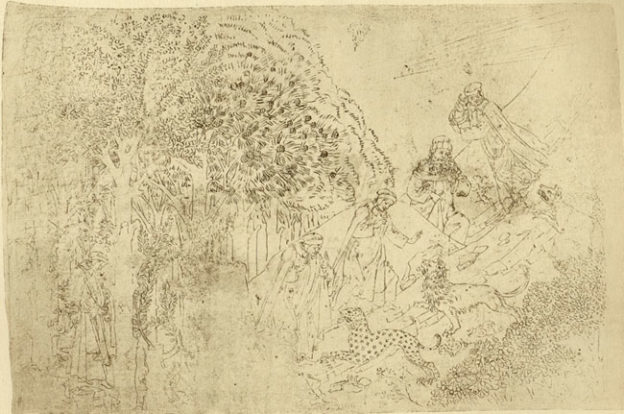
Image Creator: Botticelli, Sandro (c.1480-c.1495)

Source: The World Of Dante [ http://www.worldofdante.org/pop_up_query.php?dbid=I002&show=more ]

I came across this image in the Wrold of Dante link provided in the resoruces section of this site. The image portrays Dante and Virgil in the dark wood amongst the three beasts.  This section of the text along side this image spoke to me because they portray the medieval dream sequence trope so powerfully. The text stating, “I came to myself in a dark wood, for the straight way was lost” (1-2), introduces the reader to the medieval physicality of dreams/visions, which are also represented in texts such as the vita of Christina the astonishing and the vision of the monk of Eynsham. Another aspect besides the physicality of medieval dream/vision iterature is the notion of the dream guide. Lines 112 to 114 of Canto 1 depict Virgil offering his servaces as Dante’s guide through “an eternal place” (114), which is also depicted in the texts listed above of a guide taking the dreamer through the etherial landscape of their visions, which is typically hell and/or purgatory.

Also these lines introduces the reader to the medieval tropic imagery of the wood, which serves as a signifier of a mystical and allegorical venture in the wake of the characters. Examples of this trope can be found in Aurthruian romances and other courtly romances such as Eric and Enide. The image by Sandro Botticelli (c.1445-1510) represents the mystical and the allegorical dispositon of this text. The wood being the place where Dante encountered the three beasts who are allegroies of the three separations of hell appitite, violence and fraud; this is also where he encounters the dead Roman poet Virgil who will guide him, thus the mystical and allegorcal nature of the wood. Botticelli depicts the encounters sequentially and the wood surrounding the encounters, this is typical of late medieval/rennaisance art where all the events of a particular scene are represented in one image and , like in the literature the image reprsents, the wood serves as the signifier of the surreal in the image. The wood indicates that the image being represnted is a dreamscape.

First Assignment, Canto 5

Gustave Doré – Canto 5 linea 105: “love brought us one death, Caina waits the soul, who split our life.”

https://www.gutenberg.org/files/8789/8789-h/8789-h.htm#link5

I found this image in Project Gutenberg’s Vision of Hell, an eBook which includes the Inferno alongside the illustrated works of Gustave Doré. It’s found in the 5th Canto section of the work. The inscription below the piece is a quote from line 105 of the Canto, and it reads: “Love brought us one death: Caina waits the soul who split our life.” This alludes to the murder of Francesca de Rimini and her lover Paolo by Francesca’s husband, the older brother of Paolo. He is destined for Caina, the 9th circle of hell.

The work illustrates the whirlwind of souls which Dante finds in the second circle, where the carnal sinners, “who subject reason to lust” (38) are doomed to wail among the howling winds. Many notable figures are doomed to this fate: Cleopatra, and central figures in the Trojan war, Paris and Helen. Virgil points out “more than a thousand [other] shades” (67) in addition to those he names.  In Doré’s work you can see two souls highlighted amid a hurricane of others, romanticized to illustrate their pain and sadness.  Francesca and Paolo, who are doomed to spend eternity in the second circle. Paolo’s head leans back as in agony, and Francesca turns toward the poets to tell her story: that of two poor souls who were driven by love and lust to commit sin.

Dante says “After I had heard those wounded souls, I bowed my face, and held it low” (109), a position illustrated in Doré’s etching. Dante is overcome by emotion and pity, both encapsulated by his pose in the painting, looking down and leaning to one side. As Francesca tells the tale of her love and lust, Paolo’s wails and tears evoke so much emotion in Dante that he faints, “as a dead body falls,” (142) totally overcome by pity.

Assignment 1 – Canto 5

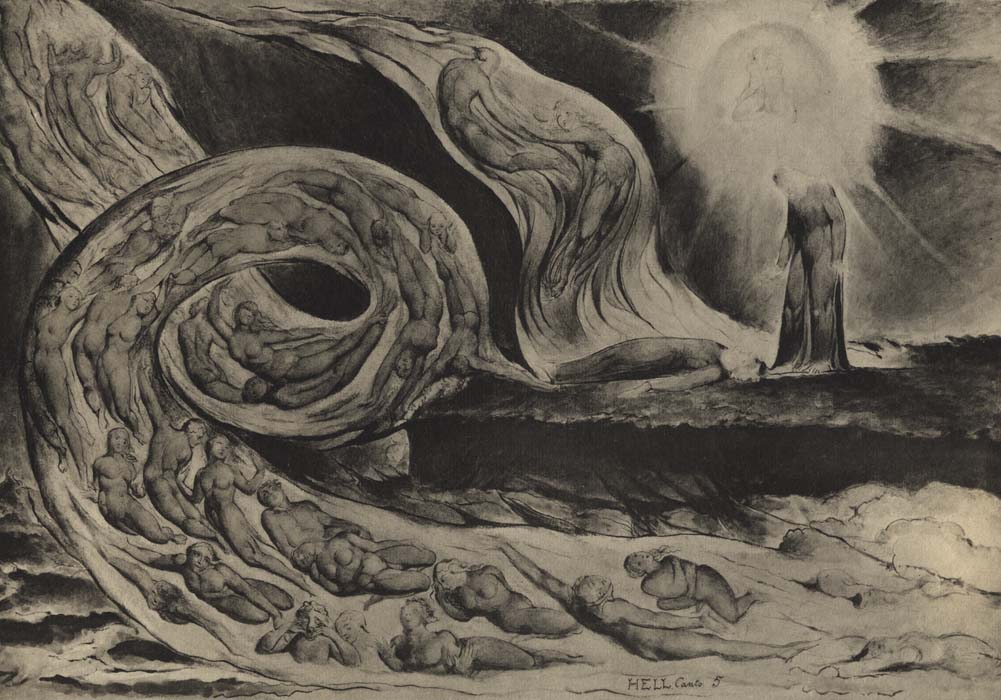
William Blake – “Dante Faints”

http://danteworlds.laits.utexas.edu/gallery04.html

I found this image from the resource site Danteworlds (UTexas). It is found in the site’s Circle 2 Gallery.  The art is by William Blake and it is entitled “Dante Faints” referring to the end of Canto 5.

Dante entered the Gate of Hell with his guide, Virgil, and passed through the first circle. This painting refers to Dante’s presence in the second circle, where lovers guilty of lust are in an “infernal whirlwind which never rests” (31) that endlessly punishes and tortures them. The painting displays souls trapped in this hellish wind. Dante encounters many famous historical and mythical women being blown in the wind including Cleopatra, Helen of Troy, and Francesca. Love, lust, and desire all led these women to their demise and suffering in the second circle of hell.

The painting refers to the entire canto but most specifically to lines 31-43 and lines 115-142. Lines 31-43 describe the restless wind that these sinners are stuck in. As Dante and Virgil encounter the women, Virgil explains to Dante what acts of love brought them to hell. Dante is especially interested in Francesca’s romance. Francesca had an affair with her husband’s younger brother Paolo and Francesca’s husband murdered them. Dante tells Francesca that her sufferings make him “sad and piteous to tears” (115-116). Dante was so moved by Francesca that he fainted as he says “so that for pity I fainted as if I were dying” (139-140). On the right side of the painting, Dante is pictured having fainted flat on his back as Virgil stands over him.

“To do before class #2”

http://danteworlds.laits.utexas.edu/prologue.html

This image was found from the databases provided, I first scanned the list and clicked on the Danteworlds (UTexas) I then clicked on the Inferno circle/ image provided and then I clicked on the tab “Dark Wood” and this painting is from is from Canto 1. The artist is Gustave Doré and this painting is called “The Leopard.” The database to me seems like it’s a research website that was produced from other websites and other networks. I don’t believe it’s in the public domain. This image refers to lines “And almost where the hillside starts to rise— look there!—a leopard, very quick and lithe, a leopard covered with a spotted hide.”

This image clearly shows and demonstrates the lines above because it’s Dante’s encounter with the leopard. He is looking at the leopard but his head is titled downwards in the image therefore he seems to be on a small hill surrounded by rocks. It seems in the image as if Dante has one leg lifted and another leg down therefore it seems to me how he may be trying to step forward, however, the leopard seems to be trying to lure its way forward trying to get closer to Dante and out of fear Dante is hesitating to move forward.

Divine Comedy, Canto 1 (first assignement)


Image by Doré, Gustave, 1890

http://www.worldofdante.org/pop_up_query.php?dbid=I008&show=more

I found this image browsing through the resources available at https://divinecomedy19.commons.gc.cuny.edu

This image presents Dante and Virgil walking together in a dark wood and being followed by a she wolf who is the allegory of greed. This image is very interesting because it symbolizes the beginning of Dante’s journey through Hell, Purgatory and then Heaven. Virgil, the ancient poet, will be his guide and protector.

“Thus for your good I think and judge that you

shall follow me, and I shall be your guide, and I will

lead you from here through an eternal place,”

(112-114)


Dante, a thirty five year old man (“In the middle of the journey of our life” where life expectancy at that time was about seventy years) finds himself in the middle of a dark, gloomy wood. Half asleep, he is confused about how it happened but soon enough he realizes that he is lost because of his own actions and wrong choices. Dark wood is the allegory of the world dominated by sin and wrong doings. Dante wakes up in this scary and hopeless place because of his bad choices in life and going down the wrong path, away from God. Disoriented and fearful, he starts walking and looking for the exit. He notices the hill and the sun rising above it (the Sun symbolizes God, which lightens the deep darkness that Dante is surrounded with. It also gives him hope). The main character is trying to attempt to climb the hill but unfortunately three beasts that appear out of nowhere make it impossible. These three beasts – a leopard, lion and she wolf, represent deadly sins which are obstacles in real life to getting through to God. A she wolf, the allegory of greed, seems to be the most dangerous and aggressive. She is trying to push Dante into dark abyss but unexpectedly he is saved by his master – Virgil. The Roman poet offers his help and is willing to lead Dante to God. In other words, he will be Dante’s guide in a difficult journey. Dante is also informed that the only way to get to God is grueling and leads through Hell, Purgatory and then Heaven where he will meet his new guide, his beloved Beatrice.


To do before class 2

Read canto 1-5 (even though I said 1-6, we’ll have plenty to discuss already with 5!).

Take the plagiarism quiz under Tutorials.

Write your first post by Feb. 4:

  • Find one image in the databases under resources that refer to canto 1 or 2 or 5.
  • Write a post including the image (try to understand if it’s in the public domain) or a link to the website.
  • Include: the name of the artist and work of art. The verses it refers to if you can locate them. A small description. Say how you found it.
  • Your post should look like a narration. Don’t give just the information.
  • You can also engage with the text if you feel like. This is mandatory starting next week, but your first post is to become familiar with this tool.

New Post!

About Posts

This is a Post. Instructors often post announcements, assignments, and discussion questions for for students to comment. Some instructors have students post assignments. Posts are listed on the “Posts” page with the newest at the top. 

Post Comments are turned on by default (see Home for information on Comments).

Add/Remove a password from this post from the Post Editor > Visibility > Edit > Password Protected.

Add/Edit/Delete a post from Dashboard > Posts