Dante’s Vision of Contrapasso in the Punishment of Sin


The idea of contrapasso in Dante’s Inferno is the pairing of sin with appropriate punishment. This is a theme evident in Dante’s first two circles as well as his “anti-inferno” in Cantos 2-5, and is further illustrated in Canto 6. Souls who have committed a certain degree of sin are sentenced to a specific circle, in which their sin is met with punishment equal to their acts against God’s will, and similar in execution. I might go so far as to describe the pairing of punishment and sin poetic, an almost ironic end for sinners who pervaded the will of God with their own.

As Dante wakes from his earlier faint in the 2nd circle and finds himself surrounded by the souls of the 3rd circle, Dante’s heavy imagery illustrates the punishment of the gluttons. These souls were poisoned by greed, and are now pelted by an eternal rain of snow, hail, and dirty water: “The rain makes them howl like dogs; they make a shield for one of their sides with the other; cast out wretches, they turn over frequently.” (19-21) As gluttons, their punishment is to lie in the mud as pigs writhing in the dirt, a comment on their state on earth. This is exemplified by Ciacco, an individual who earned his name for “the damnable sin of the bullet.” The idea of contrapasso is further and perhaps best illustrated in Canto 7. In the fourth circle, the avaricious push weights against each other. Those who spent too much or hoarded too much push against each other, poetically colliding against the opposite sin and calling out “Why do you hold?” and Why do you toss?” (29-30) Just as these souls went against the will of Fortune, a device of God, they now take what they have (their weights) and collide and push against each other, a metaphor for their behavior on Earth.

Ultimately, I believe that Dante wanted to express that hell reflects degrees of sin, but also that hell matches sin with a poetic punishment given the sin. This idea of contrapasso is shown in the pieces of the Inferno which we’ve seen, and continues to be a main theme for Dante’s vision of Hell.

Dante’s Lack of Sympathy in Cantos 6-9

I am struggling a bit with this prompt because I don’t find that Dante has much sympathy to give the damned in Cantos 6-9. Perhaps I am misreading the text but compared to the sympathy I perceived him to have for Francesca and Paolo, to the point where he fainted after witnessing their plight, the under current of emotional reaction is missing in my readings of these canto. Unfortunately, it is hard to find textual examples of a lack of emotion so instead I will focus more generally on his depiction of the Gorgons (or Erinni, they are described as Gorgons but labeled as Erinni elsewhere), found in Canto 9 lines 37-57. The story of Medusa and her sisters, found mostly in Ovid’s Metamorphosis 4.606-5.249 is heartbreaking in my opinion although apparently not to Dante. The story is basically that Neptune, God of the Sea, raped Medusa in the temple of Minerva. This angered Minerva causing her to punish the rape victim instead of her uncle the rapist by turning her into a woman with snakes for hair who could turn anyone who looked her in the eye into stone. She is later slain by Theseus who is assisted by the Gods. The mention of Medusa, who does not make an appearance in this canto, implies that she is in Hell suffering for her “crimes”. Unlike Francesca and Paolo, whose “crimes” were also sexual in nature and who Dante has the upmost sympathy for, there is no weeping or fainting over Medusa. While I understand Dante is told by Virgil to fear Medusa it is possible to both fear and pity someone. We can almost certainly say that Dante (the Poet) was very familiar with the works of Ovid since he references them countless times and therefore must have known the story of Medusa. The concept of rape has changed over time and neither Ovid nor Dante (the Poet) may have considered Medusa a rape victim. However, this isn’t the only instance of Dante’s lack of sympathy in Cantos 6-9. I will be paying closer attention to who Dante sympathizes with throughout Inferno and who he condemns.


Inferno Canto 9 Verse 46. Engraving by Gustave Doré found in an edition of the Divine Comedy on Project Gutenberg. Both book and artwork are in the public domain.


Gluttony, Cerberus, and Ciacco

I got the image above from the website below.
http://danteworlds.laits.utexas.edu/gallery05.html

In Canto 6, Dante finds himself surrounded by new sinners that are suffering and this third circle he entered is the gluttons. It always seems to be raining in this circle, but it is not pure water, it is dirty water that’s polluted, smelly, and filled with hailstones too. Cerberus is introduced; he is a gigantic three-headed guard dog of the underworld. In line 13 he is described as “cruel, monstrous beast, with 3 throat barks doglike over the people submerged there” (Inferno). Moreover, in line 15 “his eyes are red, his beard greasy and black, his belly large and his hands have talons; he claws the spirits, flays, and quarters them”. Moreover, Cerberus himself is considered a glutton when Virgil picks up a handful of stinky mud, throws it into Cerberus’s mouth and he eats it. Additionally, Ciacco from Florence is introduced. His sin was also gluttony, but Dante does not express much interest in his life other than his suffering has made him emotional. Ciacco starts a speech and proceeds to talk about the political strife between the Blacks and Whites and how the Blacks will eventually drive them out. Then, Ciacco asks Dante for a favor: to make his name famous in the living world but then Virgil interrupts and says that Ciacco will not rise again till judgement day. Ciacco would have to wait until that day to determine if that will occur. As the Canto is about to end Dante asks Virgil if the sinner’s punishments will get better or worsen after judgement day and Virgil pretty much says worse. The sinner’s bodies will be re-united with their souls, but it won’t be just their souls that are suffering. These are the souls that will be damned because their souls won’t only be suffering but along with their body which is worse. They will be experiencing both mental and physical pain. Dante usually sympathizes with the sinners whenever he hears their stories of sufferings however, in Canto 8 when he encounters Filippo Argenti he only shows rage. He asks him ” Who are you, who have become so ugly?” The sinner gives an ambiguous answer which infuriates Dante and Virgil pushed him back into the river. Virgil, in a weird way is proud of Dante for not crying or sympathizing for them anymore instead he curses them. Dante’s (the pilgrim) emotional reaction toward the sinners have been changing as we read further into the cantos; he’s been more tough with the sinners rather than soft.

Dante and Beatrice the Love that never was Assignment 1

Note: I could not find a good picture of Dante and Beatrice in Inferno. Instead of choosing a representation from Purgatorio or Paradiso I decided to use a painting depicting a scene from the Vita Nova for reasons I hope will become apparent in my post.

Last spring I took a course on the “minor works” of Dante which basically means everything but the Commedia. I wouldn’t call them minor works since they were some of the most challenging and fascinating things I had read at the time.

Our first work, Dante’s Vita Nova, especially captured my attention due to its focus on his unrequited love for Beatrice. I wont go into too much detail here but in summery her greeting of him is a blessing which at one point she denies him. This is depicted in the painting I decided to attach to this post. Eventually Beatrice dies tragically sending Dante on an introspective journey. I highly recommend the book to anyone who likes the Commedia.

Beatrice Meeting Dante at a Marriage Feast, Denies Him Her Salutation by Dante Gabriel Rossetti

The relationship, or lack there of, between Dante and Beatrice captured my attention and interest. I was fascinated by his idealization of this woman who he really hardly knew. So, when she appeared in the second canto of Inferno I paid very close attention to her.  From lines 43-142 in Canto 2, Beatrice describes how she came to assist Dante (the Pilgrim) in the start of his journey.

What captured my interest about this passage to the point of reflecting on it in my post is that Beatrice did not come on her own volition. There were two intermediaries that inspired Beatrice to go to the man that so idealized her. The Virgin Mary heard of Dante’s sufferings and fears. She spoke to St. Lucia who then went to Beatrice to ask her to help Dante (the Pilgrim)  throughout his journey. While I recognize that the number three is important in the Christian world and especially the works of Dante (the Poet) I can’t help but be curious about the Poet’s choice to not have Beatrice come directly to his aid but rather require the Virgin Mary and St Lucia to ask her to assist him. I think that a parallel could be drawn between her not giving him the salutation (and by extension blessing) during Vita Nova and her not originally intending to give him her assistance (or blessing him with aid) during Canto 2.

About above photo: Painted in 1855 by the appropriately named Dante Gabriel Rossetti who painted many scenes from the Vita Nova. This particular scene, which takes place in section 10 of Vita Nova, depicts Beatrice and Dante meeting at a marriage feast which she denies him her greeting which is akin to a benediction/blessing in Dante’s eyes. I found the water color, which is in the public domain, on Wikimedia Commons.

Who gets remembered and who does not

The idea that the only hope for those in Hell is for them to be remembered on earth has come up multiple times.  We have already seen in canto 3 that the cowards true punishment is that they can not be remembered, that they are not worth writing about and are unaccepted by both Heaven and Hell.  In Canto 3, line 64, we are told that these sinners “never were alive”.  However, in Canto 6, the Pilgrim encounters Ciacco, who asks the Pilgrim to remember him on earth, he tells him: “when you are back n the sweet world, I beg you, bring me to people’s minds”.  Despite Ciacco’s sin being worse than the cowards the Pilgrim encounters in Canto 3, he is able to hope for remembrance and receives it.  The inclusion of Ciacco in the text is the granting of his wish and the only ease of suffering he can get.  In the next circle, the Pilgrim wants to have pity for the souls there and asks Virgil if he would know any of them so that he could remember them, but similar to the cowards, the souls in this circle are not able to be granted that small hope.  Virgil tells the Pilgrim that part of their punishment is to be undistinguishable from each other, which makes it so that they may not be remembered.  Even in Canto 8, when the Pilgrim encounters the soul who attempts to touch the boat, a soul the Pilgrim wishes to be further punished, receives the kind act of being remembered on earth as Dante writes his name into the poem: “Filippo Argenti”.

Florence and its political affairs


“…Your city, which is full of envy that the sack already overflows, kept me with her during my sunny life.” (Alighieri, 49-51)


As Dante continues his journey with a guidance and help of his master Virgil he enters lower circles of Hell where he encounters new characters that represent different categories of sinners. By meeting those various characters face to face Dante refers not only to sins they committed but also to the political situation in Italy – the city of Florence, in particular.

In the Third Circle of Hell, the circle of the Gluttons, Dante meets Ciacco – the native of his own city –Florence. Ciacco probably died a few years after Dante (the author) was born and was a member of a rival party. He predicts the future of Florence, the events that will take place between 1300 and 1302. He is truly concerned that Florence will be divided due to jealousy, aspirations and hunger for wealth and success. Ciacco also informs the Pilgrim that many of important politicians of his time are situated and suffering in the lower circles of Hell. Just before lying back down in a muddy swamp he begs the Pilgrim to remember his name when he leaves Hell and goes back to the world above.

In the Fourth Circle of Hell Dante sees the sinners (The Avaricious and Prodigal) who constantly, without a break push heavy wheels of weights around in a big endless circle. Although Dante tries to recognize any of the sinners it is impossible because their faces (identities) are covered in dirt.

In the Fifth Circle of Hell Dante encounters the souls who are forced to fight in the muddy river without a break. These are the wrathful and sullen, who lived their life in anger and consequently wasted it. After crossing the river Styx Dante is being directly confronted by another Florentine – Filippo Argenti, who was the author’s major political enemy and a member of the powerful Adimari Family who was responsible, along with others, for exiling Dante from Florence. Filippo’s brother took all of his possessions The Pilgrim gets furious with Argenti and has a sort of verbal revenge on him. It was a completely different reaction to a sinful soul comparing to usual crying or fainting. This particular behavior of the Pilgrim made Virgil very proud.

To sum up both characters whom Dante meet continuing his journey through Hell -Ciacco and Filippo Argenti – are real people who while alive were directly connected to the political situation of Florence.

Author’s hate for Argenti

“A little after that, I saw such havoc
Made of him by the people of the mire,
That still I praise and thank my God for it.” (Alighieri 58)

I would like to talk about Author’s hatred for Argenti. The quote above is towards Argenti, and it’s evident that Dante (both the author and character) did not think highly of Argenti.  Up until now, Dante expresses nothing but sadness and guilt for these sinners except Argenti. It’s fascinating to see the reason why he is placed in this circle. We know that this circle is exclusively for sinners whom have committed wrath. For those whom are unfamiliar with this circle; these are people whom were consumed with anger in their lives. Now we don’t know in details Argenti’s backstory, or his relation towards the character Dante, but we do know from the text’s footnote(102 pages 63-64) that Boccaccio had mentioned in his Comento that Philippo Argenti is a man of great “pomp and ostentation”. We can suspect that this Argenti is an unpleasant person, and there’s unresolved conflict between the author and Argenti. I would like to know more about their conflict but I digress. What’s important in this post is how funny it was that the author managed to put this character Argenti whom as far as I can tell was no real substance to this sinner in terms of the grand scheme of the author’s intentions. Argenti wronged the author is the most minimal way, and now he is forever cemented in text to be ripped apart by his fellow sinners.

Assignment for blog post 2

By Monday Feb. 11, please publish your post. Engage with cantos 6-9 and reflect especially on the pilgrim’s emotional reaction vis-a-vis the damned.

Write at least one coherent paragraph of 10-11 sentences (topic sentence, development and concluding sentence), but you can write up to three paragraphs. Choose a title and use the category “Blog post 2 (due Feb. 11). Add tags of your choice.

You can discuss a visual representation of the topic you choose, or simply add an image to make your post more attractive.

Read the comments to canto 6 in the Digital Dante resource. Go to texts>Commento baroliniano>6. It will help you reflect on one of the most important cantos of Inferno.

Have fun!


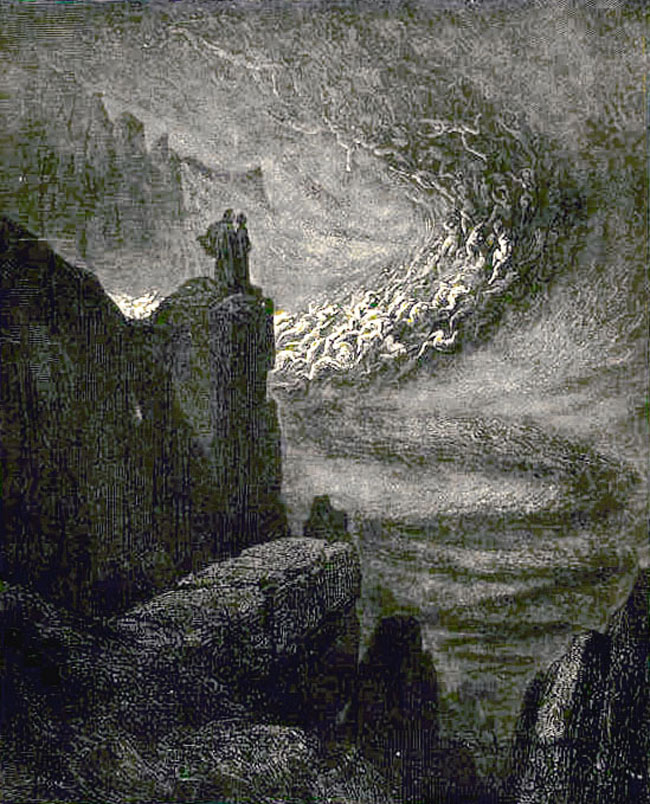
Assignment # 1 Canto 5

Doré, Gustave – “Lustful”

Doré, Lustful


http://www.worldofdante.org/pop_up_query.php?dbid=I139

I’ve found this image from the resource website: http://www.worldofdante.org/. This artwork is by Gustave Doré, and it’s entitled “Lustful”. I Believe this image is referring to Canto 5, “The hellish hurricane, which never rests” (Alighieri line 31).

Here you can see how Gustave Doré creates this nightmarish force of nature that is literally alive. The “hellish hurricane” is depicted in an interested way. The sinners are gravitated towards the eye of the hurricane. Or rather the sinners are the hurricane itself; to which there is no end, for I see the hurricane is stretched to the abyss.  The bodies were tossed around as if they were rag dolls. It definitely feels, coming off this artwork, cold and ruthless. This piece radiates a feeling of restlessness, as I mentioned before, there is no end to this hurricane, and why should it. There are new sinners emerging to this hellish plane every day or every second, as Dante Alighieri puts, “Which never rests”. I’ve chosen this image because I believe Gustave Doré encapsulate the dread and hopelessness Dante and Vigil brief visits to this chronic horrific scene.


Assignment 1: Canto 6

This image is engraved by John Flaxman in 1973. It is under the University of Virginia (The World of Dante) archive.

http://www.worldofdante.org/pop_up_query.php?dbid=I168&show=more

This image illustrates Cerberus, the three-headed beast who resides in the third (gluttony) circle of hell. When Dante regains his consciousness from a fall, he is greeted by the harshness of the weather condition; he describes that there are hailstones, heavy rains, snows, and filthy water that stinks the environment. He then sees Cerberus, barking violent over those who have been eaten. In Cerberus’ physical appearance, the beast’s eyes are red and has a big belly, and he has talons to preys on his victim at ease. Cerberus proceeds to devours his foods with raving hunger and remains to silence while he is fulfilling his appetite.