Assignment #1 – Canto III

Gustave Doré Illustration - Inferno Canto 3, 27

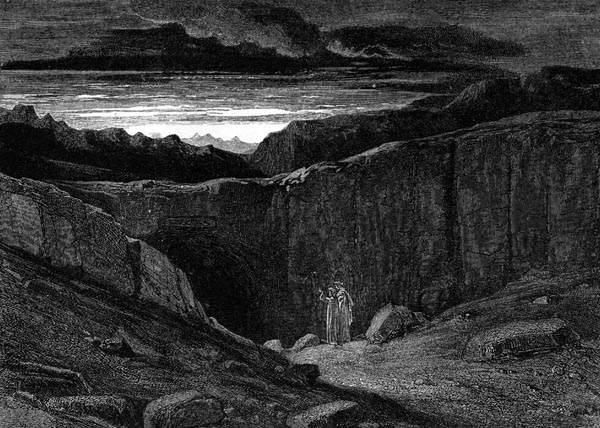
Above is an image that I found under our resource page, poetryintranslation.com.

This image depicts a dark scene in which Dante, in front of an entrance in what it looks like to  me a huge tunnel like cave. Atop this cave entrance reads,

“THROUGH ME THE WAY TO THE INFERNAL CITY:

THROUGH ME THE WAY TO ETERNAL SADNESS:

THROUGH ME THE WAY TO THE LOST PEOPLE.

JUSTICE MOVED MY SUPREME MAKER:

I WAS SHAPED BY DIVINE POWER,

BY HIGHEST WISDOM, AND BY PRIMAL LOVE.

BEFORE ME, NOTHING WAS CREATED,

THAT IS NOT ETERNAL: AND ETERNAL I ENDURE.

FORSAKE ALL HOPE, ALL YOU THAT ENTER HERE.”

where the Devil makes it clear that these are the gates of hell. The devil refers to God as a justice moving supreme maker with divine power, highest wisdom and primal love, further establishing the fact that he is in fact the Devil, hell’s gate keeper, and the infamous fallen angel in which he takes much pride. It is nearly impossible for Dante not to be discouraged and afraid standing in front of the gates of hell to which he confesses to Virgil of feeling that this not-so welcoming message is “hard” to him, implying a sense of hesitance. Virgil then replies, “‘Here, all uncertainty must be left behind: all cowardice must be dead. We have come to the place where I told you that you would see the sad people who have lost the good of the intellect.” Virgil, both encouraging and comforting Dante leads him into the unknown abyss where he finds a plethora of diverse signs of anguish and instability.

I chose this image because I seldom like to think of what heaven will look like but never what hell will look like. I feel that it is hard to picture such unpleasant sceneries and also uninviting to my interest. Instead, when I am provided with such insights on what hell might look like it further intrigues me in reflecting on how awfully severe it might be to end up there.

Assignment 1 Canto 1

untitled 208.tif

http://www.worldofdante.org/gallery_yates_thompson.html

I found this illustration on the University of Virginia’s World of Dante page.  It was under Yates Thompson 36. The illustration is by Priamo della Quercia, and is titled ‘The Three Beasts”. The illustration is not in the public domain.

This illustration refers to the majority of Canto 1. When Dante first wakes up, he finds himself in a strange, dark place. While attempting to find his way out he encounters three different animals which terrify him, before he finally meets his guide, Virgil; all of which is shown in this illustration. On the far left of the illustration, we see Dante laying on the ground, asleep, before he comes to himself. To the right, Dante is being attacked by the first of three beasts who roam this land,  a leopard. Dante has his arms flung upwards in fear of the leopard. Next, a lion is attempting to attack him. Just as before, Dante is illustrated as fearful. The third beast, a she-wolf is then attacking him, and has managed to knock him onto the ground. But on the far right, we see Dante has managed to escape, and found safety with a figure cloaked in red- Virgil.

Assignment 1 Canto 5

https://library.artstor.org/#/asset/SS35197_35197_19446895

Pinelli, Bartolomeo (Italian sculptor, painter, and printmaker, 1781-1835)

This is a image of Dante fainting after listening to the bitter love story of Francesca.

When Dante and Virgil enter the second Hell they are met with a raging tempest, “The infernal whirlwind, which never rests, drives the spirits before its violence; turning and striking, it tortures them. ” (31-33). The sinners of the second hell are those that fell victim to their own lust and weak will and are thus punished by losing control of their bodies like they have when they succumbed to their sins. The whirlwind is intense throwing bodies back and forth to the wails of occupants “Now the grief-stricken note begin to make themselves heard; now i have come where much weeping assails me” (25-27). Dante listens as Virgil starts to point out those in the storm slowly giving him bits of their respective history. Dante, prompted by Virgil, calls out to a couple and listens to their bitter tale of love. Overwhelmed with pity for Francesca and Paolo he falls over and faints after their tragic story is finished.

Assignment 1: Canto 1 Artwork

I found this image on the website http://danteworlds.laits.utexas.edu/prologue.html#darkwood. At first, I clicked on the link labeled Inferno Gallery which led to the Danteworlds Image Gallery. I clicked on the Dark Wood link which led to a page filled with different images of artwork. This particular piece is by William Blake and is entitled “The Three Beasts”. It refers to Canto 1 in which Dante encounters three beasts, a leopard, a lion, and a she-wolf.

Here are his encounters as mentioned in the text, respectively:

In lines 31-32, Dante states, “And behold, almost at the beginning of the steep, a leopard, light and very swift, covered with spotted fur;”

In lines 43-44, Dante narrates, “…but not so that I did not fear the sight of a lion that appeared to me.”

In lines 49-50, Dante observes, “And a she-wolf, that seemed laden with all cravings in her leanness and has caused many peoples to live in wretchedness.”

In the artwork there are five important figures. One of them appears to be Dante who is making a gesture towards an angel who is making a similar gesture. It seems as if the angel and Dante are protecting each other from the beasts or perhaps, keeping them at bay. Meanwhile, in this stretched out position, Dante is staring down the three animals: a she-wolf, a lion, and a leopard from top to bottom, respectively. Each of them appear malevolent and hostile, as if ready to attack or kill him, especially the leopard who is closest to Dante. Behind the angel, there is a body of water, which impedes Dante from having a successful escape from the beasts that he encounters in a forest. There’s also a sunrise in the background. It is certainly a sunrise as opposed to a sunset because in the first canto, in lines 37-38, Dante narrates, “The time was the beginning of the morning, and the sun was mounting up with those stars that were with it…” He makes this observation after encountering the fearsome leopard and prior to mentioning the appearance of a lion and a she-wolf.

According to the same online source, where the image above is provided, there is an unsettled debate on the significance and meaning of the presence of the three beasts. Certain opinions ascertain that they represent the three major divisions of hell. The three major divisions, according to Dante, are concupiscence or sexual desire, violence, and fraud. It is said that the leopard, lion, and she-wolf align with these three respectively. However, others might say that the leopard could be fraud while the she-wolf could be concupiscence. Whatever the case may be, it is clear that the three beasts are obstacles to Dante who wishes to reach the top of a hill, which may represent heaven. He becomes overcome with fear and hopelessness and at this point, he meets Virgil whom he believes is a ghost, which only heightens his terror. He begins to weep and beg for mercy, in hopes of escaping the ferocious circumstances.

Assignment #1- Canto 2


I found this image in the World of Dante under the Resources tab. The website is dedicated to be a multi-media research tool for the study of the Divine Comedy. I believe it is in the public domain since the main purpose of the website is to show the public Dante’s Divine Comedy and works. This website also allows its users to interact with poems in various ways. The image above is Beatrice visiting Virgil in Limbo made by Gustave Doré in 1890 (Dante).

In Canto 2, line 70 Beatrice is introduced, “I am Beatrice who cause you to go; I come from a place where I long to return; love has moved me and makes me speak” (Inferno); dialogue spoken by Virgil himself.  Beatrice means “She who makes blessed”. She also represents divine grace, accommodation, mediation and revelation (Inferno). In the lines 76-78, it is the first reference in which Dante gives allegoric dimension to her. “‘O lady of power, through whom alone he human race rises above all the contents of that heaven whose circles are smallest, so pleasing to me is your command that obeying….” Moreover, Beatrice plays a big role in making Dante feel better about his journey to the underworld because he does not feel worthy compared to a hero like Aeneas or the Apostle Paul. She is the one who sent Virgil to help Dante. This happened when Virgil was approached by a beautiful young woman (Beatrice) who was sent from heaven and explained she needed his help with Dante. Dante had been in love with Beatrice when she was alive so to know that she will be involved gives him reassurance.

Assignment 1 – Canto 1


http://danteworlds.laits.utexas.edu/prologue.html

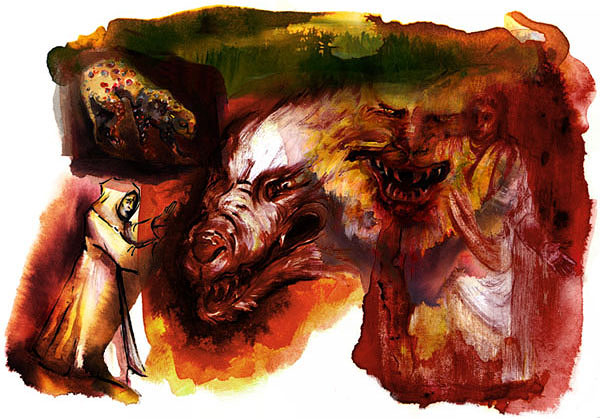
I found these images using the resources under the “Resources” tab on the site. The image is a collation of multiple works of art by Suloni Robertson. I believe this image stuck out to me the most because it displays a clear and vivid image of how Dante perceives his first journey into the dark wood.

As i was reading canto 1, I thought that he had encountered 3 actual beats, those being the lion, she-wolf, and leopard but I’ve come to the conclusions that these “beasts” are reflections of Dante’s own Fraud(Leopard), violence(Lion), and disordered appetite(she-wolf). the allegory behind this canto is very important towards understanding Dante as a poet. He introduces Virgil who in Inferno is his guide since Dante himself is a pilgrim. From lines 79-84 of Canto 1, you can tell how much respect Dante has towards and how wise Dante expresses Virgil to be “O honor and light of the other poets, let my long study and great love avail me, that has caused me to search through your volume.(81-83)”. Virgil explains to Dante that he will guide him through the path of hell so that he doesn’t fall into any traps while on the way to purgatory (line 134).

Post 1

by Gustave Doré

Dante turning from the she-wolf

The image I chose is by Gustave Doré titled, “Dante turning from the she-wolf.” I found it  by using the databases in the resources tab, and after some browsing for images that pertained to the parts of the canto that stuck out to me the most, I chose this one which is located in the World of Dante (University of Virginia) tab. The image is of Dante after he speaks with the Virgil, being guided away by them as he turns away from the she-wolf that he feared so heavily.

This image stuck out to me over the others because as I was reading, I was copying down certain lines that suck out to me. For example: “you must hold to another path, if you wish to escape this savage place.” This can be interpreted in many ways such as that of a life lesson that every single person experiences. That is, the choice to willingly go down a different path and experience happiness in your own path. Previously, the leader that approaches Dante asks him, “Why do you not climb the delightful mountain that is origin and cause of all joy? (76)” Essentially asking him what we should all ask ourselves, should we, and how do we choose happiness?

The final lines in canto 1 are what I think this picture is depicting, (which is literally the title of the image) Dante turning away from the she-wolf and choosing another path. My favorite lines in canto 1 are as follows: “and you will see those who are content in the fire, because they hope to come, whenever it may be, to the blessed people (118) “Poet, I beg you that by God whom you did not know, so that I may flee this evil and worse, that you lead me where you have just now said, so that i may see the gates of Saint Peter and those whom you call so woebegone (130-136).” I really enjoyed this and feel that there is a metaphor or allegory in this entire epic pertaining to very natural and typical feelings that human beings experience daily throughout their entire life’s journey.


Post 1: Canto 1

Image Creator: Botticelli, Sandro (c.1480-c.1495)

Source: The World Of Dante [ http://www.worldofdante.org/pop_up_query.php?dbid=I002&show=more ]

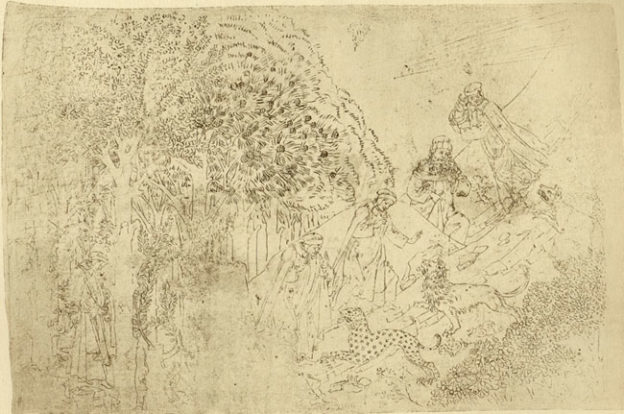
I came across this image in the Wrold of Dante link provided in the resoruces section of this site. The image portrays Dante and Virgil in the dark wood amongst the three beasts.  This section of the text along side this image spoke to me because they portray the medieval dream sequence trope so powerfully. The text stating, “I came to myself in a dark wood, for the straight way was lost” (1-2), introduces the reader to the medieval physicality of dreams/visions, which are also represented in texts such as the vita of Christina the astonishing and the vision of the monk of Eynsham. Another aspect besides the physicality of medieval dream/vision iterature is the notion of the dream guide. Lines 112 to 114 of Canto 1 depict Virgil offering his servaces as Dante’s guide through “an eternal place” (114), which is also depicted in the texts listed above of a guide taking the dreamer through the etherial landscape of their visions, which is typically hell and/or purgatory.

Also these lines introduces the reader to the medieval tropic imagery of the wood, which serves as a signifier of a mystical and allegorical venture in the wake of the characters. Examples of this trope can be found in Aurthruian romances and other courtly romances such as Eric and Enide. The image by Sandro Botticelli (c.1445-1510) represents the mystical and the allegorical dispositon of this text. The wood being the place where Dante encountered the three beasts who are allegroies of the three separations of hell appitite, violence and fraud; this is also where he encounters the dead Roman poet Virgil who will guide him, thus the mystical and allegorcal nature of the wood. Botticelli depicts the encounters sequentially and the wood surrounding the encounters, this is typical of late medieval/rennaisance art where all the events of a particular scene are represented in one image and , like in the literature the image reprsents, the wood serves as the signifier of the surreal in the image. The wood indicates that the image being represnted is a dreamscape.

First Assignment, Canto 5

Gustave Doré – Canto 5 linea 105: “love brought us one death, Caina waits the soul, who split our life.”

https://www.gutenberg.org/files/8789/8789-h/8789-h.htm#link5

I found this image in Project Gutenberg’s Vision of Hell, an eBook which includes the Inferno alongside the illustrated works of Gustave Doré. It’s found in the 5th Canto section of the work. The inscription below the piece is a quote from line 105 of the Canto, and it reads: “Love brought us one death: Caina waits the soul who split our life.” This alludes to the murder of Francesca de Rimini and her lover Paolo by Francesca’s husband, the older brother of Paolo. He is destined for Caina, the 9th circle of hell.

The work illustrates the whirlwind of souls which Dante finds in the second circle, where the carnal sinners, “who subject reason to lust” (38) are doomed to wail among the howling winds. Many notable figures are doomed to this fate: Cleopatra, and central figures in the Trojan war, Paris and Helen. Virgil points out “more than a thousand [other] shades” (67) in addition to those he names.  In Doré’s work you can see two souls highlighted amid a hurricane of others, romanticized to illustrate their pain and sadness.  Francesca and Paolo, who are doomed to spend eternity in the second circle. Paolo’s head leans back as in agony, and Francesca turns toward the poets to tell her story: that of two poor souls who were driven by love and lust to commit sin.

Dante says “After I had heard those wounded souls, I bowed my face, and held it low” (109), a position illustrated in Doré’s etching. Dante is overcome by emotion and pity, both encapsulated by his pose in the painting, looking down and leaning to one side. As Francesca tells the tale of her love and lust, Paolo’s wails and tears evoke so much emotion in Dante that he faints, “as a dead body falls,” (142) totally overcome by pity.