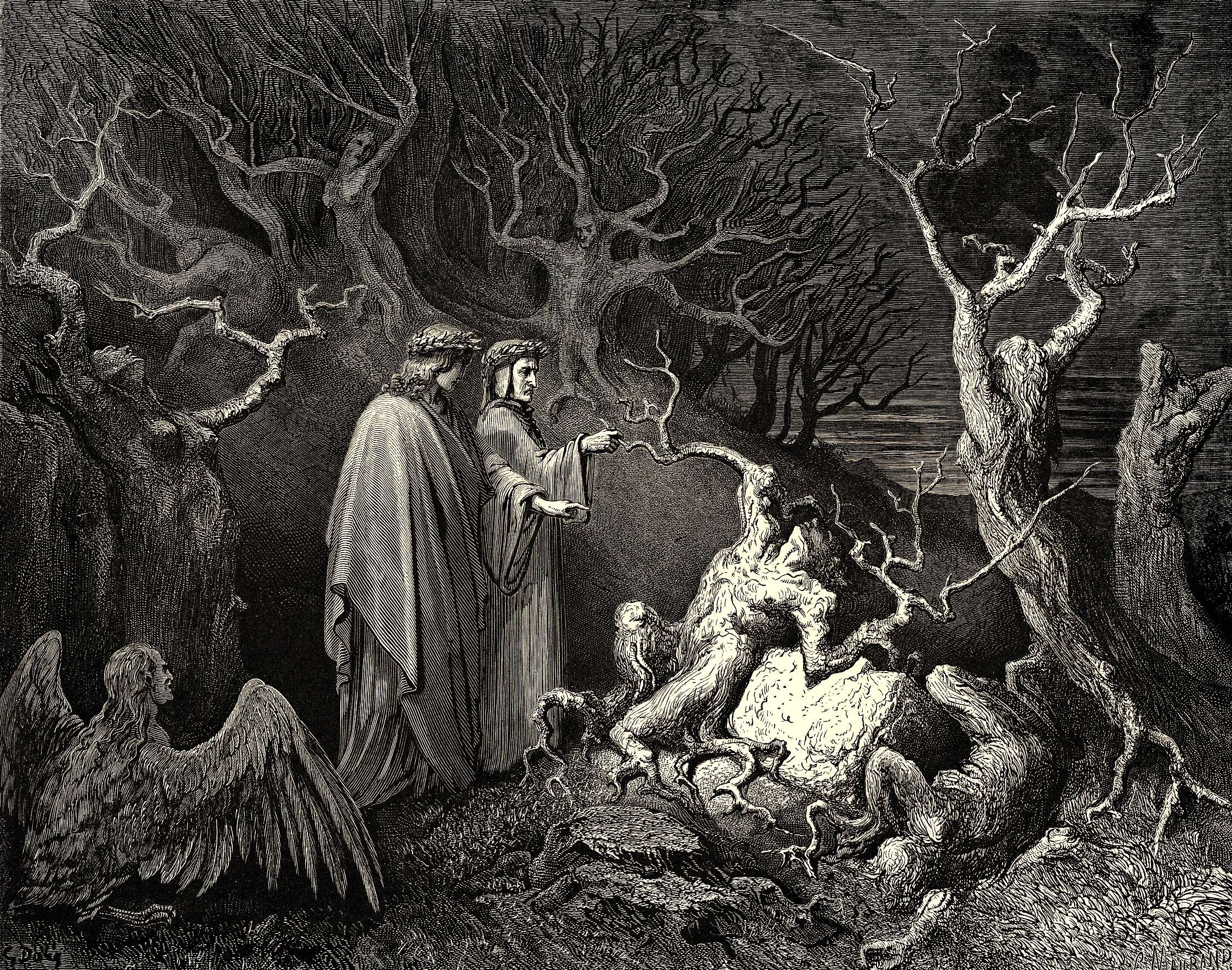
In canto 28, the Earthly paradise reflects man’s origin as an innocent creation susceptible to temptations. Dante implies that all creation including humans were created to follow the will of God. For example, Dante narrates that “by which the pliant branches, trembling, were bent, all of them, toward where the holy mountain casts its earliest shadow,” (Canto 28, lines 10-12). Dante characterizes the breeze that bends the branches as “unchanging in itself” (canto 28, line 7). In a mortal and materialistic world, everything ages and deteriorates. If anything is unchanging, it’s considered immortal and divine. Thus, the wind is an extension of God’s divinity and helps the creations follow the will of God. Moreover, Dante uses the adjective “pliant” to describe the branch to imply that nature itself , including the trees are created to bend at the will of God. He elaborates that they bent to “where the holy mountain casts its earliest shadows.” Even though the plants are supposed to bend at the will of God, they’re not bending in the “right” direction. Usually, trees and plants naturally bend towards the source of light which represents God, however, in this case, they’re bending towards the shadows where there is no light. In a sense, the plants are a metaphor for humans, Dante is implying that even though humans and all of nature is created to serve God, humans have strayed from their true purpose. The “holy mountain” is designed in such a way that it closest to the heavens so God’s light may always reach its inhabitants . However, humans turned to the “shadows” where God’s light does not reach them, and in doing so, they became shadows of their former selves that once lived in the Garden of Eden.
The body of waters reflects man’s pure origin and inevitable condemnation. Dante narrates that “ All the waters that back here are the purest,” (canto 28, line 28) and “it [they] hide nothing,” (canto 28, line 30). Just like the pure water, God created humans as pure beings devoid of all sins with clear intentions. Just as the water hides nothing about its contents, humans didn’t hide anything from God and each other. However, Dante elaborates that “although it moves dark, dark under the perpetual shade, which never lets sun or moon shine through.” (Canto 28, lines 31-32). The description of the water is contradictory because even though it’s pure, it’s dark. Usually, if water has a dark hue, it means that its contaminated. Since, the Earthly paradise represents the origin of humans, the description of the waters parallels the human transformation from pure creations to morally corrupt beings. Even though the body of water is close to the the stars in the heavens, the celestial light can’t penetrate the water because it’s located in the first place that humans sinned and fell from heaven. God created the Earthly paradise so that his light can always shine on Adam and Eve. However, when they disobeyed him, they fell from heaven and the celestial light in the forms of stars, sun, and moon no longer directly shined on them. The pure and dark nature of the water shows that the once pure humans are corrupted inside, and God’s light fails to penetrate their heart, hence they’re purposeless and led astray. There is a repetition of the word “shadow” to reiterate that the paradise is full of shadows just like humans are shadows of their original status and glory.
The Garden of Paradise essentially displays what humans have lost. Hence, the garden is physically characterized so that it can show the true story of humans as pure beings who fell from Grace. In fact, Matelda narrates that “Because of his own fault he dwelt here but little; by his own fault he changed into weeping and labor his virtuous laughter and sweet play.” (canto 28, line 94-96). The clauses set up a parallel between “weeping” and “virtuous laughter,” and “labor” and “sweet play” to show how humans live on earth and how they lived on the Garden of Eden. The earthly Paradise mirrors the punishment for Adam and Eve’s sin and their fall from Paradise. Dante claims “You put me in the mind of where and what Proserpina was,”( canto 28, line 49-50). Dante claims that the Earthly paradise reminds him of the story of Prosperina because just as she lost her virginity and ability to reside on Earth when Hades raped and imprisoned her, humans lost their status and ability to reside on the Earthly paradise. For Dante, the earthly paradise represents the origin of humans and their true narrative which include the purity of their creation and their simultaneous fall from paradise.
Personal Note: I’m not entirely sure what my final paper is, however I am exploring some leads. I’m planning on attending the Harrowing of Hell play. Based on my feeling on it, I may decide to do a comparative essay based on Dante’s inferno and the play’s interpretation of hell. If I don’t like the play, I might pick something else to do.
Side note: I’m confused about the female characters and what they represent. I read that Persepolina represents the “human err” in the notes and I don’t understand what error she committed. I think her suffering is similar to the humans but its through no fault of her own. Also, while I understand that Matelda is represented as the “ unfallen Eve”, I don’t understand what Beatrice represents? Is she the “redeemed Eve”?