Burden of a body

Illustrazioni sulla Divina commedia di Dante [in 4 portfolios] by Scaramuzza, Francesco

Makeup for blog post 3

This image depicts the second ring of the seventh circle in hell. This is where those who have committed violence against themselves reside. These souls are turned into trees and their bodies that have been discarded are hung from their branches. The picture captures the moment of the sinners dragging their bodies before they are transformed. The body motions in the picture really capture the feeling of dragging a limp body. Especially the woman whose body’s hair is tied around her neck, hanging from the neck the hair creates an image of a reverse noose giving a not so subtle hint to how she might have committed suicide. It gives an impression of how they were when they lived, struggling to move a body that just seems to have given up and refuses to cooperate, that must have been really taxing for their souls. This could have been one of the factors that have pushed them to suicide, to relieve them of their “dead” weight. For a human the body is an important piece that makes him whole and to just throw it away causes them to become less than human, and thus they are punished. Unable to re-enter their own bodies they must now accompany the sinners for eternity as truly dead weights.

Status Classifications Based On Light

In Canto 1 of Paradiso, Dante classifies light as a hierarchical attribute that administers order in the universe. Dante defines light as “The glory of Him who moves all things penetrates through the universe and shines forth in one place and less elsewhere.” (Canto 1, lines 1-3). Dante perceives light as a manifestation of God’s glory. Dante implies that the unequal distribution of light in the universe is responsible for the nature of Paradiso, Purgatorio, and Inferno. Dante deliberately used the world “penetrate” to point out the physical limitations that explain why some domains receive more sunlight than the other. For example, Paradiso is closest the heavens hence it “receives most of his light.” (Canto 1, line 4). Purgatorio is further away from heaven hence, it receives comparatively less sunlight. Since the inferno is at the core of the earth, light can’t penetrate the surface and hence the inferno receives no sunlight. The degree of light that each place receives classifies the domains based on how close the souls are to God physically and spiritually.

Dante uses light imagery to display his new status among the ranks of souls. Dante claims that in heaven “our intellect goes so deep, that the memory cannot follow it.” (Canto 1, line 7-8). Light provides individuals with clarity which enhances their intellect. Dante claims that “The lantern of the world rises to mortals to divers outlets,” (Canto 1, lines 37-38). Even though the “lantern” is a metaphor for the sun,  the light in a “lantern” is small and eventually extinguishes. Dante implies that mortals can only comprehend  a fraction of God’s grandeur and his inner-workings of the world before they die. Dante deliberately uses the word “divers outlets” to further reiterate that the condemned human civilization  can only experience God’s presence through small outlets. Comparatively, Dante narrates that “I fixed my eyes on the sun beyond our wont.” (Canto 1, line 54). Unlike the other mortals who have to avert their gaze when they look at the sun from a far distance, Dante directly looks at the sun up-close in heaven with Beatrice. Dante subtly distinguishes his status from the rest of the mortals because he can see the full sun hence, he knows more about God’s inner-workings than the rest of the universe. It also implies that he’s closer to God than the rest of the mortals. Moreover, by watching the sun with Beatrice, he puts himself on the same level as her. Though, Dante attempts to humble his character by claiming that “I did not endure it long, yet not so little that I did not see it emitting sparks all around,” (Canto 1, lines 58-59). The phrase is an oxymoron because while he admits to his mortality in comparison to Beatrice who continues to look on, he also claims that he saw it long enough to comprehend its nature that’s unknown to most mortals. Hence, he says that he is a mortal however, he claims to know more than the average mortals, revealing his inner desire to transcend his own mortality.

Dante wants to become a part of the light because he wants to be a savior for the world. Dante appeals to Apollo to make him “a vessel of your [his] power.” (Canto 1, line 14). Apollo is the Greek God of sun and light. He rides the chariot across the sky to make day. Dante wants to be a vessel for God’s light and this reflects his desire to be a savior for this world. He believes that humans have strayed from God’s path, hence, he communicates his journey in the epic to metaphorically bring God’s light back into people’s lives. He also states that “O divine power, if you lend so much of yourself to me that I make manifest the shadow of the blessed kingdom that is stamped within my head” (Canto 1, lines 22-24). He deliberately uses the word “shadow” because only light can create shadows. He wants God to bestow him with enough knowledge about Paradiso that he can communicate that information with the world, hence be a “shadow” of the heavenly kingdom. When he sees the sun, he also claims that “And as a second ray will spring forth from a first, mounting upward like a pilgrim that wishes to return home.” (Canto 1, 49-51). Dante uses a simile to compare the light to a “pilgrim” however, Dante is the pilgrim on this journey, hence he’s comparing himself to the light. While the word “home” is ambiguous, it can have 2 meanings. The ray is “mounting upward” and since heaven is both upward and the origin of the rays, it can mean that the rays want to return to heaven. This can reflect Dante’s desire to be a part of heaven and God’s glory. However, it can also mean that Dante wants to return to Earth as a ray of God’s light. In this sense, his desire to be Apollo’s “vessel”, the “shadow” of heaven’s Kingdom, and the  “second ray,” show that he wants to return to Earth with information about the divine world that he can communicate with his people so that they can mend their ways while they still have time.


Second Reflection Post

Since my first reflection post, I have only written two blog posts (along with detailed comments that I wrote instead of blog post 7). Regardless, reading over those two posts and thinking about my personal engagement with the text I have a few observations.

My first observation, which I could have included in the first reflection post, is that  I am very reluctant to write about works of art. I am much more comfortable analyzing literature since I have experience doing so. I struggle to analyze art, even in comparison to literature, since I don’t even know the correct vocabulary to do so. I seem to have made the unconscious decision to focus mostly on what Dante writes and then supplement it with a painting rather than focus on the painting alongside the poetry. While I am always an advocate of pushing oneself to try something more difficult, I also kept finding myself spending too much time trying to discover the meaning of the painting over the meaning of the text.

I did find the guided questions we had to answer about art at the Metropolitan Museum of Art to be very challenging and instructional. Having guided questions to focus on helped me, although I still felt very lost at some points trying to answer them. I ended up writing over a thousand words and still did not feel satisfied I had answered all of the questions in their entirety when I submitted the post. The post actually would have been a lot longer but I edited out any observations I made that did not directly relate to the questions being asked. After reading other peoples posts about their Met visits I am not sure if I made the right choice in doing so but it is the choice I made all the same.

My other major reflection isn’t so much related to the blog posts as it is related to how I am engaging with the text. I personally have been struggling to find the same deep interest I had with Inferno while reading the later two canticles. I am somewhat of a completionist, meaning I have a hard time skipping around and not studying things in their complete original order. My mom loves to poke fun at me for it. I have to read book series in order starting from the beginning even if there is no connecting plot between the books. I mention all of this seemingly unimportant information because I am still trying to discover why I am struggling so much to engage with the text and find ways to do so. In a perfect world, I would just read the parts we aren’t assigned but doing so initially left me with even more confusion. If anyone else has had this problem and has any suggestions I would love to try any ideas out.

Reflective Post 2

As I look back on my blog posts, I learned that I would summarize and analyze too much where I would repeat myself. However, I feel with each post I was able to successfully navigate through the canticles and make connections between various cantos. For example in blog post six I am able to discuss the different emotions between Dante and Virgil and identity the theme of Canto 24.  For my final paper, I hope to use all the skills I learned with blogging, which include being short and to the point, strong analysis, incorporating quotes when needed from The Divine Comedy as well as a thoroughly explained thesis. One blog post I feel proud of is the most recent: blog post 8 when I talked about the Garden of Eden, rather than spending hours on details I wrote the most important facts from that canto and a short analysis. I was also able to relate blog post 8 to the MET museum and a work of art which I feel is an important skill to have as a writer; being able to connect ideas even though they are different which is also part of the final paper.  Although it still has been difficult for me, I’ve been trying to stick to one topic rather than several because condensing my writing to one single idea is much better than several scattered ones. I’ve noticed that I write too many ideas not only for this class but for other writing intensive classes as well. I feel my strong point is that I am able to explain ideas thoroughly so someone else reading my work isn’t confused but I overelaborate to a certain point. My favorite blog post was the blog post from the MET, it was interesting to see different types of works of art face-to-face rather than on the computer and being able to relate them to Dante and the text was a fun interactive way of combining various works to get one main idea.


The Ascension of Dante and Beatrice

“Dante and Beatrice Ascending”, Giovanni di Paolo, 1444-50, Parchment/Body Color  


In this illustration, depicting Paradiso, Dante and Beatrice have just left Earth from the top of the mountain of Purgatory. They and are flying towards heaven together. While they ascend, Beatrice’s eyes are “fixed on the eternal wheels” (1.64). Through bright and serene colors Giovanni di Paolo illuminates the ascension into the fiery light described in Canto 1 of Paradiso.

Beatrice, Dante’s spiritual guide, must explain the situation to an awestruck and perplexed Dante. She tells the pilgrim that the universe is a hierarchy of being and Heaven awaits them. This portrayal of the physical structure of the universe expresses the balance of theology and science during the Middle Ages. Beatrice describes to Dante his departure from Earth saying, “It would be a marvel in you if, free from impediment, you had remained below” (1.139-140). In other words, Beatrice tells Dante that because he has fully completed his purification process in Purgatory the only natural next step is the ascent to God.

Canto 1 sets the tone for the themes Dante the poet will convey throughout Paradiso. The Canto begins with “The glory of Him who moves all things penetrates through the universe and shines forth”, meaning God’s light is everywhere in his universe. The entire focus of Paradiso concentrates on God. God is the main subject from the start of the Canto, not Dante the pilgrim. Continuing, Dante describes the difficulty of conveying all that he sees on his way to Paradise. Dante states, “I have seen things that one who comes down from there cannot remember and cannot utter” (1.5-7). It is compelling to note the distinction in Dante the poet’s use of language in Paradiso versus in Inferno and Purgatory. We see already in the first canto of Paradiso Dante has trouble putting into words what he sees. Dante calls upon Apollo, the god of poetry, to help him explain what he sees in Paradise.

reflective post 2

In my first reflective post I set a goal for myself to try using more outside sources.  Before that post, I had only used an outside source once.  In my last three posts since then I have used at least one outside source.  I am happy with the quality of these posts over my previous posts and I am glad I chose this goal.

My first post after I set this goal was comparing the Inferno and the movie As Above So Below, which I knew had made various references to the Inferno, but I did not fully understand some of them until after we had finished reading it.  For this post, I first looked for images and other resources through our class site but nothing seemed to strike me as something I could write a lot about.  I had never written about artwork and literature before, but I had written about film and literature which is where I got the idea to connect these two works.  I really enjoyed writing about the movie and its connections to Dante’s poetry.  There were so many references to the Inferno that I only touched on a few in my post, which is why I am excited to write my final paper on the same topic so that I can include more of these connections and adaptations.

I had to write about artwork in connection to Dante’s poetry for the Met post.  I enjoyed going to the Met and seeing these pieces in relation to Dante.  My problem with writing on artwork in previous posts was that art based on the Inferno seemed to be so extensive and it was somewhat overwhelming while at the same time I was unsure of where to begin writing about it.  The questions we were given for this post and the fact that we had specific works of art to see and write about made it easier for me to understand how to write about art and its connection to literature.  Because I enjoyed this post and finally understood writing about art, I chose to write my last post on a piece of art.

Reflective Post 2

As I look back on my posts since my previous reflection, I have becomes more comfortable with fully analyzing images related to our readings. Prior to this, I would give a brief summary of our readings for the week. As I look at every element of the images, rather than just the obvious action, I was able to find small details I have not noticed before. In my 7th post, I chose to use two images, one for Dante and Virgil’s encounter with Satan, and another when they finally reach purgatory. I was still focusing on the narrative rather than truly analyzing the details of the images, which tells us a story of its own. After the met visit and answering the questions given, I learned to view art in a different perspective rather than seeing what’s on the surface. In post 8, I chose an image related to Dante finally meeting Beatrice again in Purgatory. In that post I briefly mentioned the fated meeting, and paid close attention to how the artist, John Flaxman, chose to depict the moving scene. Rather than just mentioning what was stated in the canto about Dante crying over the disappearance of Virgil, I also acknowledged Beatrice’s stance, and the figures in the background. I was able to understand that every aspect of the image contributes to how to artist chose to portray the scene. Although I have become more comfortable with analyzing, I still have difficulties grasping Dante’s symbolism for what he is telling us in his poetry.

Final Paper

Final Paper

Dalí vs Boticelli

The representation and interpretation of lucifer in Dante’s Inferno by Salvador Dalí and Sandro Boticelli.

In my final paper I will focus on the interpretation of the concept of the devil in Dante’s Inferno as depicted by Salvator Dalí and Sandro Boticelli.

In the first part I will briefly introduce the interpretation of the concept of Hell in Dante’s Inferno. Then I will focus on the image of the emperor of the dolorous kingdom presented by the author


In the second part I will present the illustration of Lucifer created by Salvador Dalí in 1951 for Dante Alighieri’s Divine Comedy. I will describe it in detail and enumerate similarities and differences with the image of Lucifer presented by Dante in Inferno.

In the third part of my paper I will present the illustration of Lucifer created by Sandro Boticelli. I will provide the description of the drawing and state the similarities and differences with the Lucifer of Dante.

This image requires alt text, but the alt text is currently blank. Either add alt text or mark the image as decorative.


In the last part of my paper I will state that the illustrations of Dalí and Boticelli clearly reveal how these two artists captured Dante’s poetical imagery through a variety of interpretations and artistic processes. I will also conclude which of the two presented works come closer to the image of devil presented by the author himself.

The Woman and The Giant

Makeup for Blogpost 4

Giant and whore atop the transformed cart, John Flaxman, engraving.

Giant and whore atop the transformed cart, Gustave Doré, woodcut

John Flaxman and Gustave Doré both depict the same scene from canto 32 of Paradiso. At the end of the canto 32, the chariot which Beatrice had arrive on is transformed into a group of beasts. Dante sees “ungirt whore” sitting upon them (line 149).

Doré’s rendition, the giant has his hands placed on the woman, as if he is forcing her down. In Flaxman’s, she appears more of a willing participant, with the giant’s arm loosely around her waist, but without the forcefulness of Doré’s. In Flaxman’s, the giant wears a crown, carries a sword behind him. The woman wears a feathered hat on her head. This lends to a more regal look to the pair, than in Doré’s, where the giant is barely dressed, giving him the look of a savage and unkempt, more animal than man. The back of the chariot can still be seen in Flaxman’s depiction, and presumedly the transformation into the beasts has not fully taken place yet. However, for Doré’s work, the chariot has already completely disappeared from view.

Doré displays the beasts that the chariot has transformed in as looking straight forth, towards the audience of the artwork, whereas Flaxman’s beasts are looking to the side of the frame. The beasts looking forward appear more fearsome, because they can be seen as targeting the viewer.

Dante writes that the woman “turned her greedy, wandering eye towards” him, and the giant reacted in anger to this (line 154-159). Flaxman shows the giant and the woman looking at each other, albeit from the corner of their eyes. However, with Dante’s account in mind, she is most likely looking towards the poet, and the giant is looking at the woman in annoyance. In Doré’s depiction, the woman and the giant are both looking in the same general direction. The giant’s head is tilted downwards and to his right, away from the woman. Since Dante tells us the woman is looking at him, the giant’s gaze must also be on Dante.


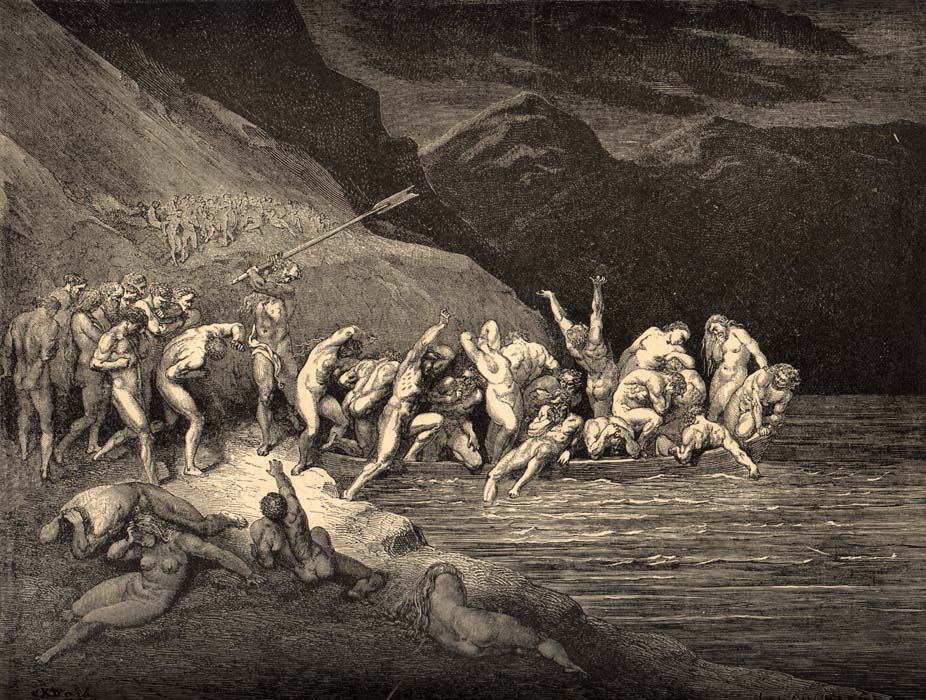
Ferrying the Damned

Illustration of “Charon Ferrying the Damned” by Gustave Dore

(Blog Post 1 make-up)

This work created by Gustave Dore which depicts Charon Ferrying the Damned has elements very similar to how Dante describes the scene in canto 3 of Inferno. In the work, we can easily see Charon as the figure with the oar which is how Dante has described him. Dante introduces this figure in Inferno as, “Charon the demon, with eyes like glowing coals, making signs to them, gathers them all in; he beats with his oar whoever lingers” (Inferno, 109-111). The work also shows Charon swinging back the oar as if he is about to whack the damned who are trying to squeeze themselves onto the boat. We can also tell that he might be close to striking the souls by the way the figure just behind Charon cowers and shrinks back in fear.

Another element of this work that is depicted similarly to how Dante describes it is the congregation of the damned souls. Dante describes the souls as, “… all of them together, weeping loudly, drew near the evil shore that awaits each one who does not fear God” (Inferno 3, 106-108). The pain and distress is depicted in work through the positioning of the bodies. Some reach up and out while other are stretched out in a helpless manner and other have their heads in their hands. When describing this scene Dante also mentions, “… over here again a new flock gathers” (Inferno 3, 119-120). This also depicted in the work with the group of souls just behind Charon and the congregation of souls we can faintly see in the background on the mountain side who will journey to the same fate. Through these elements it can be determined that Gustave Dore accurately depicted what Dante describes upon reaching the Acheron.