Category Archives: Posts

Canto 11 – A Brief Break to Explain the Organization of Hell/The Presence of the Number 3 and The Importance of Nature

Canto 11 reminded me of previous cantos where Virgil and Dante pause because Dante, the pilgrim, needs explanations and clarity from Virgil. This is a recurring technique of Dante, the writer, in which he allows the readers to mirror his character and gain answers to similar confusions that the pilgrim himself is experiencing.

While Virgil and Dante are resting, Virgil explains the organization of Hell in more depth. The organization also enables the reader to note how Dante, the poet, classifies the severity of certain sins over others. I thought it was compelling that the religious presence of the number three appears again in this Canto. First, Virgil tells Dante there are three smaller circles. Hell is separated into three parts. The first circle in middle hell is also divided into three subcircles where the sinners are separated into three groups based on the gravity of violence either committed against others, against oneself, and the worst, which is violence against God.

I was a little confused as to why Dante punishes sodomy as a worse punishment than the crimes committed by the lustful in Circle 2/Canto 5. But, when I reread Virgil’s explanations to Dante I gained more clarity. It is important to note that sodomy is a sin of violence. This means that Dante, the writer, does not punish sodomizers for their morality but more so because he views it as unnatural to the world. Dante the poet defines crimes against God as the most violent because they go against the natural will of life. Virgil states that sodomy and those who harm God scorn “nature and its goodness.” (Canto 11, Line 47). For Dante, something that contradicts nature is far worse and violent than engaging in lust. Above all, God is the most important, therefore going against him and harming what he created is worse than harming others.

Lastly, Dante, the writer, punishes the fraudulent at a lower place in Hell. Virgil tells the pilgrim that fraud, “seems to cut solely into the bond of love” and “forgets the love that Nature makes” (Canto 11, Lines 52-58). It is clear again how severe defying nature is to Dante, the poet. When one is fraudulent and deceitful, he is going against the natural trust and love people are meant to have for one another. Dante ranks fraud worse than violence because it directly contradicts natural trust.

Mankind’s Fraud

In Canto 11, Dante and Virgil have a brief respite from their journey before continuing on, and both agreeing that they should make use of this time, Virgil decides to tell the pilgrim who they will be seeing next, so that he does not have to explain later. In lines 22-24: “Of every malice gaining the hatred of Heaven, injustice is the goal, and every such goal injures someone either with force or with fraud.” This line explains that the actions of men that Heaven punishes, are all actions that have the end goal of hurting someone. Virgil goes on to say later in the canto, that this hurt can be directed at “God, to oneself, and to one’s neighbor..” (Line 31). However, those who hurt another with violence are not punished to the same degree as those who are fraudulent, which here means those who lie or mislead.

Line 25-27: “But because fraud is an evil proper to man, it is more displeasing to God; and therefore the fraudulent have a lower place and greater pain assails them.” The mention of fraud being an evil that only mankind has is the reasoning for the greater punishment of those who commit fraud. Later in the canto, Virgil explains that fraud can be committed only where there is trust, and that fraud takes advantage of this trust (lines 52-53). This greater punishment of fraud because it is a human flaw may be linked to Satan deceiving in the Garden of Eden, committing the first fraud.

Religious and Political Allegory in Canto 13

In Canto 13 Dante reintroduces a political and religious allegory through the folly recount Pier Delle Vigne. In this Canto, Dante and Virgil arrive at the seventh circle, second sub-circle, where obscure atmosphere confuses Dante and gives forth to the instruction from Virgil to rip a branch from a tree. As Dante dismembers the branch he sees blood spewing from its end. The tree then cries out ” Why do you split me?” (Canto 13, 31.3). This cry of pain was the voice of Pier Delle Vigne, a politician who acted as secretary to Emperor Frederick II. Within this seventh circle the sin is that of suicide, which Dante uses as a religious allegory by showing that although Pier may have been without sin, meaning, Pier might have been innocent of the treasonous crimes attributed to him at the time and therefore sinless, Pier committed suicide which is blasphemous to God and in and of itself condemns the suicided to hell through lack of ability to repent. Furthermore a religious contrast between Pier and St. Peter by noting that Pier scarcely let anyone from the emperors presence, ” that i excluded almost everyone from his intimacy;” (Canto 13, 61.1) whereas Peter is the one who holds the gates of heaven open to those worthy. This shows a love of openness in Peter and not in Pier. However, as Pier continues to unpack his emotional distress, he reveals folly in his lack of wisdom and repentance stating, “by the strange new roots i swear to you that i never broke faith with my lord.”; Pier is incredulous to his betrayal of God and feels pitiful towards himself.

In terms of political allegory, Dante illustrates the corrupt political nature in Florence. Although Pier is possibly innocent, the ease in which corruptness is introduced and convicted upon Pier depicts an unstable and weak political system in which corruptness is expected and will be apparent throughout the rest of Dante’s journey through hell.

Virgil Got His Confidence Back- Canto 12

I’ve come to realize that Virgil is regaining his confidence in Canto 12. For example, at the start of the Canto, both Virgil and Dante meets the Minotaur, Crete: Virgil, with annoyance shouts at the Cretin to leave or else he faces punishment, ”Get thee gone, beast, for this one cometh not/ Instructed by thy sister, but he comes/ In order to behold your punishments.” (Alighieri 19-21).  Furthermore, When Crete goes insane with rage and charges towards to them, Virgil takes lead and instructs Dante to dodge pass Crete while he is distracted by his wrath,  “Run to the passage;/ While he wroth, ’tis well thou shouldst descend.”(Alighieri 26-27). It is evident that Virgil is no longer that person who faced defeat at the entry of Dis (Canto 8). Virgil goes as far as to boasts upon outsmarting Crete, “Thou art thinking/ Perhaps upon this ruin, which is guarded/ By that brute anger which just now I quenched.” (Alighieri 31-33). Furthermore, as they continue with their journey, Virgil and Dante encounters a group of Centaurs with bows and arrows demanding an explanation about their presence, to which Virgil, again with confidence and bravado states, “Our answer will we make/ To Chiron, near you there; in evil hour,/ That will of thine was evermore so hasty.”  (Alighieri 63-35). Here Virgil takes a stand: he will not budge until he speaks to Chiron. This whole Canto, in my opinion has a hidden theme, which is reclamation. Virgil is now becoming a true leader, a proper guide. Up until now, Virgil had helped Dante through the first five circles of Hell, and that does merit trust, but with this new confident assertive Virgil; Dante feels assured and sheds any doubts that he has accumulated from Virgil’s previous failed actions.


Farinata friend of foe?

In canto 10, Dante and his master (Virgil) find themselves still in the 6th circle of hell. They both wander around the tombs of the Heretics. Amongst these heretics were the Epicureans. The Epicureans believed that the soul died with the body. A soul comes to Dante calling him a Tuscan which is later on discovered to be Farinata.

“O Tuscan who through the city of fire, alive, walk along speaking so modestly, let it please you to stop in this place. Your speech makes you manifest as a native of that noble fatherland to which perhaps I was too harmful.”(Inferno, Canto 10, 22-27)

These lines caught my attention because we can see that Virgil encourages Dante to have a conversation with Farinata. One of my questions to this is: how are Farinata and Dante connected? And why does he call Farinata his “leader”. Also, is Dante afraid of Farinata? I’m asking this because lines 34-36 mention “I had already fixed my eyes in his; and he was rising up with his breast and forehead as if he had hell in great disdain”. To me, that sounds a bit extreme to have all of Hell in disdain, how much power does Farinata have?.

I can tell that Farinata and Dante are discussing some sort of politics and it leads me to assume that they were of opposite parties since Farinata says “fiercely were they opposed to me and to my ancestors and to my party, so that twice I scattered them.”(Canto 10, 46-47).

Another soul interrupts the conversation that barely begun between Farinata and Dante which is later on known to be the father of Guido(Dante’s friend). The father asks Dante why his son did not accompany him, so I can imply that Guido is already dead.

Heresy and its Connection to Medieval Philosophies

Farinata degli Uberti addresses Dante, engraving by Gustave Doré

“The people who are lying in the sepulchers, could they be seen? For all the covers are lifted, and no one is standing guard.”

And he said to me: “All will be closed from Jehoshapat, they return with the bodies they left up there.

Epicurus and his followers have their cemetery in this part, who make the soul die within the body.”

Dante’s descriptions of heretics in the 10th Canto start with this question from Dante. He asks Virgil why the covers of the sarcophagi are lifted, a strange detail of their punishment. Virgil’s answer sheds more light on the Last Judgement which has been discussed in past Cantos, as he describes that the covers will be closed after their inhabitants return from Jehoshapat, the site of the Last Judgement. From there these souls will return with their bodies from above, and seal themselves in their tombs for eternity.

This description furthers the dialogue between Dante and Virgil regarding the future fate of the damned. In the 3rd Circle, Virgil mentions how the sinners will be reunited with their bodies following the Last Judgement, and that their punishments now are less severe compared to the reunification of body and soul. Prior to the Comedy, there were two ideas about the nature of humanity. Plato believed that human nature was complete with the soul, and that the body was a fall from the “perfect.” Aristotle believed that the form of the soul was the body, and leaned toward the impossibility of eternal life because when the body died, so did the soul. The medieval perspective was an adaptation of Aristotle’s perspective, which identified that the soul and body were separate, but that the unification of the two was the “perfect” human nature. Because the souls of the damned are only punished through the soul, after the Last Judgement and the unification of soul and body their punishment will be total. Their suffering will be complete because of the punishment of soul and body.

Another important detail of this terzina is Virgil’s description of Epicurus, a heretic. He says that Epicurus and his followers “make the soul die within the body,” relating the medieval-Aristotle perspective on the soul to the sins of heretics. Through perversion of of the mind, heretics violate a facet of human nature in much the same way that murder or other acts of violence violate the body.

the appearance of souls in canto 13

In Canto 13, Vigil and the Pilgrim enter the second ring of the seventh circle of Hell.  The souls being punished here are the only ones so far that are represented as a manifestation of something other than a human form.  Even though none of the souls the Pilgrim has seen on his journey have been attached to their former bodies, they have always appeared as though they had bodies.  Many times these souls even look as they did in life, since the Pilgrim tells us on multiple occasions that he recognizes them (as in canto 12, line 123 for example).  There have been a few occasions where the souls are unrecognizable: the instance in canto 6 where the Pilgrim encounters Ciacco who asks if  he can recognize him, the Pilgrim responds “”The aguish that you have perhaps drives you from my memory, so that it does not seem I have ever seen you”” (lines 43-45); the Pilgrim’s response shows the reader that in this case (gluttony) the suffering has altered the appearance of the soul so that it no longer looks like the body and can not be recognized from life on Earth to life in Hell.  Even the cowards in canto 3, who are unworthy of remembrance even, are recognizable (canto 3, lines58-60).

So it is a great shock for the Pilgrim when he encounters the souls in canto 13, who do not appear in even a remotely human form.  When they arrive in this circle, the Pilgrim can hear the sounds of suffering all around him but can not make out where they are coming from–the voices are disembodied, quite literally, although this may make the reader realize that all the voices (including the voice of Virgil, who represents the voice of truth and reason throughout the poem) are disembodied.  The eerie feelings surrounding the Pilgrim at the beginning of this canto are a reminder of his mortality and the fact that he should not be in this world that belongs only to the dead.  The reader is just as confused as the Pilgrim here, as we find out the truth through his actions just as he does–since we are human and we are alive we feel the same uneasiness at the disconnect of our souls and our bodies.  The souls in this circle are manifested as bushes and plants–a fitting punishment since they did not respect their bodies while they were alive.  In death, the other inhabitants of Hell have been granted an illusion of a body, a connection to their visual representation on Earth.  Though it is not much consolation, these souls who look like their bodies are able to maintain more of their identity in death since the physical appearance remains at least similar (the soul the Pilgrim speaks with never tells us his name, as though he no longer has a right to his identity associated with it just as he no longer has the right to the identity associated with his body).

It is important too that the souls are plants and not animals.  The souls here are being punished for violence towards themselves–they used their free will, their agency, and their bodies against themselves; so it is fitting that as punishment they take the form of something with  no agency–no hands to hurt themselves with.  In life they were confronted with pain or problems and rather they chose to destroy themselves in order to escape what they feared on Earth.  Now they have no ability to stop the physical pain they are being caused by the Harpies (as they have no defense system) and no ability to escape the pain as they did in life (since they are without agency and limbs).

The soul the Pilgrim speaks with explains that even after the last judgement, when all the other sinners will have their bodies reconnected with their souls, the souls here will have the cruel privilege of their bodies being returned to the plant which now houses their souls.  Since the last judgement is the perfection of their punishment, these sinners will be forced to see the bodies they destroyed, disrespected, and took away from themselves and be unable to return  to them.

Frozen swamp

http://www.worldofdante.org/pop_up_query.php?dbid=I143&show=more

Dante Alighieri’s Inferno from the Original by Dante Alighieri and Illustrated with the Designs of Gustave Doré (New York: Cassell Publishing Company, 1890)


Dante finds himself in the third circle of hell after recovering from a state of unconsciousness cased by extreme and profound sympathy that he felt for two lovers – Francesca and Paulo.

“… new torments and new tormented ones I see around me wherever I walk, and wherever I turn, and wherever I look.” (Canto 6, 7-9) Here the pilgrim becomes extremely overwhelmed by what he sees, by what surrounds him. He already fainted twice and seems exhausted but now he realizes that it is only the beginning of the journey. The new damned souls surround him to the point he feels trapped and helpless because there is no way out.

“I am in the third circle, with the eternal, cursed, cold, and heavy rain; its rule and quality never change.” Dante describes the third circle of hell using multiple adjectives that convey a very negative and unpleasant image of this place. Rain, which is a key word here and typically has a positive connotation, falls in abundance here. Because of the fact that it is an area of gluttons everything here comes in a plentiful amount, never changes and has no end, which becomes a curse.

“Great hailstones, filthy water, and snow pour down through the dark air, the earth stinks that receives them.” Dante continues his description of the third circle of hell presenting in as frozen and odorous swamp. It becomes obvious for the reader that there is a shift in the pilgrim’s perception of hell. There are no feelings of compassion or sorrow anymore, just overwhelming repulsion.

Hell as Babel

In Canto 7, we are confronted with Plutus opening verse of “Pape Satan, pape Satan aleppe!”. This verse deserves a special mention because it is one those verse in the Divine Comedy that remains untranslated, and it might lose its intended and original meaning if it is translated. Untranslatable verse like this allows us to investigate on the general meaning and the hidden implication of the words in the verse.

In the case of “Pape Satan, pape Satan aleppe!”, Alighieri does not use the common Italian/Latin word ‘papa’ as pope, but instead uses the informal and debased version of the word ‘pape’.  And at the same time ‘Pape’ is a rhetorical device that act as an interjection for showing affection. The last word ‘aleppe’ is similar to the first Hebrew alphabet of ‘aleph’ which implies God (the divine one). In the verse ‘aleppe’ is placed at the end of the verse, showing that God permeates from the beginning to the end (Digital Dante C Inf VII).

Not only Plutus is a Greek god of wealth, we can imagine that he has shown proficiency in the art of language, mastering both Italian, Latin, and Hebrew, and as well as mastering the debauched dialects of these languages. He is to be reminded of a polyglot with a confused tongue who were banished from the tower of Babel. It is like that of Plutus, a pagan god who is punished by the Judeo-Christian version of God. Plutus, speaking with “his clucking voice”, utter the corrupted speech of interjection, “Pape Satan, pape Satan aleppe!” to show his affection to Satan, yet satirizing himself to reveal the papacy state during Alighieri’s time, when the indignation of Paganistic heresy were very common.

On a broader scale, I am not familiar with the specific historical context of how the multiplicity of language comes into play with the sociopolitical structure of the Church state (since the common language is Latin). But there might implication on how the diversity of languages and thoughts affect the sociopolitical structure of the Church state, if there is any at all, from my previous drawing of the parallel between the tower of Babel to the political state during Alighieri’s time.


The Gluttonous Politics of Florence

“Ciacco” – Suloni Robertson (http://danteworlds.laits.utexas.edu/gallery05.html)

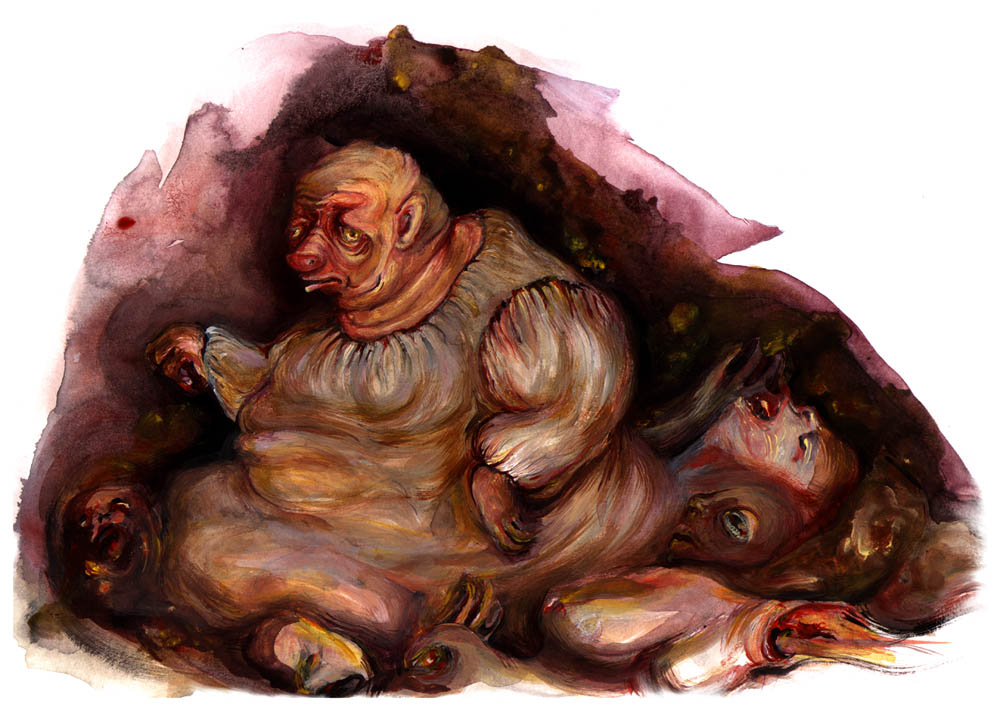
In Canto 6, Dante awakens in the third circle of hell. He finds himself surrounded by suffering spirits who are punished by an “eternal, cursed, cold, and heavy rain” (7) because of their indulgences and greed. Dante encounters Cerberus, the mythological three-headed dog-like demon beast, who continuously barks at the cursed souls. Then, Dante comes across a soul who asks him, Dante, to “recognize me if you can.” Dante cannot recognize him because the soul no longer looks like his living self but he is Ciacco of Florence who is punished in the third circle of hell for his sin of gluttony. According to UTexas’ Dante Worlds, Ciacco may be a derogatory reference to “pig” in the Florentine dialect of Dante’s day which is probably why Suloni Robertson depicts Ciacco as a stuffed pig in her painting. The pig is used as a metaphor for the excessive greed politicians often use for their own personal gains. Ciacco explains to Dante that there all the others in the third circle also “endure similar punishment for similar guilt” (55-56). Dante weeps again for Ciacco’s suffering and troubles but once he realizes who is speaking to he wants to know the future of Florentine politics. Dante asks Ciacco if worthy men are in heaven or hell and Ciacco responds, “They are among the blacker souls” meaning despite their certain good actions in life their selfishness punished them in the deeper circles of hell.

Canto 6 shows how massively important the politics of Florence are to both Dante the writer and Dante the character. Florence is something that personally affects Dante and this is the first place in Inferno where politics are thoroughly introduced and the focus is what is going to happen to Florence.