Daily Archives: April 28, 2019

The Woman and The Giant

Makeup for Blogpost 4

Giant and whore atop the transformed cart, John Flaxman, engraving.

Giant and whore atop the transformed cart, Gustave Doré, woodcut

John Flaxman and Gustave Doré both depict the same scene from canto 32 of Paradiso. At the end of the canto 32, the chariot which Beatrice had arrive on is transformed into a group of beasts. Dante sees “ungirt whore” sitting upon them (line 149).

Doré’s rendition, the giant has his hands placed on the woman, as if he is forcing her down. In Flaxman’s, she appears more of a willing participant, with the giant’s arm loosely around her waist, but without the forcefulness of Doré’s. In Flaxman’s, the giant wears a crown, carries a sword behind him. The woman wears a feathered hat on her head. This lends to a more regal look to the pair, than in Doré’s, where the giant is barely dressed, giving him the look of a savage and unkempt, more animal than man. The back of the chariot can still be seen in Flaxman’s depiction, and presumedly the transformation into the beasts has not fully taken place yet. However, for Doré’s work, the chariot has already completely disappeared from view.

Doré displays the beasts that the chariot has transformed in as looking straight forth, towards the audience of the artwork, whereas Flaxman’s beasts are looking to the side of the frame. The beasts looking forward appear more fearsome, because they can be seen as targeting the viewer.

Dante writes that the woman “turned her greedy, wandering eye towards” him, and the giant reacted in anger to this (line 154-159). Flaxman shows the giant and the woman looking at each other, albeit from the corner of their eyes. However, with Dante’s account in mind, she is most likely looking towards the poet, and the giant is looking at the woman in annoyance. In Doré’s depiction, the woman and the giant are both looking in the same general direction. The giant’s head is tilted downwards and to his right, away from the woman. Since Dante tells us the woman is looking at him, the giant’s gaze must also be on Dante.
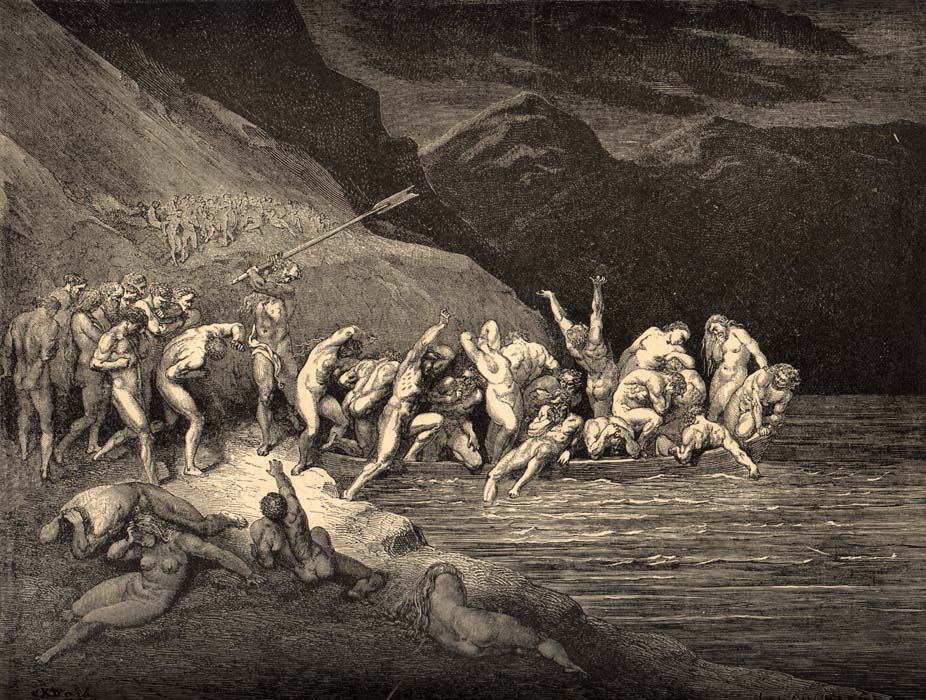



Ferrying the Damned

Illustration of “Charon Ferrying the Damned” by Gustave Dore

(Blog Post 1 make-up)

This work created by Gustave Dore which depicts Charon Ferrying the Damned has elements very similar to how Dante describes the scene in canto 3 of Inferno. In the work, we can easily see Charon as the figure with the oar which is how Dante has described him. Dante introduces this figure in Inferno as, “Charon the demon, with eyes like glowing coals, making signs to them, gathers them all in; he beats with his oar whoever lingers” (Inferno, 109-111). The work also shows Charon swinging back the oar as if he is about to whack the damned who are trying to squeeze themselves onto the boat. We can also tell that he might be close to striking the souls by the way the figure just behind Charon cowers and shrinks back in fear.

Another element of this work that is depicted similarly to how Dante describes it is the congregation of the damned souls. Dante describes the souls as, “… all of them together, weeping loudly, drew near the evil shore that awaits each one who does not fear God” (Inferno 3, 106-108). The pain and distress is depicted in work through the positioning of the bodies. Some reach up and out while other are stretched out in a helpless manner and other have their heads in their hands. When describing this scene Dante also mentions, “… over here again a new flock gathers” (Inferno 3, 119-120). This also depicted in the work with the group of souls just behind Charon and the congregation of souls we can faintly see in the background on the mountain side who will journey to the same fate. Through these elements it can be determined that Gustave Dore accurately depicted what Dante describes upon reaching the Acheron.


Next post (due April 29)

This is just a reminder that in this post you are free to analyze your own post, comment on the reading for this week (Purgatorio 32-33, Paradiso 1-2), analyze a picture.

In class you will present the topic of your paper very briefly to the class and in groups we will discuss the 4 cantos (be ready to select meaningful passages).

Enjoy the rest of the break!