
As I look back on my posts since my previous reflection, I have becomes more comfortable with fully analyzing images related to our readings. Prior to this, I would give a brief summary of our readings for the week. As I look at every element of the images, rather than just the obvious action, I was able to find small details I have not noticed before. In my 7th post, I chose to use two images, one for Dante and Virgil’s encounter with Satan, and another when they finally reach purgatory. I was still focusing on the narrative rather than truly analyzing the details of the images, which tells us a story of its own. After the met visit and answering the questions given, I learned to view art in a different perspective rather than seeing what’s on the surface. In post 8, I chose an image related to Dante finally meeting Beatrice again in Purgatory. In that post I briefly mentioned the fated meeting, and paid close attention to how the artist, John Flaxman, chose to depict the moving scene. Rather than just mentioning what was stated in the canto about Dante crying over the disappearance of Virgil, I also acknowledged Beatrice’s stance, and the figures in the background. I was able to understand that every aspect of the image contributes to how to artist chose to portray the scene. Although I have become more comfortable with analyzing, I still have difficulties grasping Dante’s symbolism for what he is telling us in his poetry.
Monthly Archives: April 2019
Final Paper
Final Paper
Dalí vs Boticelli
The representation and interpretation of lucifer in Dante’s Inferno by Salvador Dalí and Sandro Boticelli.
In my final paper I will focus on the interpretation of the concept of the devil in Dante’s Inferno as depicted by Salvator Dalí and Sandro Boticelli.
In the first part I will briefly introduce the interpretation of the concept of Hell in Dante’s Inferno. Then I will focus on the image of the emperor of the dolorous kingdom presented by the author
In the second part I will present the illustration of Lucifer created by Salvador Dalí in 1951 for Dante Alighieri’s Divine Comedy. I will describe it in detail and enumerate similarities and differences with the image of Lucifer presented by Dante in Inferno.

In the third part of my paper I will present the illustration of Lucifer created by Sandro Boticelli. I will provide the description of the drawing and state the similarities and differences with the Lucifer of Dante.


In the last part of my paper I will state that the illustrations of Dalí and Boticelli clearly reveal how these two artists captured Dante’s poetical imagery through a variety of interpretations and artistic processes. I will also conclude which of the two presented works come closer to the image of devil presented by the author himself.
The Woman and The Giant
Makeup for Blogpost 4

Giant and whore atop the transformed cart, John Flaxman, engraving.

Giant and whore atop the transformed cart, Gustave Doré, woodcut
John Flaxman and Gustave Doré both depict the same scene from canto 32 of Paradiso. At the end of the canto 32, the chariot which Beatrice had arrive on is transformed into a group of beasts. Dante sees “ungirt whore” sitting upon them (line 149).
Doré’s rendition, the giant has his hands placed on the woman, as if he is forcing her down. In Flaxman’s, she appears more of a willing participant, with the giant’s arm loosely around her waist, but without the forcefulness of Doré’s. In Flaxman’s, the giant wears a crown, carries a sword behind him. The woman wears a feathered hat on her head. This lends to a more regal look to the pair, than in Doré’s, where the giant is barely dressed, giving him the look of a savage and unkempt, more animal than man. The back of the chariot can still be seen in Flaxman’s depiction, and presumedly the transformation into the beasts has not fully taken place yet. However, for Doré’s work, the chariot has already completely disappeared from view.
Doré displays the beasts that the chariot has transformed in as looking straight forth, towards the audience of the artwork, whereas Flaxman’s beasts are looking to the side of the frame. The beasts looking forward appear more fearsome, because they can be seen as targeting the viewer.
Dante writes that the woman “turned her greedy, wandering eye towards” him, and the giant reacted in anger to this (line 154-159). Flaxman shows the giant and the woman looking at each other, albeit from the corner of their eyes. However, with Dante’s account in mind, she is most likely looking towards the poet, and the giant is looking at the woman in annoyance. In Doré’s depiction, the woman and the giant are both looking in the same general direction. The giant’s head is tilted downwards and to his right, away from the woman. Since Dante tells us the woman is looking at him, the giant’s gaze must also be on Dante.
Ferrying the Damned
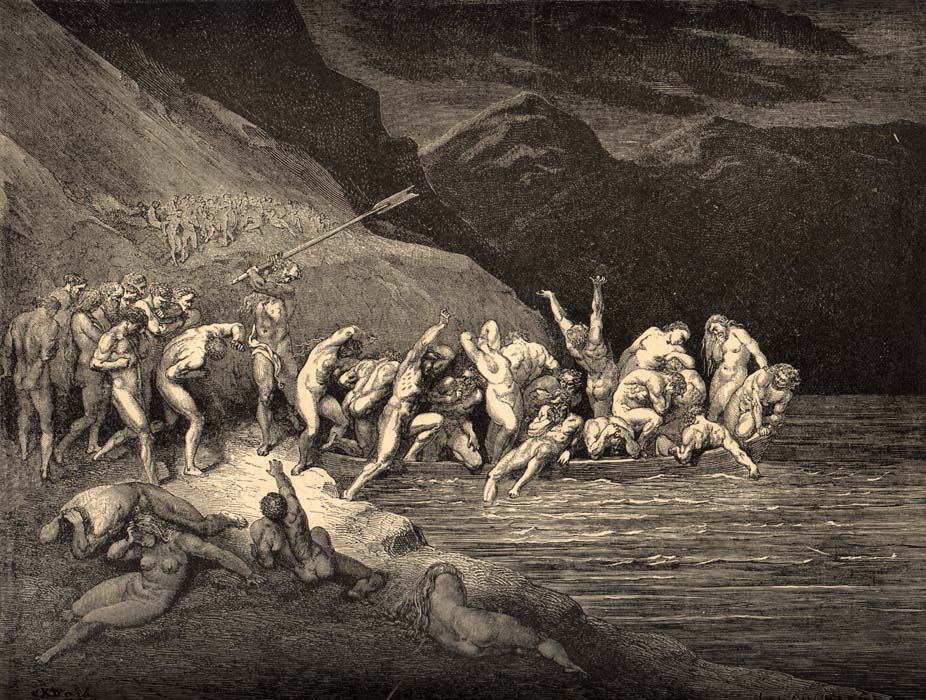
Illustration of “Charon Ferrying the Damned” by Gustave Dore
(Blog Post 1 make-up)
This work created by Gustave Dore which depicts Charon Ferrying the Damned has elements very similar to how Dante describes the scene in canto 3 of Inferno. In the work, we can easily see Charon as the figure with the oar which is how Dante has described him. Dante introduces this figure in Inferno as, “Charon the demon, with eyes like glowing coals, making signs to them, gathers them all in; he beats with his oar whoever lingers” (Inferno, 109-111). The work also shows Charon swinging back the oar as if he is about to whack the damned who are trying to squeeze themselves onto the boat. We can also tell that he might be close to striking the souls by the way the figure just behind Charon cowers and shrinks back in fear.
Another element of this work that is depicted similarly to how Dante describes it is the congregation of the damned souls. Dante describes the souls as, “… all of them together, weeping loudly, drew near the evil shore that awaits each one who does not fear God” (Inferno 3, 106-108). The pain and distress is depicted in work through the positioning of the bodies. Some reach up and out while other are stretched out in a helpless manner and other have their heads in their hands. When describing this scene Dante also mentions, “… over here again a new flock gathers” (Inferno 3, 119-120). This also depicted in the work with the group of souls just behind Charon and the congregation of souls we can faintly see in the background on the mountain side who will journey to the same fate. Through these elements it can be determined that Gustave Dore accurately depicted what Dante describes upon reaching the Acheron.
Next post (due April 29)
This is just a reminder that in this post you are free to analyze your own post, comment on the reading for this week (Purgatorio 32-33, Paradiso 1-2), analyze a picture.
In class you will present the topic of your paper very briefly to the class and in groups we will discuss the 4 cantos (be ready to select meaningful passages).
Enjoy the rest of the break!
Next classes
I hope you all enjoy the break. Please refer to our course schedule and final paper assignment to prepare for our next two classes. I also copy here the timeline:
Timeline:
- By the end of April you will email me (or write in a post) about the topic of your final paper.
- You will bring a proposal of your paper to class on May 1 for peer-review. You will show a picture/slide to the class representing the topic of your paper. The class has to be ready to ask questions and give suggestions.
- You will bring a hard copy of an outline of your paper (introduction, questions to be addressed and thesis statement, and bibliography you believe you will use to write the paper) on May 8. We will peer review the outline.
Remember that we read Purgatorio 32-33 and Paradiso 1-2 for May 1.

Giusto di Gand’s portrait of Dante (ca 1473)
Garden of Eden vs. Forest of Harpies
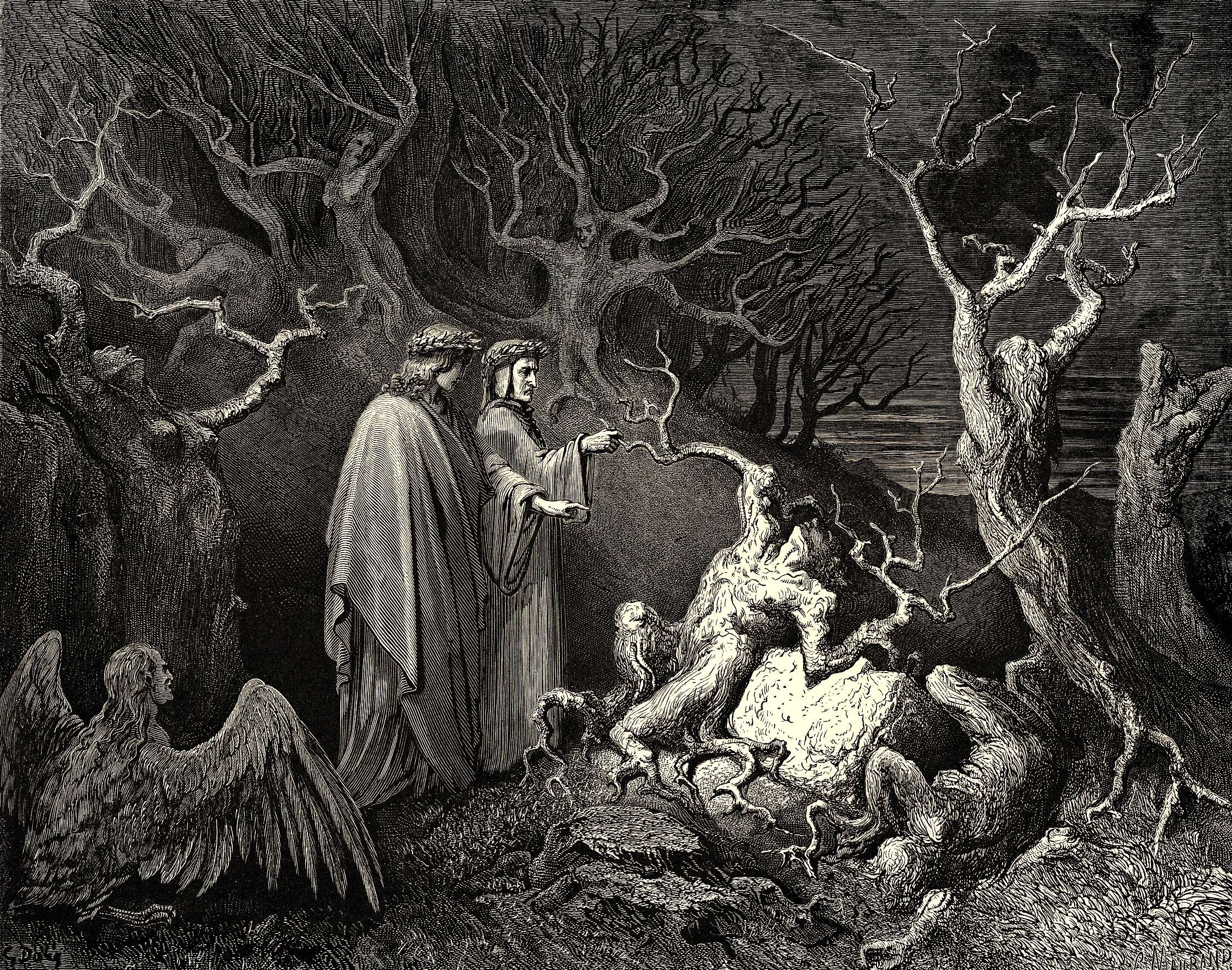

In Canto 28, we can see the first major juxtaposition of Purgatorio and Inferno. As both scenes embody a forest environment, Dante uses his great ability of imagery to illustrate what we find out is the Garden of Eden in canto 28. Dante starts the canto with with a lively attitude: “eager already to search within and about the dark forest, thick and alive, which tempered the new day to my eyes.” This reading portrays the first scene of livelihood–without worry– and “eagerness” of Dante. Dante no longer is to be cautioned or held back by Virgil because there is nothing to caution against.
The amount of beauty reflected in Dante’s words are unparalleled throughout his journey of Inferno and Purgatorio. Unlike the dark forest in canto 13 with the harpies and souls of the suicides, the Garden of Eden has but a sweet breeze, graceful enough to disturb the branches of the trees but not the resounding birds with their lovely songs. Dante elevates the beauty of the Garden to that of a beauty of scenic art; just as Dante incorporates fictional characters in inferno, he does the same in the garden of eden by incorporating Matelda as a nymph. She is a figure of beauty inhabiting the garden along the river and serves as partial tour guide of the Garden by explaining that the garden was meant to be a “token of eternal peace” for man because he was made in the image of God but fell from sanctity into sin.
Furthermore, canto 13 in Inferno depicts a forest that tokens the eternal suffering of sinners that think they can end their lives on their own terms. The forest of the harpies is inaccessible to the souls that aren’t victims of suicides–we know this– but it isn’t brought into full perspective until we read this canto of the garden of eden. The garden of eden is placed on top of the mountain, therefore being inaccessible to those unworthy of the perilous mountain climb. Dante does very well in comparing and contrasting the layout of inferno and Purgatorio, they seem to be perfectly juxtaposed in their structure and therefore in their scenic elements.
Dante’s True Paradise
(this post accidentally got erased late at night and i was really mad and re wrote it in the morning)
Canto 28 opens up with dante in the Garden of Eden. Dante seems to be free now to go about with his free will as he wants. According to Digital Dante, the first word of the Italian translation is “Vago” which means “desirous.” Translated into English, the first lines go as follows: “Now keen to search within, to search around that forest, dense, alive with green, divine, which tempered the new day before my eyes, without delay, I left behind the rise and took the plain advancing solely, slowly across the plain, advancing solely, slowly across the ground where every part was fragrant.” Here he is describing the garden and his newly realized freedom to roam about it. How beautiful it is and how alive he feels within it. Beatrice claims Dante to be a witness of the “Earthly Paradise” and to write down everything he sees. This Canto is much brighter and more positive than anything we have read so far. In canto 30, digital Dante points out that the Italian words “altrui” and “altrove” are both “powerful indicators of the seduction of the new.” These last canti are all geared towards the future which is something new to the comedy. Virgil is finally gone and Beatrice has arrived.
A few ideas i have had for the final paper pertaining to Dante’s Inferno and Purgatorio is to write about some of my favorite scenes in relation to the art that I saw at the MET. Another subject I could touch on is more of a personal one where I could explain how difficult it has been for me to understand the comedy as a whole but then towards the middle of the semester become more interested and actually enjoying the read.
Final Piece for True Paradise
The final piece for Dante’s salvation is Beatrice. In canto 30 Dante is awestruck at finally seeing Beatrice after all those years “I saw the lady who had first appeared/ to me beneath the veils of the angelic/ flowers look at me across the stream” (Alighieri 64-66). But, this does not mean that Dante is going to Paradise. Here, Beatrice is depicted with a stern and harsh stance towards Dante, “just as a mother seems / harsh to her child, so did she seem to me/ how bitter is the savor of stern pity!”(Alighieri 79-81). Dante is to undergo one last trial or reflection in order to ascend. It makes you wonder if the journey through Hell and Purgatory was enough to grant entry to Paradise, but it is not that simple; Dante passed and spectated throughout his journey, not participating. Dante merely took lessons from cautionary stories. In order to truly grant access to Paradise he must look into himself, and renounce all his sins by feeling anguish and sorrow: “my reply/ be understood by him who weeps beyond,/ so that his sorrow’s measure match his sins”(Alighieri 106-108). We have come to know since the beginning of Inferno that Dante has overwhelming love for Beatrice. With that in mind, there is no room for self deception for Dante. He cannot hide or lie about his sins to himself or even his love. Thus, he finally rids himself of sin by acknowledging them and feeling remorseful.
The Earthly Paradise
In canto 28, the Earthly paradise reflects man’s origin as an innocent creation susceptible to temptations. Dante implies that all creation including humans were created to follow the will of God. For example, Dante narrates that “by which the pliant branches, trembling, were bent, all of them, toward where the holy mountain casts its earliest shadow,” (Canto 28, lines 10-12). Dante characterizes the breeze that bends the branches as “unchanging in itself” (canto 28, line 7). In a mortal and materialistic world, everything ages and deteriorates. If anything is unchanging, it’s considered immortal and divine. Thus, the wind is an extension of God’s divinity and helps the creations follow the will of God. Moreover, Dante uses the adjective “pliant” to describe the branch to imply that nature itself , including the trees are created to bend at the will of God. He elaborates that they bent to “where the holy mountain casts its earliest shadows.” Even though the plants are supposed to bend at the will of God, they’re not bending in the “right” direction. Usually, trees and plants naturally bend towards the source of light which represents God, however, in this case, they’re bending towards the shadows where there is no light. In a sense, the plants are a metaphor for humans, Dante is implying that even though humans and all of nature is created to serve God, humans have strayed from their true purpose. The “holy mountain” is designed in such a way that it closest to the heavens so God’s light may always reach its inhabitants . However, humans turned to the “shadows” where God’s light does not reach them, and in doing so, they became shadows of their former selves that once lived in the Garden of Eden.
The body of waters reflects man’s pure origin and inevitable condemnation. Dante narrates that “ All the waters that back here are the purest,” (canto 28, line 28) and “it [they] hide nothing,” (canto 28, line 30). Just like the pure water, God created humans as pure beings devoid of all sins with clear intentions. Just as the water hides nothing about its contents, humans didn’t hide anything from God and each other. However, Dante elaborates that “although it moves dark, dark under the perpetual shade, which never lets sun or moon shine through.” (Canto 28, lines 31-32). The description of the water is contradictory because even though it’s pure, it’s dark. Usually, if water has a dark hue, it means that its contaminated. Since, the Earthly paradise represents the origin of humans, the description of the waters parallels the human transformation from pure creations to morally corrupt beings. Even though the body of water is close to the the stars in the heavens, the celestial light can’t penetrate the water because it’s located in the first place that humans sinned and fell from heaven. God created the Earthly paradise so that his light can always shine on Adam and Eve. However, when they disobeyed him, they fell from heaven and the celestial light in the forms of stars, sun, and moon no longer directly shined on them. The pure and dark nature of the water shows that the once pure humans are corrupted inside, and God’s light fails to penetrate their heart, hence they’re purposeless and led astray. There is a repetition of the word “shadow” to reiterate that the paradise is full of shadows just like humans are shadows of their original status and glory.
The Garden of Paradise essentially displays what humans have lost. Hence, the garden is physically characterized so that it can show the true story of humans as pure beings who fell from Grace. In fact, Matelda narrates that “Because of his own fault he dwelt here but little; by his own fault he changed into weeping and labor his virtuous laughter and sweet play.” (canto 28, line 94-96). The clauses set up a parallel between “weeping” and “virtuous laughter,” and “labor” and “sweet play” to show how humans live on earth and how they lived on the Garden of Eden. The earthly Paradise mirrors the punishment for Adam and Eve’s sin and their fall from Paradise. Dante claims “You put me in the mind of where and what Proserpina was,”( canto 28, line 49-50). Dante claims that the Earthly paradise reminds him of the story of Prosperina because just as she lost her virginity and ability to reside on Earth when Hades raped and imprisoned her, humans lost their status and ability to reside on the Earthly paradise. For Dante, the earthly paradise represents the origin of humans and their true narrative which include the purity of their creation and their simultaneous fall from paradise.
Personal Note: I’m not entirely sure what my final paper is, however I am exploring some leads. I’m planning on attending the Harrowing of Hell play. Based on my feeling on it, I may decide to do a comparative essay based on Dante’s inferno and the play’s interpretation of hell. If I don’t like the play, I might pick something else to do.
Side note: I’m confused about the female characters and what they represent. I read that Persepolina represents the “human err” in the notes and I don’t understand what error she committed. I think her suffering is similar to the humans but its through no fault of her own. Also, while I understand that Matelda is represented as the “ unfallen Eve”, I don’t understand what Beatrice represents? Is she the “redeemed Eve”?

