In the 8th circle, there is an important change in the representation of the sinners and the Pilgrim’s disposition towards them. In the first of the trenches within this circle the Pilgrim encounters a sinner who is hiding “by lowering his face” (canto 18, line 46). This is the first time on his journey that the Pilgrim encounters a sinner who does not want to be remembered. In all the previous circles, it is an act of pity and an attempt to slightly reduce the sinners’ suffering by reviving their name on earth. After entering Hell, sinners are memorialized in all of Dante’s cantos except for canto 3, 7, and 11. The sinners in canto 3 are not memorialized because they are the cowards who “the world permits no fame of them to exist”; which literally means they are not allowed to be remembered even though the Pilgrim is able to recognize some of them (canto 3, line 49, 58). The sinners in canto 7 are not able to be remembered because “the undiscerning life that befouled them makes them dark now to all recognition” (canto 7, line 53-54).
The sinner in canto 18 is Venedico Cacciamenico and he does not want to be remembered because of his sin. It is important that Dante tells his story in this canto because here he is not telling the story out of pity or respect or in an attempt to help. Though we get Cacciamenico’s story, there is little conversation or commentary from the Pilgrim on this character. As it is only the first trench of the eighth circle, it is possible that the Pilgrim is not yet sure about the way he feels about his opinion on these sinners. It is possible that Dante tells Cacciamenico’s story precisely because he does not want it to be told, which shows that Dante understands how the punishments in Hell are part of God’s plan.
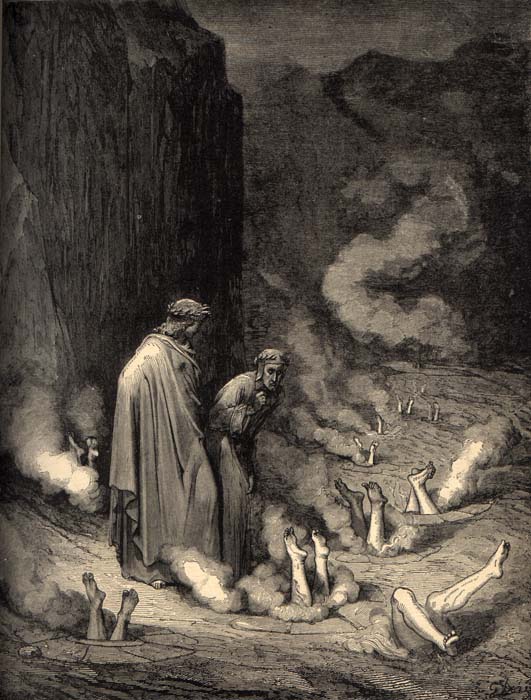
The Pilgrim has definitely learned this lesson by the time he reaches the third trench. There he encounters Pope Nicholas II, whom he berates under Virgil’s approving smile (canto 19, line 121-123). While this canto is clearly Dante’s excuse to criticize the Catholic Church, because this criticism is directly coming from the character of the Pilgrim, it marks the point where the Pilgrim has first truly understood God’s plan in Hell.
However, dante takes a small step backwards in canto 20 when he begins to feel pity once again, now for the sinners in the fourth trench. The sinners here are contorted so that their heads are turned all the way around and they must walk backwards; Dante tells his readers: “now think for yourself how I could keep dry eyes” (canto 20, line 20-21). Here, the Pilgrim is reacting to the disfigurement, but is quickly reprimanded by Virgil for having pity on such sinners (canto 20, line 26-30).