Daily Archives: March 12, 2019

Dante’s Fear

Dante and Virgil are now entering the sixth pouch of the eighth circle. While they believed they had escaped the demons in the previous pouch, they now realize they are being chased by a huge pack of the Malabranche, meaning “evil claws.”

The canto seems to give the travelers a sense of uneasiness. In the beginning of the Canto, Dante seems afraid that they angered the  “Silent, alone, no one escorting us, we made our way. One went before, one went after, as Friars Minor when they walk together.” (Inferno 23, 1-3) 

Saving Dante, Virgil grabs him and jumps through the sixth pouch of the Eighth Circle with Dante in his arms. Now that they have lost the Malabranche, they are in the Sixth Pouch, where they see more souls aligned in a circle.

“And they were dressed in cloaks with cowls so low they fell before their eyes.” (Inferno 23, 76)

Dante is trying to find one of the souls now that he might recognize as he has been. Instead, he is now the one who is recognized by his Tuscan language. “Stay your steps, o you who hurry so along this darkened air!” (Inferno 23, 77)

Dante seems unsure of what will happen next, but seems to continue to symbolize his truths and emotions through the constant darkness and uncertainty of his journey with Virgil through the circles into hell. 

Of Cosmological Apatheia

Stoicism is a school of philosophy that dates back from 300 B.C.E. It emphasizes philosophy ought to be practiced not as academic studies, but as a way of life. Alighieri has indeed incorporated many stoical concepts and references throughout the Cantos from thinkers like Epictetus, Seneca, and Cicero. Of those concepts, I would like to introduce what Apatheia is. Apatheia, as the stoic Epictetus would define, ‘is freedom from unhealthy passion’ (pain, fear, craving, and pleasure) and having apatheia in one’s life would constitute a life of that is both virtuous and flourishing (IEP).

The method of practicing and developing apatheia towards one life can be achieved through the visualization of the cosmos from the omnipresent perspective of looking at the world down below and up above.

We can see that Alighieri expresses a similitude of the grandeur view of the cosmos. On line 1-3 of Canto 24, There is an astrological description showing the relative relation between the Sun and the constellation of Aquarius, which causes the changing of the firmament. It is important to notice the order of this Terzina because the cosmological element is ordered like this: Sun, Aquarius, and the sky.

In that part of the youthful year when the sun

tempers its locks under Aquarius and already the

nights are moving south (Inf. 24. 1-3)

Then on the next Terzina, the causal relationship between the ground and the frost – which hints at the melting of frost – alludes to the Earth and the changing of the weather.

when on the ground the frost copies the image of

her white sister, but her pen retains its temper only

briefly (Inf. 24. 4-6)

And again, the element of frostiness is being mentioned again in later line, “see the fields all white”. But more importantly, the perspective of the cosmos shifts into a one that focuses on human matter. And there is some type of unbalanced display of emotions that are concerned with the changing of season and nature.

[the peasant] goes back in his house, and complains here and

there, like a wretch who knows not what to do; then

he goes forth again and stores hope in his wicker basket

again (Inf. 24. 10-12)

Those dispositions can be characterized as being fearful, anxious, and distressed when the changes in the environment are not depended on our expectations and our ability to control certain situations. Such moment of unstable emotion is emphasized on line 16-17, “so my master made me lose confidence, when I saw his brow so clouded”. However, there is a sudden shift in Virgil’s disposition in the next two Terzina that can be summarized as:

with the sweet expression I first saw at the foot of the mountain, / he opened his arms and took hold of me (Inf. 24. 20-23)

And as Seneca has said

“The wise man and devotee of philosophy are needless to say inseparable from his body, and yet he is detached from it so far as the best part of his personality is concerned, directing his thoughts towards things far above.” (Letter LXV, Letters from a Stoic)

The excerpt brought from Seneca highlights the importance of Virgil’s virtuous strength, in which draws a connection when the pilgrim praises Virgil “And like one who uses judgment as he acts, always seeming to look ahead, so, carrying me up to the top.” We can see there is an implicit iconography of ascension by comparing these two excerpts. It is the one who directs his study above earthly and cosmological configurations to establish a complete perspective of the cosmos, thus enables one to have an outlook of mental calmness on life.

As a whole Alighieri’s meticulous layering of the cosmos imagery provides adequate ground for that one must see the world in a way that goes beyond human and social affairs, the changing of earthly environment and seasons. We must put our fascination onto the stars and the constellations to develop a sense of universal apatheia, that human worries and suffering is so insignificant compared to the sublime vastness of the universe. From there on, we can go ‘up’ to see the world in perspective starting from the smallest anthropological layers to the cosmological layers (human and society, the earth, the firmament, and the stars) to have a complete view of nature and the divine, and that we must confront the uncontrollable nature with emotional resilience like that of the cardinal virtues (justice, prudence, fortitude, temperance).

Test of Faith

In the Commento Baroliniano of canto 21 it discusses that Malacoda was able to deceive Virgil thus placing them in danger “Malacoda is able to deceive Virgilio because he accompanies his lie with a great truth: the true date of the death of Christ … Malacoda’s truthful lie—in effect, a falsehood that appears true—is the precise inversion of comedìa, a truth that appears false.” This marks the second time that Virgil has failed in this journey of guiding Dante. Although it wasn’t a walk in the park their journey has been relatively smooth aside from some hiccups like this event or at the gate of Dis. The purpose of this journey seems to be for Dante to understand the actions that God makes and to have faith in his decisions. But what is the purpose of these failures, these are certainly not coincidental Hell itself and its occupants are all governed by God himself, this little excursion of Dante and Virgil is definitely a part of his design. These incidents don’t seem to affect Dante much as we saw during the gate of Dis, he only became more and more nervous as he watched Virgil become more anxious through his face. In contrast these events seem to affect Virgil much more as we saw during in Dis his confidence that always seemed to be invincible was wounded and even now as we have seen in these recent dealing with the devils it has left a crack in him. It seems that this journey is also a test of faith for Virgil as much as it is for Dante.

Virgil and Dante’s Relationship

During Canto 23, the closeness of the relationship that Dante and Virgil have developed during their journey is shown. From the second Virgil appears to Dante in canto 1, it is clear the pilgrim admired the poet. However, the source of Virgil’s concern for Dante seems mostly dependant on the fact a higher power wished it. However, during their travels through the various circles of hell, it is evident that a bond has been developed. In the start of canto 23, in lines 28-30, Virgil is able to know what Dante is feeling and worried about just by looking at him. And while theres no doubt Dante or anyone would look quite shaken having just run away from demons, it also goes to show the intimacy that has developed between the two. Virgil can recognise Dante’s concern without him having to verbalise it.
Dante has reguarly refered to Virgil as a father and master, mostly in the context of what a great inspiration to Virgil has been to him. In this canto it goes a step foward, with Dante describing motherly actions of Virgil towards him, eg. line 37-42: ‘my leader seized me quickly, like a mother who is, awakened by the noise and sees the flames burning close by, who takes up her son and flees, caring more for him than for herself, not stopping even to put on her shift:” Virgil has gone further than simply being Dante’s guide, to caring baout his safety above all else.

Canto 24: Reptilian Thievery and The Symbol of Snakes and Rebirth

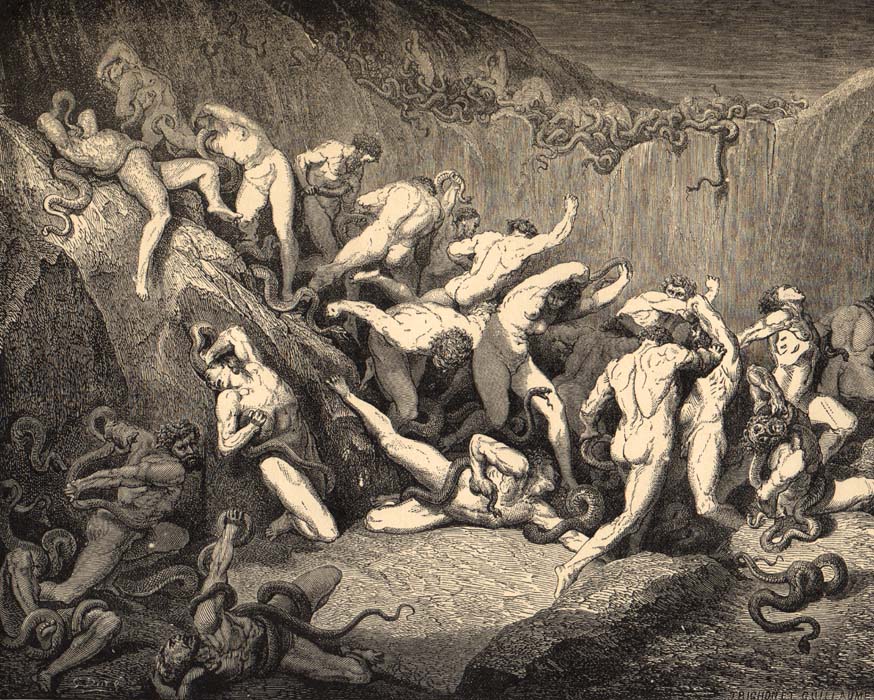
Gustave Doré, “Thieves”, Date: 1890, Medium: engraving

http://danteworlds.laits.utexas.edu/gallery11.html

Canto 24 begins like Canto 22 with a lengthy simile. In Canto 24, Dante and Virgil reach the seventh bolgia of the eighth circle. They find a ruined bridge and must climb rocks in order to reach the next level of hell. Dante is quite anxious, but Virgil helps Dante by carrying him and guiding him in what to do. Dante describes Virgil’s wisdom by comparing him to “one who uses judgment as he acts” (Canto 24, Line 24). Dante pauses for a rest from the difficult climb and Virgil advises him that “one does not gain fame sitting on down cushions,” meaning recognition does not come to those who are lazy. This advice seems to be an indication of Dante the poet’s life outside of Inferno.

Next, Dante and Virgil approach the sinners of Canto 24, thieves. Dante notices a “terrible crowding of serpents” (81). As shown in the Blake medium, the thieves are naked and chased by serpents. Once the snakes catch the sinners they bind their legs and hands. When the sinners are bitten, they catch fire, burn, and are reborn. Dante alludes to the Phoenix when he describes the fate of the thieves as they rise from the ashes like a Phoenix. It is both compelling and fitting that Dante, the poet, using snakes in the punishment for thieves. Snakes are often the symbol of rebirth. They shed their skin, transform, and represent immortality. Historically, snakes also act as bearers of secrets. In a religious context, snakes can represent deceit for it was a serpent who deceives Eve into eating a forbidden fruit. The serpents in Canto 24 punish thieves, people who hide massive secrets by stealing and trying to get away with their crime. It seems as though these thieves are snakes but instead of positive renewal they are forced to burn, die, and be reborn only to have to continue that process for eternity. As thieves they stole, therefore as sinners, they are infinitely having their livelihoods stolen from them as they are bitten by snakes. In Blake’s medium, it is evident by their expressions that the sinners are in pure agony as they are entangled by serpents.

Dante and Virgil encounter a sinner and Virgil asks him who he is. The sinner replies with, “I rained down from Tuscany” (121). Again the person Dante confronts introduces himself not by name but by the place he is from, signifying that one’s hometown is the strongest identity marker and truly makes him who he is. The sinner continues and states his name as Vanni Fucci. He is there because he stole from the church and blamed it on someone else. Fucci is among the unique sinners that Dante meets. He is one who truly does not want to be seen as he is in Hell. He states, “It pains me more to be caught in the wretchedness where you see me than when I was taken from the other life” (133-134). Fucci feels the shame and embarrassment of his crime. He is more focused on his place in Hell unlike other sinners, like Francesca, who are so stuck in a moment and fixated on what they were in life.


Sliding in haste into home of the hypocrites


Artist: Bartolomeo Pinelli
1825, Print, Italy
https://art.famsf.org/bartolomeo-pinelli/canto-xxiii-pl-47-linferno-di-dante-dantes-inferno-19633037283

Virgil and Dante continue their journey through the 8th circle of hell after secretly escaping from fighting devils that cause two of them fall in a pitch full of boiling tar. That situation causes the pilgrim to remember the Aesop Fable about a mouse and a deceitful frog who offered to carry a tiny animal across a river with a malicious intention of drowning him. Dante doesn’t even try to hide his overwhelming fear that enraged demons will eventually catch up to them. His agitation continues to build up making his “hairs curling with fear” (Divine Comedy, Dante Alighieri, Canto XXIII, 19), which consequently creates suspense and tension. He suggests to his master to look for a hiding spot before the steamed up demons wind up at their side. Well, Dante’s intuition turns out to be very much on point because the devils appear in pursuit out of nowhere. At that very moment Virgil grabs Dante:

“… like a mother who is

awakened by the noise and sees the flames burning

close by,

who takes up her son and flees, caring more for

him than for herself, not stopping even to put on her

shift:” (Divine Comedy, Canto XXIII, 37-42)

Virgil slides down the rocky cliff with Dante in his arms straight into the sixth pouch, which is the home of hypocrites. Dante completely taken by surprise describes the speed of them moving down:

“Water has never cursed more swiftly down a

slice to turn the wheels of a land mill, as it

approaches the paddles,

than did my master down the wall, carrying

me along on his breast like his son, not his

companion.” (Divine Comedy, Canto XXIII, 46-51)

Once Virgil and Dante reach the sixth bolgia they are safe at least from the devils that chased them because they are not able to leave their assigned part of hell. Although at times devils seem to have power over damned souls in the end they are nothing but Divine’s tools eternally trapped in hell.

The scene described above, which appears a little comical to me, shows that Virgil puts Dante’s safety first. What I find even more interesting is the fact that Virgil is presented here not only as the pilgrim’s beloved master and the guide but also as a person with maternal feelings towards him.


Canto 22 Deception


From Canto 21, Virgil and Dante were crossing the bridge into pouch five of circle eight. Virgil advises Dante to hide behind a rock while he tries to negotiate their passage with Malabranche (Sparknotes). Malabranche offers 10 demons to help them with their passage. This pouch contains the Barterers. Barolini states that Barratry “is the corruption of civic governance, and the result of barratry is the corruption of the social order” (Barolini). In canto 22, Dante and Virgil are walking with the ten demons. However, Dante’s attention “was all given to the pitch, to see every condition of the moat and of the people burned in it” (Inferno 22, 16-17). As Dante is observing the sinners, he notices their actions common to a dolphin. Martinez and Durlings note to lines 19-21, states that the traditional idea of how dolphins would warn the sailors when there was a storm approaching. Martinez and Durling bring up the point through their notes how Dante are continuously comparing the sinners to animals (Martinez and Durling, note to lines 19-21, canto 22 p.57102c). All throughout canto 22 Dante is continuously stating animal- like images of the sinner. Now the protagonist- barrater is known in the commentary tradition as Ciampolo (Barolini). I learned some background information regarding Ciampolo’s story when reading Barolini’s notes. She states that “Ciampolo’s story suggests the difficulty of maintaining equilibrium- toward material goods in such an environment. He was the son of a ribaldo, of a man who is not poor but who had on inheritance to squander and who destroyed first his means and then himself” (Barolini). Barolini also states that the story of Ciampolo’s father, like Ciampolo’s own, suggests the pressures generated by life in an environment where financial prudence was much less valued than “largesse” in spending (Barolini). When Virgil asks Ciampolo if there are any Italians in this pouch, “Ciampolo offers to betray his fellows in order to betray the devils, who betray each other in their eagerness to betray the sinners and in their eagerness to have Ciampolo betray his comrades” (Barolini). When reading this idea made by Barolini, I researched more on a different analysis of Ciampolo’s behavior in this canto. I read that Ciampolo’s episode is linked in the bolgia of barratry to political subversion and universal corruption (Falvo). The author of this source states that “this idea is supported by the image of the pitch… the sinof barratry that has spread to a whole community of people has become a paradigm for universal corruption and degradation, so will the punishment of this sin affecting the sinners and their persecutors, become the emblem of a moment in retributive justice” (Falvo). There is a them of deception in this canto. Ciampolo’s use of language shows an example of Dante’s idea of how the sinners speeches provide another way of understanding the punishments of Hell and show that pnishing sin does not always help the sinner understand the nature of what he or she has done wrong (Course Hero). Ciampolo’s promise of contriving greater sorrow for his companions was his way of challenging the devils at their own game of cruelty and deception (Falvo). When Ciampolo bluffed, it portrayed Ciampolo’s victory and Alichino’s defeat (Falvo). To Dante, this was acted out as a “ludo”, or sport/ theatrical play (Martinez and Durling, note to line 118, canto 22 p.57102e). The sinners have their own communications and codes of governance, all rooted in malice and betrayal (Barolini).


I found this image in the image section of the Barolini website. It shows the sinners in the tar- like substance. If you look closely it looks like Virgil and Dante are hugging each other as they watch in fear the exchange between Ciampolo and the demon.

Sources:
Alighieri, Dante, et al. Divine Comedy of Dante Alighieri : Inferno, edited by Ronald L. Martinez, Oxford University Press USA – OSO, 1996. ProQuest Ebook Central, https://ebookcentral.proquest.com/lib/huntercollege-ebooks/detail.action?docID=693941.

Barolini, Teodolinda. “Inferno 22: Diabolic Sport.” Commento Baroliniano, Digital Dante. New York, NY: Columbia University Libraries, 2018. https://digitaldante.columbia.edu/dante/divine-comedy/inferno/inferno-22/

Falvo, Joseph D. Decameron Web | Society, Brown University, www.brown.edu/Departments/Italian_Studies/LD/numbers/02/falvo.html.

“Inferno Themes.” The Logistic Model Has Good and Bad Features PROS CONS Mathematically Tractable, College Life, www.coursehero.com/lit/Inferno/themes/.
