Daily Archives: March 4, 2019

Feministic Dualism: Purity vs Corruption

In canto 19 in third pouch of the 8th circle of hell, Dante defines the dualism between purity and corrupted purity exclusively in the terms of a woman. Canto 19 is different than the other cantos because it inherently draws upon the stereotype that women are temptresses, seductresses, and that their worth is defined by their purity. In the previous canto, men were punished for deceiving women however there was no inherent expectation for them to be pure. However, in canto 19, there is an inherent expectation that woman have to be pure. The biblical origin is that Eve tempted Adam to eat the apple from the Forbidden tree which ultimately led them to their condemnation. This canto references the contradictory dual perception of woman as inherently pure and seductive. For example, Dante addresses the sinners as “that should be brides of goodness” (Canto 19, lines 2). The clergy is married to the church hence, they’re “brides”. However the church isn’t the husband, it’s the “Lovely lady” (Canto 19, line 55). The entire relationship between the church and the clergy is described as a marriage however, there is no male pronoun in the entire relationship. The sacredness of the church is a feminine aspect however the loyalty of the clergy is also a feminine aspect. That insinuates that being pure as a sign of loyalty is primarily a feminine trait. In a marriage, the woman is loyal to the husband by preserving her virginity. However, Dante makes the analogy that a clergy member is loyal to the church by preserving it’s virtues (not participating in simony) and the sanctity of the church. However, if a clergy member violates the virtues,  he becomes an adulterer which is still an inherently feminine trait. The men do not have nearly as much accountability to be pure and loyal as the women. In fact, Pope Nicholas III claims that “And truly I was the son of the she-bear, so greedy to advance her cubs, that I pocketed wealth up there, and myself down here.” (Canto 19, line 69-71). Pope Nicholas does not take accountability for his own action, nor blames mankind for his flaws, however, he claims that his greed inherently came from a female species. The “she-bear” has a dual meaning in this context. The Pope is referencing the “she-bears” as a primitive manifestation of greed. However, in the Bible, the “she-bears” mauled 42 children that were mocking Prophet Elisha- a revered prophet in Christianity. Pope Nicholas’ analogy is flawed because the she-bears committed violence for the sake of preserving the prophet’s purity (untainted reputation) however, he committed a fraud that ultimately tainted the purity of the church. This misconception among Simonists that greed is a genetic contribution of womankind is further reiterated in how the manner in which Simonists are punished parallels child-birth imagery. For example, Dante narrates “From the mouth of each protruded the feet and legs of a sinner, as far as the thighs, and the rest was inside.” (Canto 19, lines 18-21). This imagery is similar to childbirth however, the orientation is reversed to show that the clergy member’s couldn’t retain the purity of this maternal and sacred role. The child’s head is supposed to protrude from the womb (naturally) however the legs are protruding from the mouth. Clergy Members are also baptizers and they’re supposed to bring life into this world like mothers however, their corruption means that they can only give birth to even more corrupted souls. Nevertheless, women are still associated with greed. This concept is reiterated by the idea that during the apocalypse, the physical manifestation of greed is a female monster. Dante claims “She who was born with seven heads, and took strength from her ten horns as long as virtue pleased her husband.” (Canto 19 line 108-109). During the apocalypse, this woman’s seven heads represent the 7 sacraments and the 10 heads represent the 10 commandments. She’s a “harlot” or prostitute that was associated with a paganistic Roman. Her lack of commitment parallels the clergy’s lack of commitment to Church. This subtly implies that a woman’s greed and lust are responsible for mankind’s condemnation, because these traits exclusive belong to their species.


Citations:

“Bear Definition and Meaning – Bible Dictionary.” Bible Study Tools, Salem Web Network, www.biblestudytools.com/dictionary/bear/.

 

Dante’s views on Simony

This image from the Yates Thompson 36 manuscript depicts Canto 19. In this canto, Dante and Virgil encounter those who are damned because of the sin of Simony. The definition of this is using the position in the church to sell church positions or privileges. The souls here are stuck head down in holes, with only their legs and feet exposed, and their feet inflamed. Here, Dante refers to the church as a bride, in this metaphor, the pope is the groom, and by being simoniac has failed to protect her. He sees this as a truly awful sin, and does not show any pity towards the souls, as he has in some previous cantos. This is shown in line 12, when he exclaims “how justly your Power distributes!” Dante wholly approves of the punishment given to these sinners.

In the image, these souls are shown in the centre. Their legs and feet are red, almost as if the skin has been removed. there is even more red at the entrance of the hole, and the red is sprayed, and looks like blood. Dante is shown talking to Pope Nicholas III in the centre of the piece. In the second half of the canto, Dante berates then man, telling him that he deserves the suffering he is now enduring. Dante then takes pride in the approval he gets for what he has said, in lines 121-123: “I firmly believe that it pleased my leader, with such a contented smile he listened still to the sound of the true words I spoke.” On the far right of the image, Virgil has lifted the pilgrim up, ready to carry him away.


The Pilgrim Begins to Understand God’s plan in Hell

In the 8th circle, there is an important change in the representation of the sinners and the Pilgrim’s disposition towards them.  In the first of the trenches within this circle the Pilgrim encounters a sinner who is hiding “by lowering his face” (canto 18, line 46).  This is the first time on his journey that the Pilgrim encounters a sinner who does not want to be remembered.  In all the previous circles, it is an act of pity and an attempt to slightly reduce the sinners’ suffering by reviving their name on earth.  After entering Hell, sinners are memorialized in all of Dante’s cantos except for canto 3, 7, and 11.  The sinners in canto 3 are not memorialized because they are the cowards who “the world permits no fame of them to exist”; which literally means they are not allowed to be remembered even though the Pilgrim is able to recognize some of them (canto 3, line 49, 58).  The sinners in canto 7 are not able to be remembered because “the undiscerning life that befouled them makes them dark now to all recognition” (canto 7, line 53-54).

The sinner in canto 18 is Venedico Cacciamenico and he does not want to be remembered because of his sin.  It is important that Dante tells his story in this canto because here he is not telling the story out of pity or respect or in an attempt to help.  Though we get Cacciamenico’s story, there is little conversation or commentary from the Pilgrim on this character.  As it is only the first trench of the eighth circle, it is possible that the Pilgrim is not yet sure about the way he feels about his opinion on these sinners.  It is possible that Dante tells Cacciamenico’s story precisely because he does not want it to be told, which shows that Dante understands how the punishments in Hell are part of God’s plan.

The Pilgrim has definitely learned this lesson by the time he reaches the third trench.  There he encounters Pope Nicholas II, whom he berates under Virgil’s approving smile (canto 19, line 121-123).  While this canto is clearly Dante’s excuse to criticize the Catholic Church, because this criticism is directly coming from the character of the Pilgrim, it marks the point where the Pilgrim has first truly understood God’s plan in Hell.

However, dante takes a small step backwards in canto 20 when he begins to feel pity once again, now for the sinners in the fourth trench.  The sinners here are contorted so that their heads are turned all the way around and they must walk backwards; Dante tells his readers: “now think for yourself how I could keep dry eyes” (canto 20, line 20-21).  Here, the Pilgrim is reacting to the disfigurement, but is quickly reprimanded by Virgil for having pity on such sinners (canto 20, line 26-30).

A Change in Dante

In canto 19 Dante the pilgrim makes a switch from pitying the damned souls he comes across to accepting and agreeing with God’s punishment for them. Now in the eighth circle of Hell Dante and Virgil travel to the third “trench” within this circle to see those who chose in life to make wealth and power their God. Their heads and torsos are in these holes in the trench while their legs and feet are exposed to be burned by fire. One soul Dante the pilgrim notices is burned more than the others is Pope Nicholas III. He was the Pope when Dante was a young boy. Dante for once agrees with God’s punishment for souls like Pope Nicholas III and feels entirely sure with Gods justice. This is a very different change from previous cantos where Dante would pity over souls in other parts of hell. In Canto 5, where Dante is met with Francesca and Paolo, he pities their current state and almost feels to blame because their adulterous act occurred after they had read romantic poetry together. Virgil notices this change in Dante and is pleased with Dante’s progress in understanding Gods justice and plan in Hell. After all, Dante’s understanding of Hell is necessary for his journey onto the right path that eventually will lead him back to heaven.

Dante’s tone towards sinners

In Canto 19, Dante and Virgil have reached the third pouch of the eighth circle called the simonists. Dante considers these sinners the worst kind because these corrupt clergy fornicate for gold and silver. The simonists are punished by being buried upside down in holes the size of baptism basins; their feet also protrude only to be burnt by eternal flames. In lines 103-105, Dante says “I would still use heavier words; for your avarice afflicts the world, trampling the good and raising up the wicked”. If Dante did not have respect for the papal office, he would have many more negative things to say regarding the simonists. Throughout the Inferno, Dante’s tone has varied with different sinners. In this particular canto, he feels no pity or sympathy towards Pope Nicholas II and unconsciously takes the role of a friar at a religious confession. Pope Nicholas II is unaware of this and thinks it’s his successor but Dante later on reveals himself. Dante’s attitude toward this sinner is nothing but rage; he does not sympathize with him whatsoever. Similarly, in Canto 8, Dante does not sympathize with the sinner At Filippo Argenti who was an enemy of Dante in the real world. He becomes infuriated with his ambiguous answer regarding why the sinner has become so ugly and pushed him back into the river. Like in Canto 19, Virgil is very pleased with Dante’s attitude towards these sinners because it is showing him not to sympathize with them anymore. He joyously hugs and kisses him in Canto 8 and happily carries him like a baby across the bridge in Canto 19. Nevertheless, Dante does sympathize with some such as the sinners in Canto 20 whose heads are on backwards and they are forced to walk without seeing anything in front them or their future. Likewise, Farinata the heretic in Canto 10, who can dive into the future but know nothing about the present state of human affairs. This fourth pouch consists of diviners, astrologers, and magicians who all cry as they walk while tears trickle down their buttocks. Dante feels so much pity for them while Virgil only feels scorn for the sinners. Dante wept as he did for Francesca and Paolo in Canto 5 who both suffered from lust. Additionally, Dante sympathizes with Pier Della Vigna in Canto 13 who committed suicide due to nasty rumors and Brunetto Latini, his former mentor and sodomite, in Canto 15. Thus, Dante’s attitude toward the sinners in the different circles has varied depending on what sin they committed and who they mean to him.


The punishment of looking back vs. the punishment of looking forward

Dante and Virgil are in the fourth pouch of the eight circle. The sinners walk with their heads facing backwards.These sinners are those who “wanted to see ahead.” Therefore,the prophets, astrologists, and magiciansin this circle are punished for attempting to see into the future. Dante states, “for the face was turned toward the kidneys, and they were forced to walk backwards, since seeing forward was taken from them” (canto 20 lines 13-15). The punishment of not being able to foresee the future is the opposite to Farinata’s punishment in which he and his fellow sinners can see the future but know nothing about the present state of human affairs which occurs in Canto 10. Dante asks Farinata how he and other souls in hell seem to be able to foretell the future but cannot know the present. Farinata responds but saying the souls in Canto 10 are only able to see distant things – the future as well as the past, but not the present. Farinata also can foresee Dante’s exile. Farinata also explains that he and the other punished souls are blind to see what is directly in front of them, which is a punishment in itself because he and Cavalcante are left wondering about what is happening with those they knew and cared about. Dante feels pity for the punishment of his friend’s father and Dante asks Farinata to tell Cavalcante that his son Guido is still alive. Although Dante also feels pity at first for the souls in Canto 20, Virgil reminds Dante that the soothsayers are punished because they altered the future ordained by God. Dante writes, “Here pity lives when it is quite dead: who is more wicked than one who brings passion to God’s judgment?” (Canto 20 lines 28-30). This gives Virgil the chance to re-emphasize this idea that all the suffering occurring in hell as well as in this canto is part of God’s divine justice. Virgil teaches Dante that to weep at what God has rightly ordered against the wicked is itself wicked. The fortune-tellers in this circle also guilty of fraud, because they use tricks to make money. Therefore, Virgil tells Dante that he shouldn’t pity these souls unlike how he feels pity towards Farinata and Cavalcante. Virgil tells Dante to look at one of the backwards-facing souls whom is known as Amphiaraus. Virgil explains that because Amphiaraus tried to see too far ahead/ into the future, he now can only see behind him. This is illustrated when Dante writes, “Look how he has made his breast his back; because he wished to see too far ahead, now he looks backward and treads a backward path” (Canto 20, lines 37-39). Virgil also mentions Tiresias and Manto. Manto was a female soothsayer who settled in Mantua, located in northern Italy which is also Virgil’s birthplace. After she died, people named the city Mantua which was a dedication to Manto. The people also gathered and built a city around her burial place. Virgil points out to Dante that these three famous soothsayers are of classical myth. As a demonstration of God’s divine justice, their punishment fits their sin. Because the sinners in this canto wished to see far ahead, they can now only see behind them. Hence their punishment matches and completes their sin.


Canto 19: Dante Condemns the Catholic Church

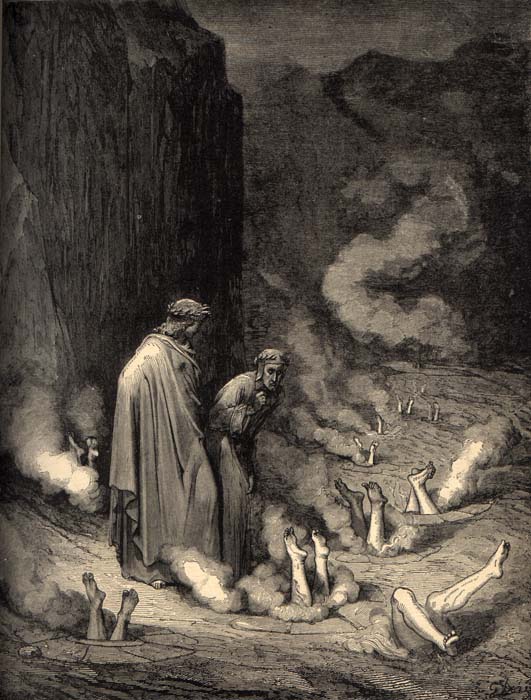
“Simonists” by Gustave Doré (http://danteworlds.laits.utexas.edu/gallery10.html)

In Canto 19, Dante and Virgil arrive in the Third Bolgia of the Eighth Circle. The sinners there are Simoniacs, corrupt clergy who bought or sold sacred heavenly services for money. From the very start of the Canto, Dante immediately angrily criticizes the Simoniacs saying, “You who the things of God, that should be brides of goodness, rapaciously adulterate for gold and for silver.” (Canto 19, Lines 1-4).

Canto 19 solidifies just how important God means to Dante the writer and Dante the pilgrim. The canto also displays how strongly Dante feels towards those who are disloyal and disrespectful to God. Dante, the pilgrim, does not feel sympathy nor pity for the Simoniacs as he has felt for sinners in previous Cantos. Instead, he feels content with their punishment. Dante tells Pope Nicholas, “Therefore stay here, for you deserve your punishment.” (97). He continues and states, “You have made gold and silver your god.” (112). Dante’s tone throughout Canto 19 is pure rage and intensity against those who chose money as their god and therefore did not worship the right God. His hatred for the Simoniacs shows how passionate and how serious God means to him. Dante finds that those who did not take God seriously deserve eternal punishment. Dante adds, “And were it not that I am forbidden by my reverence for the highest keys, which you held in happy life, I would use still heavier words” (100-103), meaning that Dante’s respect for the papacy is keeping him from insulting the Simoniacs even more. Virgil is pleased with Dante’s angry speech towards the Simoniacs. As Virgil was proud of Dante in his interaction in Canto 15 with Brunetto Latini, the pilgrim again believes his leader is pleased “with such a contented smile he listened” (120). 

As shown in the Gustave Doré artwork, God has punished the Simoniacs by stuffing their greedy heads and bodies into holes in the ground with their legs and feet hanging out. In Doré’s work Dante seems to be speaking to Pope Nicholas and if you zoom closely into Dante he has a facial expression of disgust and revulsion. Dante compares the holes in the ground to “places for the baptizers” (17). It is compelling that the sinners are stuffed into the ground head first as oppose to their body first like during a baptism. I think this punishment for Simoniacs fits with the unorthodox and sacrilegious decisions they made during their lives.
