Category Archives: Posts

Next post (due April 29)

This is just a reminder that in this post you are free to analyze your own post, comment on the reading for this week (Purgatorio 32-33, Paradiso 1-2), analyze a picture.

In class you will present the topic of your paper very briefly to the class and in groups we will discuss the 4 cantos (be ready to select meaningful passages).

Enjoy the rest of the break!

Next classes

I hope you all enjoy the break. Please refer to our course schedule and final paper assignment to prepare for our next two classes. I also copy here the timeline:

Timeline:

  1. By the end of April you will email me (or write in a post) about the topic of your final paper.
  2. You will bring a proposal of your paper to class on May 1 for peer-review. You will show a picture/slide to the class representing the topic of your paper. The class has to be ready to ask questions and give suggestions.
  3. You will bring a hard copy of an outline of your paper (introduction, questions to be addressed and thesis statement, and bibliography you believe you will use to write the paper) on May 8. We will peer review the outline.

Remember that we read Purgatorio 32-33 and Paradiso 1-2 for May 1.

Giusto di Gand’s portrait of Dante (ca 1473)


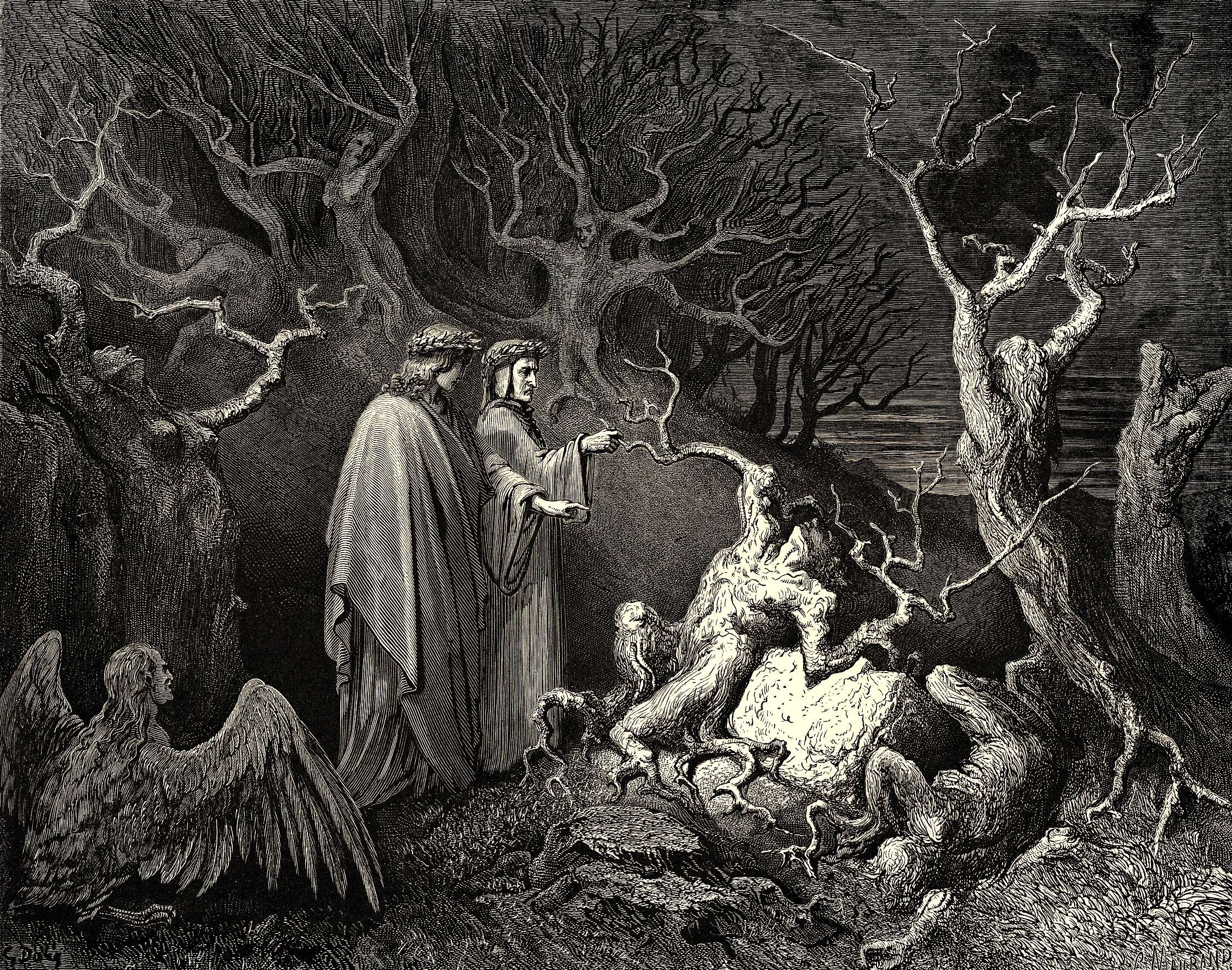
Garden of Eden vs. Forest of Harpies

Image result for canto 13

Image result for canto 28 purgatorio

indrasmusings – WordPress.com

Paris Review

In Canto 28, we can see the first major juxtaposition of Purgatorio and Inferno. As both scenes embody a forest environment, Dante uses his great ability of imagery to illustrate what we find out is the Garden of Eden in canto 28. Dante starts the canto with with a lively attitude: “eager already to search within and about the dark forest, thick and alive, which tempered the new day to my eyes.” This reading portrays the first scene of livelihood–without worry– and “eagerness” of Dante. Dante no longer is to be cautioned or held back by Virgil because there is nothing to caution against.

The amount of beauty reflected in Dante’s words are unparalleled throughout his journey of Inferno and Purgatorio. Unlike the dark forest in canto 13 with the harpies and souls of the suicides, the Garden of Eden has but a sweet breeze, graceful enough to disturb the branches of the trees but not the resounding birds with their lovely songs. Dante elevates the beauty of the Garden to that of a beauty of scenic art; just as Dante incorporates fictional characters in inferno, he does the same in the garden of eden by incorporating Matelda as a nymph. She is a figure of beauty inhabiting the garden along the river and serves as partial tour guide of the Garden by explaining that the garden was meant to be a “token of eternal peace” for man because he was made in the image of God but fell from sanctity into sin.

Furthermore, canto 13 in Inferno depicts a forest that tokens the eternal suffering of sinners that think they can end their lives on their own terms. The forest of the harpies is inaccessible to the souls that aren’t victims of suicides–we know this– but it isn’t brought into full perspective until we read this canto of the garden of eden. The garden of eden is placed on top of the mountain, therefore being inaccessible to those unworthy of the perilous mountain climb. Dante does very well in comparing and contrasting the layout of inferno and Purgatorio, they seem to be perfectly juxtaposed in their structure and therefore in their scenic elements.

Dante’s True Paradise

(this post accidentally got erased late at night and i was really mad and re wrote it in the morning)


Canto 28 opens up with dante in the Garden of Eden. Dante seems to be free now to go about with his free will as he wants. According to Digital Dante, the first word of the Italian translation is “Vago” which means “desirous.”  Translated into English, the first lines go as follows: “Now keen to search within, to search around that forest, dense, alive with green, divine, which tempered the new day before my eyes, without delay, I left behind the rise and took the plain advancing solely, slowly across the plain, advancing solely, slowly across the ground where every part was fragrant.” Here he is describing the garden and his newly realized freedom to roam about it. How beautiful it is and how alive he feels within it. Beatrice claims Dante to be a witness of the “Earthly Paradise” and to write down everything he sees. This Canto is much brighter and more positive than anything we have read so far. In canto 30, digital Dante points out that the Italian words “altrui” and “altrove” are both “powerful indicators of the seduction of the new.” These last canti are all geared towards the future which is something new to the comedy. Virgil is finally gone and Beatrice has arrived.


A few ideas i have had for the final paper pertaining to Dante’s Inferno and Purgatorio is to write about some of my favorite scenes in relation to the art that I saw at the MET. Another subject I could touch on is more of a personal one where I could explain how difficult it has been for me to understand the comedy as a whole but then towards the middle of the semester become more interested and actually enjoying the read.

Final Paper timeline

Only 3 students have contacted me re: the final paper.

Please review my guidelines and timeline here.

You might review all the assignments to see if you are missing anything. Many of you have completed the blogging activity (except for the reflective paper 2), which is due on April 29. As a reminder, you can use that post to “make up” for missing assignment but you have to tell me what you are planning on doing. I think some of you didn’t go to the MET. That would be an opportunity.

See you in class!

Hint Background Subject School Learning Backdrop

The Harrowing of Hell

Collectio Musicorum & The American Theatre of Actors 

present 

THE HARROWING of HELL  

A Play from the 13th Century 

Translated into Modern English and 

Directed by Jeff Dailey

Wednesday through Saturday at 8pm, Sunday at 2pm 

April 10 – April 21 2019   

The American Theatre of Actors 

314 West 54th Street in NYC 


http://www.theharrowingofhell.com/


New York, NY (March 29,  2019 ) Sometime in the 13th century, an anonymous author wrote a short play detailing the events of the Harrowing of Hell, when, after dying, Jesus went to Hell to rescue all the prophets imprisoned there.  This play, one of the first ever written in English, was so popular it survives in multiple sources, but has never been performed in the United States.  Newly translated into modern English, you may see this play in April at the American Theatre of Actors.  In it, Jesus, vanquishes Satan, and then goes on to release Adam, Eve, and others from their hellish imprisonment.

Also on the program is another medieval play, “The Fall of the Angels,” dating from the 14th century, which shows how Satan came to be cast into Hell in the first place, along with a performance of “The Soliloquy of Satan,” by the 20th century American poet Elliott Blaine Henderson.  The actors will also perform music from the Middle Ages.


Appropriate for the Easter season, these short plays show how their authors attempted to deal with the presence of evil in a comical way. This production will take you back centuries and enable you to see drama never before performed in New York.

The text of “The Harrowing of Hell” has been translated and adapted by Dr. Jeff S. Dailey, who is also the stage director.


Performances will be held Wednesdays through Saturdays at 8 pm, Sundays at 2pm. April 10th through April 21st, 2019. Tickets are $20 and may be reserved by calling 212 581 3044 or may be purchased at tdf.org [tdf.org].


The production is directed by Jeff S. Dailey, noted as a specialist in the works of Sir Walter Scott and as a stage director specializing in verse drama.  His recent productions include dramatic versions of Anglo-Saxon poems and the works of the pre-Shakespearean playwright John Bale.  The cast features  Benjamin Beruh, Jeremy Carter, Connor Chaney, Ben Hayslett, Justin Little, Monty Renfrow, Logan Roberts, Sabrina Fara Tosti and Christopher Yoo.


The Vice of Pride

Vices are the main focus of purgatory rather than sin. Pride specifically is the first vice theme in purgatory. Nature is also a common theme that we see throughout the comedy. We see that nature plays a major role in purgatory since nature can be described as a reflection of God and His beauty. Thus, purgatory includes imagery of Mary, skies, stars and other majestic scenery/symbolism. This relates to pride as well because in purgatory, one must cleanse themselves of this vice by showing humility and meekness, the antonym of vice.

Compared to the Inferno, where pride also known as ego, is what caused Lucifer, one of the most high angels to fall to the lowest position, is significant. In purgatory however, the greater the pride in life the greater the weight of stone to be carried. This is a burden that is caused from their own vice to be lifted when the opposite occurs. When one thinks less of themselves than more which is an interesting contrast.

Pride and Position

Dante watches as the prideful purge themselves, Title: Proud Penitents (Oderisi da Gubbio), Illustration by Gustave Doré, Source: Danteworlds (UTexas) (Galleries of Purgatory (Terrace of Pride))

As Dante and Virgil continue to voyage through purgatory they find themselves on the first terrace in canto 10. Each of the seven terraces symbolize the seven capital vices, of which the travelers encounter the prideful souls. Dante, as the author, purposefully creates parallels between cantos of the same number in purgatory and inferno. As an example, upon entrance in both the sixth circle of heresy and the terrace of pride, not a single soul is visible in sight. The reason for this could possibly be that the arrogance with which the souls carry themselves push them to believe that any visitors that come their way aren’t worthy of seeing who they are immediately nor are the visitors worthy of knowing who they are. While this may not be true for all the souls of the sixth circle, the behavior of the souls that Dante does get to meet indicate otherwise. As for purgatory, the reason for this has to do with the contrapasso of the punishments of the prideful. Each of the souls are forced to look at the ground because of the tremendously heavy stones weighing them down on their spines. This is an opposition to the overly-confident attitudes that the souls have in their living days where their attitudes kept their heads up high during every encounter. The punishment allows them to understand the negative traits they possess and how one cannot spend eternity as someone who treats others as though they are below them. The simultaneous pounding of their chests reflects the process of the purging of the souls into better versions of who they used to be giving them an element of sincerity that lacks in the souls of inferno.

Meanwhile, the sinners of canto 10 in inferno have mainly committed heresy but one character, known as Farinata, shows evidence of pride and arrogance. Dante narrates, “I had already fixed my eyes in his; and he was/ rising up with his breast and forehead as if he had/ Hell in great disdain,” (34-37, 173, Inferno). The focus on his breast and forehead symbolize the importance of courage. Farinata keeps his head held high, which forces Dante to look up to him while they’re conversing as he stands at the base of Farinata’s tomb. This, consequently, creates a hierarchy between the two characters putting Farinata above Dante. As Farinata rises from his tomb in a prideful and arrogant manner, he maintains a calm and collected demeanor despite the circumstances he finds himself in. His pride is further emphasized when Dante proclaims, “…as if he had Hell in great disdain. (34-35, 157, Inferno). The superior tone, in sharp contrast to the souls of purgatory, implies an attitude of superiority that lacks in the atmosphere, itself, of purgatory. Farinata acts as though he is above the afflictions of Hell and cannot be bothered to concern himself with the sufferings that surround him. Furthermore, his bearing implies a concern with social status which is emphasized when he asks Dante if he comes from the opposing political faction of Guelphs. Such attitudes aren’t present either at Dante’s first encounter with the prideful, despite their vices, because if they behave in such a manner, which counters the will of God and his reasoning for placing the souls in either inferno, purgatory or paradise, then the purging souls would not be where they are now in the first place.

The social statuses, however, that Farinata preoccupies himself with are understandable because, the deeper one delves into inferno, the rougher, harsher and more terrifying the souls’ punishments become. Perhaps, he is attempting to prove to Dante that although he is in the sixth circle of Hell, he is worth much more than what God deems him to be, who consequently places him in this petrifying circle. When it comes to purgatory, the higher one climbs the levels of purgatory, the closer they come to the entrance of paradise and all the goodness and light it contains. This signifies that even though the prideful souls are in the first terrace and as a result, aren’t as close to paradise as the rest of the souls, their purging is considered worth the journey. Their social statuses, unlike the souls of inferno, are temporary and are subject to transforming into a brighter and more peaceful eternity as opposed to the devastating and never ending torments of inferno.

Justified Punishment

Dante at this point, now fully understands why these sins are punished and how essential it is for the punishment to match the severity of their sins. What I want to find out is why is Lucifer isn’t active throughout Inferno? It would make sense for the king of Hell to apply his might against the dammed throughout Dante and Virgil’s pilgrimage. To help us understand the very nature around Hell and Lucifer let us examine Canto 33 . Here in this Canto, Dante and Virgil are in the ninth circle and they come across a sinner named Count Ugonilo who chews the neck of his killer and betrayer, Archbishop Ruggieri. Both of these men are betrayers, but what’s important to note is how Ugonilo acts for his sins: “That sinner raised his mouth from his fierce meal, / then used the head that he had ripped apart / in back; he wiped his lips upon it’s hair.” (Alighieri 1-3).  Ugonilo attacks the man who betrayed with anger and disgust. There is hate in those bites. It’s evident here that wrath has made Ugonilo go insane with rage.

Examining Canto 34, Virgil and Dante are in the City of Dis. They meet the king of Hell who stands in the middle showing no emotions(I will discuss about Lucifer nature later). Lucifer has three heads to which each mouth contains a sinner: Judas, who betrayed Jesus Christ, Brutus and Cassius both of whom betrayed Julius Caesar.  All three men are chewed and shredded, never dying: “Within each mouth he used it like a grinder/ with gnashing teeth he tore to bits a sinner, / so that he bought much pain to three at once.(Alighieri 55-57).  According to this, these sinners are forever in a state of perpetual agony. Notice that these sinners are expressing emotion unlike Lucifer himself. With these examples in mind, I believe Dante meant to show the readers that although the sinners are touched by evil. They still remain human. Pure evil has no traces of humanity, which would make sense since Lucifer is evil incarnate.

There is an interesting note about Purgatory that further explains the presence of sins around humans and perhaps Dante’s intentions about the sinner’s circumstances. In Canto 1 of Purgatory, Dante and Virgil meet Cato, a Roman Politician who is famous for his defiance of Julius Caesar.  What fascinating about this sinner Cato is the fact he killed himself as a form of freedom from Julius Caesar as explain by Virgil, “You know it who, in Utica, found death/ for freedom was not bitter, when you left/ the garb that will be bright on the great day.”(Alighieri 73-75). Since we’ve come to know that suicide is a crime against God, it’s problematic to see Cato’s role in this realm. To understand why Cato is in Purgatory instead of Hell we must remember that Dante based his morality on Aristotle’s schema. According to Aristotle, death by suicide is a crime against one’s society, but in Cato’s case his society was conquer by Julius Caesar. Rather than being in part of the new society by the conqueror, he decided to free himself by suicide. This is why there is a special case for Cato Presence, for his actions is proof his incorruptible nature.