
In the Commento Baroliniano of canto 21 it discusses that Malacoda was able to deceive Virgil thus placing them in danger “Malacoda is able to deceive Virgilio because he accompanies his lie with a great truth: the true date of the death of Christ … Malacoda’s truthful lie—in effect, a falsehood that appears true—is the precise inversion of comedìa, a truth that appears false.” This marks the second time that Virgil has failed in this journey of guiding Dante. Although it wasn’t a walk in the park their journey has been relatively smooth aside from some hiccups like this event or at the gate of Dis. The purpose of this journey seems to be for Dante to understand the actions that God makes and to have faith in his decisions. But what is the purpose of these failures, these are certainly not coincidental Hell itself and its occupants are all governed by God himself, this little excursion of Dante and Virgil is definitely a part of his design. These incidents don’t seem to affect Dante much as we saw during the gate of Dis, he only became more and more nervous as he watched Virgil become more anxious through his face. In contrast these events seem to affect Virgil much more as we saw during in Dis his confidence that always seemed to be invincible was wounded and even now as we have seen in these recent dealing with the devils it has left a crack in him. It seems that this journey is also a test of faith for Virgil as much as it is for Dante.
Monthly Archives: March 2019
Virgil and Dante’s Relationship
During Canto 23, the closeness of the relationship that Dante and Virgil have developed during their journey is shown. From the second Virgil appears to Dante in canto 1, it is clear the pilgrim admired the poet. However, the source of Virgil’s concern for Dante seems mostly dependant on the fact a higher power wished it. However, during their travels through the various circles of hell, it is evident that a bond has been developed. In the start of canto 23, in lines 28-30, Virgil is able to know what Dante is feeling and worried about just by looking at him. And while theres no doubt Dante or anyone would look quite shaken having just run away from demons, it also goes to show the intimacy that has developed between the two. Virgil can recognise Dante’s concern without him having to verbalise it.
Dante has reguarly refered to Virgil as a father and master, mostly in the context of what a great inspiration to Virgil has been to him. In this canto it goes a step foward, with Dante describing motherly actions of Virgil towards him, eg. line 37-42: ‘my leader seized me quickly, like a mother who is, awakened by the noise and sees the flames burning close by, who takes up her son and flees, caring more for him than for herself, not stopping even to put on her shift:” Virgil has gone further than simply being Dante’s guide, to caring baout his safety above all else.
Canto 24: Reptilian Thievery and The Symbol of Snakes and Rebirth
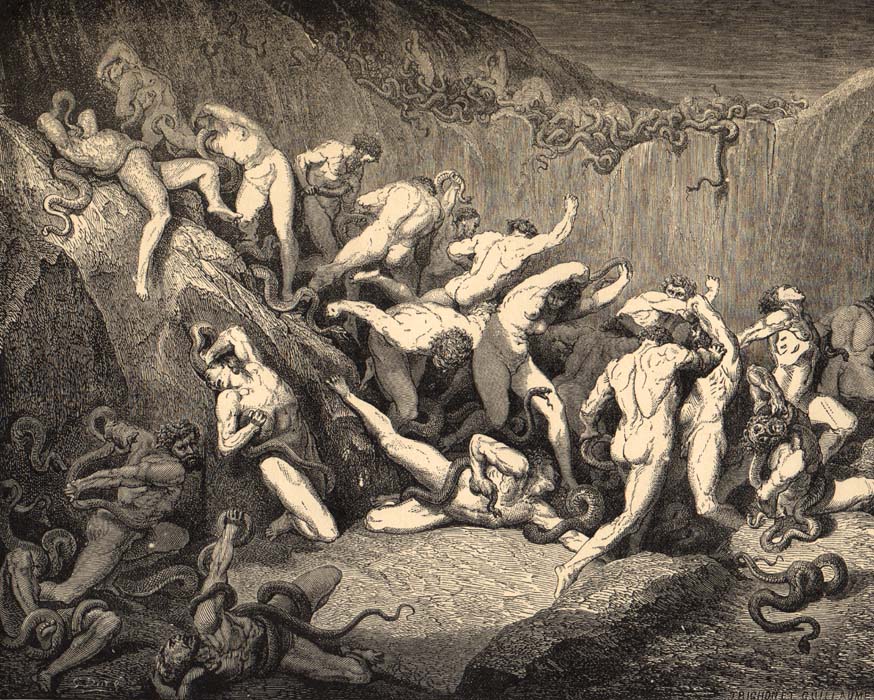
Gustave Doré, “Thieves”, Date: 1890, Medium: engraving
http://danteworlds.laits.utexas.edu/gallery11.html
Canto 24 begins like Canto 22 with a lengthy simile. In Canto 24, Dante and Virgil reach the seventh bolgia of the eighth circle. They find a ruined bridge and must climb rocks in order to reach the next level of hell. Dante is quite anxious, but Virgil helps Dante by carrying him and guiding him in what to do. Dante describes Virgil’s wisdom by comparing him to “one who uses judgment as he acts” (Canto 24, Line 24). Dante pauses for a rest from the difficult climb and Virgil advises him that “one does not gain fame sitting on down cushions,” meaning recognition does not come to those who are lazy. This advice seems to be an indication of Dante the poet’s life outside of Inferno.
Next, Dante and Virgil approach the sinners of Canto 24, thieves. Dante notices a “terrible crowding of serpents” (81). As shown in the Blake medium, the thieves are naked and chased by serpents. Once the snakes catch the sinners they bind their legs and hands. When the sinners are bitten, they catch fire, burn, and are reborn. Dante alludes to the Phoenix when he describes the fate of the thieves as they rise from the ashes like a Phoenix. It is both compelling and fitting that Dante, the poet, using snakes in the punishment for thieves. Snakes are often the symbol of rebirth. They shed their skin, transform, and represent immortality. Historically, snakes also act as bearers of secrets. In a religious context, snakes can represent deceit for it was a serpent who deceives Eve into eating a forbidden fruit. The serpents in Canto 24 punish thieves, people who hide massive secrets by stealing and trying to get away with their crime. It seems as though these thieves are snakes but instead of positive renewal they are forced to burn, die, and be reborn only to have to continue that process for eternity. As thieves they stole, therefore as sinners, they are infinitely having their livelihoods stolen from them as they are bitten by snakes. In Blake’s medium, it is evident by their expressions that the sinners are in pure agony as they are entangled by serpents.
Dante and Virgil encounter a sinner and Virgil asks him who he is. The sinner replies with, “I rained down from Tuscany” (121). Again the person Dante confronts introduces himself not by name but by the place he is from, signifying that one’s hometown is the strongest identity marker and truly makes him who he is. The sinner continues and states his name as Vanni Fucci. He is there because he stole from the church and blamed it on someone else. Fucci is among the unique sinners that Dante meets. He is one who truly does not want to be seen as he is in Hell. He states, “It pains me more to be caught in the wretchedness where you see me than when I was taken from the other life” (133-134). Fucci feels the shame and embarrassment of his crime. He is more focused on his place in Hell unlike other sinners, like Francesca, who are so stuck in a moment and fixated on what they were in life.
Sliding in haste into home of the hypocrites

Artist: Bartolomeo Pinelli
1825, Print, Italy
https://art.famsf.org/bartolomeo-pinelli/canto-xxiii-pl-47-linferno-di-dante-dantes-inferno-19633037283
Virgil and Dante continue their journey through the 8th circle of hell after secretly escaping from fighting devils that cause two of them fall in a pitch full of boiling tar. That situation causes the pilgrim to remember the Aesop Fable about a mouse and a deceitful frog who offered to carry a tiny animal across a river with a malicious intention of drowning him. Dante doesn’t even try to hide his overwhelming fear that enraged demons will eventually catch up to them. His agitation continues to build up making his “hairs curling with fear” (Divine Comedy, Dante Alighieri, Canto XXIII, 19), which consequently creates suspense and tension. He suggests to his master to look for a hiding spot before the steamed up demons wind up at their side. Well, Dante’s intuition turns out to be very much on point because the devils appear in pursuit out of nowhere. At that very moment Virgil grabs Dante:
“… like a mother who is
awakened by the noise and sees the flames burning
close by,
who takes up her son and flees, caring more for
him than for herself, not stopping even to put on her
shift:” (Divine Comedy, Canto XXIII, 37-42)
Virgil slides down the rocky cliff with Dante in his arms straight into the sixth pouch, which is the home of hypocrites. Dante completely taken by surprise describes the speed of them moving down:
“Water has never cursed more swiftly down a
slice to turn the wheels of a land mill, as it
approaches the paddles,
than did my master down the wall, carrying
me along on his breast like his son, not his
companion.” (Divine Comedy, Canto XXIII, 46-51)
Once Virgil and Dante reach the sixth bolgia they are safe at least from the devils that chased them because they are not able to leave their assigned part of hell. Although at times devils seem to have power over damned souls in the end they are nothing but Divine’s tools eternally trapped in hell.
The scene described above, which appears a little comical to me, shows that Virgil puts Dante’s safety first. What I find even more interesting is the fact that Virgil is presented here not only as the pilgrim’s beloved master and the guide but also as a person with maternal feelings towards him.
Canto 22 Deception

From Canto 21, Virgil and Dante were crossing the bridge into pouch five of circle eight. Virgil advises Dante to hide behind a rock while he tries to negotiate their passage with Malabranche (Sparknotes). Malabranche offers 10 demons to help them with their passage. This pouch contains the Barterers. Barolini states that Barratry “is the corruption of civic governance, and the result of barratry is the corruption of the social order” (Barolini). In canto 22, Dante and Virgil are walking with the ten demons. However, Dante’s attention “was all given to the pitch, to see every condition of the moat and of the people burned in it” (Inferno 22, 16-17). As Dante is observing the sinners, he notices their actions common to a dolphin. Martinez and Durlings note to lines 19-21, states that the traditional idea of how dolphins would warn the sailors when there was a storm approaching. Martinez and Durling bring up the point through their notes how Dante are continuously comparing the sinners to animals (Martinez and Durling, note to lines 19-21, canto 22 p.57102c). All throughout canto 22 Dante is continuously stating animal- like images of the sinner. Now the protagonist- barrater is known in the commentary tradition as Ciampolo (Barolini). I learned some background information regarding Ciampolo’s story when reading Barolini’s notes. She states that “Ciampolo’s story suggests the difficulty of maintaining equilibrium- toward material goods in such an environment. He was the son of a ribaldo, of a man who is not poor but who had on inheritance to squander and who destroyed first his means and then himself” (Barolini). Barolini also states that the story of Ciampolo’s father, like Ciampolo’s own, suggests the pressures generated by life in an environment where financial prudence was much less valued than “largesse” in spending (Barolini). When Virgil asks Ciampolo if there are any Italians in this pouch, “Ciampolo offers to betray his fellows in order to betray the devils, who betray each other in their eagerness to betray the sinners and in their eagerness to have Ciampolo betray his comrades” (Barolini). When reading this idea made by Barolini, I researched more on a different analysis of Ciampolo’s behavior in this canto. I read that Ciampolo’s episode is linked in the bolgia of barratry to political subversion and universal corruption (Falvo). The author of this source states that “this idea is supported by the image of the pitch… the sinof barratry that has spread to a whole community of people has become a paradigm for universal corruption and degradation, so will the punishment of this sin affecting the sinners and their persecutors, become the emblem of a moment in retributive justice” (Falvo). There is a them of deception in this canto. Ciampolo’s use of language shows an example of Dante’s idea of how the sinners speeches provide another way of understanding the punishments of Hell and show that pnishing sin does not always help the sinner understand the nature of what he or she has done wrong (Course Hero). Ciampolo’s promise of contriving greater sorrow for his companions was his way of challenging the devils at their own game of cruelty and deception (Falvo). When Ciampolo bluffed, it portrayed Ciampolo’s victory and Alichino’s defeat (Falvo). To Dante, this was acted out as a “ludo”, or sport/ theatrical play (Martinez and Durling, note to line 118, canto 22 p.57102e). The sinners have their own communications and codes of governance, all rooted in malice and betrayal (Barolini).
I found this image in the image section of the Barolini website. It shows the sinners in the tar- like substance. If you look closely it looks like Virgil and Dante are hugging each other as they watch in fear the exchange between Ciampolo and the demon.
Sources:
Alighieri, Dante, et al. Divine Comedy of Dante Alighieri : Inferno, edited by Ronald L. Martinez, Oxford University Press USA – OSO, 1996. ProQuest Ebook Central, https://ebookcentral.proquest.com/lib/huntercollege-ebooks/detail.action?docID=693941.
Barolini, Teodolinda. “Inferno 22: Diabolic Sport.” Commento Baroliniano, Digital Dante. New York, NY: Columbia University Libraries, 2018. https://digitaldante.columbia.edu/dante/divine-comedy/inferno/inferno-22/
Falvo, Joseph D. Decameron Web | Society, Brown University, www.brown.edu/Departments/Italian_Studies/LD/numbers/02/falvo.html.
“Inferno Themes.” The Logistic Model Has Good and Bad Features PROS CONS Mathematically Tractable, College Life, www.coursehero.com/lit/Inferno/themes/.
Uneasiness and Apprehension Tone
The devils are going after the travelers in the beginning of canto 23. There is a tone of uneasiness and fear. The Melabranche seems to be chasing after the travelers however, Dante cannot be hurt as mentioned previously in other cantos as his journey was foredained by God. However, the precariousness of the ending was conveyed to us for instance when the travelers anticipated the coming of the messenger so Dis could open. Virgil foolishly leads them to danger which inevitability instills fear in Dante as we see from his thoughts. It is also the uncertainty one gets from Aesop’s fable that contributes to the uneasiness of the canto. This is purely a poetic choice by Dante. As Barolini states in his commentary, the term “Gia”, which means already or hardly, was used multiple times in this canto and previous cantos such as 8 as a technique for emphasis. It helped build the apprehension that was developed throughout and especially at the beginning of this canto. It conveyed the picture that everything was happening at once for instance when the Melabranche was gaining on the travelers as Dante was thinking. We see however that this fear is unreasonable as we are reminded that the devils cannot leave their Bolgia. Dante though incites this fear to all in order to prove and depict the opposite, that hell has no control over the rest.
Virgil Speaks to Dante about Fame
In Canto 24, Virgil gives the Pilgrim a lecture on fame, he says: “one does not gain fame sitting on down cushions, or while under coverlets; and whoever consumes his life without fame leaves a mark of himself on earth like smoke in the air or foam in water…” (canto 24, lines 46-51). This speech serves multiple purposes in this canto. First of all, it motivates the Pilgrim as a character to continue on his journey after a difficult point in which they were lied to by devils and the Pilgrim sees his master emotionally affected by this (canto 23, lines 139-141). Secondly, it highlights Christian virtues in two ways, in the first sentence: “you will have to cast off sloth in this way” (canto 24, line 46) and it outlines a non-wasteful way to use the gift of life you have been bestowed by God. The speech also serves an important purpose outside of the characters; Virgil’s encouragement for the Pilgrim to seek fame can be read as representing Dante’s act of writing the Divine Comedy, to use his life to gain fame by writing poetry. Lastly, it creates a contrast between fame (which is the best way to be remembered on earth) and infamy (which is the worst way to be remembered on earth and is how Dante writes the sinners in his poetry back into existence on earth). The next sinner Virgil and the Pilgrim encounter tells them his story reluctantly, understanding the negative image it paints of himself; before telling his story he looks at the Pilgrim “and was covered with sad shame” (canto 24, line131-132). Dante is the opposite of this sinner, as he and the Pilgrim tell their story with pride and not shame because their story (the Divine Comedy) brings them fame, while the stories of the sinners within the Comedy continue to bring them infamy as long as they are read.
Beasts vs Sinners (Parallel)
In Canto 22, the fraudulent nature of sinners parallels the deceptive nature of the Evil Claws. Even though it’s revealed in the later Cantos that Malacoda intentionally misguided Dante and Vergil to take the wrong path, the deceptive nature of Malacoda and his beasts is hinted at in the descriptive imagery used in the 5th pouch of the 8th circle. In the 5th pouch Dante describes the submerged sinners as “ dolphins do, when they signal to sailors, arching their spines, to take measures to save their ship”(Canto 22, lines 18-20). The simile has a dual meaning because it’s not only acknowledging the behavior of the sinners but also the behavior of the beasts. The demons are pretending to help Dante cross the 8th Circle hence they’re acting as “dolphins” leading Dante and Vergil who represent the sailors however, the beasts are really like the sinners themselves who trick and deceive people. Dante elaborates that “so from time to time, to lessen the pain, a sinner would show his back and hide it in less than a flash.” (Canto 22, lines 21-23). Dante implies that a sinner shows glimpses of their true nature.
Both, the beasts and the sinner from Navarre show that they can’t deny their nature. The beasts are compelled to sadistically torture the soul from Navarre. They say “O Ruby Face, see you get your nails in him, and tear his skin off!’ All those cursed ones were shouting at once.” (Canto 22, lines 39-41). The moment that the beasts first saw the damned soul, their first instinct was to tear the soul apart. This raises the questions that if the souls have this little patience with the damned soul, how long will it be before they succumb to their violent nature and do the same to Dante and Vergil. The sinner from Navarre also can’t help but use trickery to escape his circumstantial problems. In the real world, he “took to barratry” (Canto 22, line 52) to escape the financial problems caused by his “wastrel” (Canto 22, line 50) father. Likewise, he tricks the Claws into hiding near the back and escapes. Dante narrates that “The Navarrese chose his moment well, planted his feet on the ground, and escaped their design.” (Canto 22, line 120-122). The Navarrese previously denied any intentions of running away or procuring any more “suffering for his own kind” (Canto 22, line 109). However, when he was presented with the opportunity to escape, he took it, true to his nature. Both the Beasts and the Navarrese are susceptible to their deceptive natures
Both the Navarrese and the Claws have the capacity to betray their own accomplices. Dante uses an extended metaphor that “as sometimes one frog stays while the other jumps” (Canto 22, lines 29-31) to foreshadow that the beings will deceive or turn against their own kind. In the metaphor, Dante specifies that these frogs are “at the edge of a ditch” (Canto 22, line 24). The frogs have a dual meaning. They represent the sinners in the pool pitch who are physically turning but also reflects their nature to turn against people that trust them. The frogs are at the edge because the depth of the edge is unknown just as their true is unforseen. The Navarrese sinner betrays his accomplices when he says “Tuscans or Lombards, I can make them come;” (Canto 22, lines 96-98). He offers his friends to the beasts so that they can reduce his punishment. He claims that “for one that I am, will make seven come as I whistle, as is our custom to do so, when one is a lookout.” (Canto 22, lines 102-104). There is an obligatory and almost militaristic bond between these men, yet he’s ready to violate that trust and betray them for his own safety. Likewise, when the sinner escaped, the Beasts turned against each other. Dante narrates that “The heat was a quick ungrappler; but not for that could they come forth, they had so enlimed their wings.” (Canto 22, lines 141-143). They were so physically tangled in their fight that even the heat from the pitch couldn’t pull them apart. They demons attacked their own fellows instead of working together. Thus, the sinners and the Claws don’t have it in their nature to be loyal to their kind.
Evil Tail’s Clever Deceit
In Canto 21, Dante and Virgil encounter a group of devils collectively referred to as Evil Claws. The meeting that ensues portrays Virgil as being an overly confident master who takes the word of a devil despite being in a subcircle of the circle of fraud and the inherent evil nature of the beast-like creature. Virgil questions one of the devils: ” ‘Do you think, Evil Tail, that you see me here,’/said my master, ‘once already safe from all your tricks,/without God’s will and favorable fate? Allow us/ to walk on, for it is willed in Heaven that I guide/ someone on this savage journey,’ ” (79-83, 323). In other words, Virgil reminds the devil that he has already journeyed on this path through Hell on his own without the trickery or deceptions of the devils harming or affecting him in any manner. He is able to get past them and does not imagine how or why it should happen otherwise this time. Virgil also wishes to express that part of the reason he is traveling through Hell with the pilgrim and must be allowed to continue to do so, is because God is allowing it to happen through His own will. Virgil’s bold demeanor appears to be effective for the time being when Evil Tail lets his guard down, orders the rest of his group not to abuse Virgil or Dante in any manner and to guide them on through their next path.
This reaction that Evil Tail presents seems to be a positive sign on the surface. However, the reality of the situation is that Evil Tail is deceiving Virgil by allowing the latter to believe that Evil Tail is bowing down to Virgil’s reasoning and self-assured tone. Barolini elaborates on this point by claiming, “Malacoda [Evil Tail] weaves truth with falsehood into a perfectly designed trap, giving instructions and information that seem straightforward and helpful to Virgilio but that his troops can decode as deceitful and hostile,” (Barolini). The escorts that Evil Tail sends along with the two travelers have evil intentions in mind and are aware that they are allowed to carry them out because of Evil Tail’s clever manner of speaking with Virgil. The ‘trap’ that Barolini mentions refers to the deceiving approach Evil Tails uses in making his three statements. The first and the third one are true while the second one, claiming that there’s an unharmed bridge that will ease Virgil and Dante’s path, is the false statement. As Barolini points out, this cleverness of throwing in a false statement in between two true ones effectively distracts Virgil from the fact that he is being deceived thanks to the self-assurance present in Virgil’s attitude.
Such deception supports the idea that Virgil’s ability to reason with the demons of Hell is not always successful as Virgil, and especially, Dante hopes. Dante’s lack of trust and his overwhelming fear of the demons is influenced by a moment in canto 8 where Virgil is unable to carry out his word. Virgil takes an assertive stance against a group of demons that protect the gates of the city of Dis. He fails to sway their stubbornness in any which way resulting in Virgil and Dante inability to cross the gates. This, in turn, discourages Virgil immensely. Consequently, Dante marks this as a significant failure that must be kept in mind throughout the rest of the journey. Although Dante has faith in Virgil’s intelligence and ability to deal with the creatures of Hell, he does not wish to forget this moment for the sake of eluding danger which Virgil fails to do so in canto 21. Furthermore, Virgil fails to recognize the idea that simply because Evil Tail complies with his demands, this does not signify that Evil Tail will stay true to his word. After all, as mentioned before, in a circle that contains sinners of fraud, it should be remembered that the demons, though they punish those sinners, are not restrained themselves and are free to carry out their evil nature as they please. Virgil must also keep in mind that it is self-centered to believe that he is incapable of failure in his dealings with demons. There is obvious evidence otherwise which justifies Dante’s dread of the situation and it should be taken seriously, especially in an environment where it is understandable to have such sentiments.
Secondary Source: https://digitaldante.columbia.edu/dante/divine-comedy/inferno/inferno-21/
The Father Figures of Dante
Canto 15 of The Inferno focuses on the third part of the second circle of Hell, those who commit crimes against God. In this part of Hell Dante and Virgil find Brunetto Latini who was a very important teacher to Dante in his youth. The shade of Latini refers to Dante as his son twice, on lines 31 and 37, and Dante refers to the shade of Latini as a “kind paternal image” on line 83 further cementing their father/son relationship. Although it may seem odd that Dante would put such a revered father figure in Hell, Latini is not the first father figure Dante comes across on his journey. In Canto 10 Dante and Virgil find Cavalcante de’ Cavalcanti in the sixth circle of hell among the heretics. As the father of Dante’s first friend, Guido Cavalcanti, there is a subtitle father/son dynamic underscoring their meeting although I have not been able to isolate a good quote to definitively prove that.
The appearance of two father figures of Dante in Inferno begs the question, where is Dante’s biological father? Nowhere. Neither of Dante’s parents are mentioned in his works which is curious since so many important people in his life to appear throughout The Commedia. Why would Dante omit his parents?
Reading Dante by Giuseppe Mazzotta gives the interesting and tantalizing fact that Dante’s father, Alighiero di Bellincione, was accused of usury but is not found among the usurers. While it is important to note that Dante’s mother, Bella degli Abati, is also not mentioned in his works she also died when Dante was around 5 or 6 years old, meaning it is very possible that Dante had few memories of her. Given that Dante’s father died when Dante was 18 years old, the combination of Dante’s condemnation of usury, a crime that, according to Mazzotta, was used by other poets as a way to slander Dante and imply that he did not come from a good family could be seen as a strong condemnation of his father. A very common theme in all of Dante’s works is an anxiety about how others think of him and how his fame will survive once he is gone. For someone so concerned with what other people think of him and who values the worlds memory of himself so much that being remembered is one of the things Dante takes away from those who are in Hell, it is not a baseless hypothesis to suggest that Dante would be very bothered by the insinuations against himself and his family. Dante might not have wanted to admit to the world openly that his father was guilty of usury but could not resist severely condemning others guilty of the same crime to separate himself and his fame from that of his father.
The end of Canto 16 has a passage that has caused many debates between scholars as mentioned in the notes of our book. Lines 106-114 detail a moment where Dante unties a chord which he gives to Virgil to use as a tool to help them descend lower into the inferno. This moment seems to be unrelated to the discussion about Dante and his father above but our notes give the additional context that early commentators thought that the chord Dante unties represents fraud, mentioning that it could be either the inclination to commit or history of committing fraud. Given that Dante’s father was accused of usury, a form of fraud, could this be an admission by Dante that the accusations against his father were not only true but also that Dante himself assisted in that fraud? Or could it symbolize Dante freeing himself from the shame he felt due to his father’s crimes since the sins of the father should not fall upon the son?
The conspicuous absence of Dante’s biological father paired with the way that Dante highlights father figures in his life throughout his works begs a question about the relationship the two men had. This is a question that probably will never be satisfyingly answered but I plan on looking for other representations of the father figure throughout The Commedia to see what there is to find.

