Monthly Archives: March 2019

reflective post 1

Upon reviewing my blog posts, I have noticed that I have been mainly following the theme of remembrance through the Inferno.  With the exception of my third post, which focuses on the Old Man of Crete and Dante’s use of classical mythology, all my other posts have either directly addressed the way the act of remembrance is used in the text or alludes to it by examining the representation of sinners in comparison to their living appearance.  In my most recent post, I still follow this theme, but take it in a somewhat different direction by addressing it in relation to Dante and the Pilgrim as opposed to the sinners as I had been doing in my other posts.

As I follow this theme through the cantos, my ideas in my posts have become more complex as the theme itself expands in the text.  In my first post I commented on how some sinners are allowed to be remembered and others are not and that this act of remembrance is an act of pity and alleviates suffering.  At that early stage in the Inferno this was all clearly defined as Virgil told the Pilgrim (and the readers) which sinners could and could not be remembered and why.  However, later on this becomes more complicated as the sins become worse.  What we knew changes–being remembered can be an act of punishment, some sinners can be remembered but not by physical appearance which alters their previous identity, and in my last post I reflected on Virgil’s explanation to the Pilgrim that there are different types of remembrance (fame and infamy) for different people.  This last one ties together all the confusing and conflicting things the Pilgrim feels and describes surrounding the memory of the sinners he encounters.

I found that while I quote a lot from the Inferno, I do not often quote from outside sources like many other students do.  I did use an outside source in my post on the Old Man of Crete and I noticed that it bolsters my ideas in that post more than just quoting from Inferno does in my other posts.  I will try to incorporate more outside sources in my future posts.  I also have not used any artwork or images in my posts like I have seen many other students do.  I am not necessarily a visual learner in this way and so I did not think to try it, however I would like to try doing one of my future posts this way to see if my understanding of text can benefit from it.
Reflective post (1)

I read parts of Divine Comedy back in high school, many years ago. Since I read it in my native language I understood the words but, in truth, nothing more than that. It definitely didn’t move my mind or heart. In other words it didn’t affect me in any way, because even though I understood the language I failed to understand the rich content. It is hard to explain why it happened, but for sure it was caused by many factors like cultural background, age, lack of ability to imagine certain things, limited understanding of various concepts.

A few years forward I am reading Dante’s masterpiece again. This time around I read it in a foreign language but with more mature and more analytical mind.

I have written a few posts based on cantos I read. In these posts I elaborate on concepts, ideas or images that I found interesting or intriguing. Choosing the subject for my posts and exploring it more while reading additional notes or materials available helped me comprehend the content even better.

My first post is a form of introduction of two main characters – Dante the pilgrim and his master Virgil, the circumstances the former unexpectedly found himself in and the journey that he is about to take. My second post doesn’t focus only on the main character but also introduces two secondary characters – Ciacco and Filippo Argenti – two sinners suffering in hell. This post also describes the political situation of Florence to which Dante (Dante – the author this time) was directly connected. In my third post I mainly concentrate on Dante’s (pilgrim) feelings, emotions and state of mind while the journey continues through hell continues. This analysis of someone’s behavior requires certain analytical skills and drawing conclusions from descriptions found in the book. The fourth post pays particular attention to sinners who represent the worst form of violence (the violence against nature) – the sodomites. It describes their wrongdoing and immorality, which result in eternal and horrific punishment. In addition it presents Dante’s view on the sin of sodomy and its very negative social and spiritual consequences. The fifth post contains description of the punishment for the Panders and the Seducers but also presents clearly Dante’s condemnation of corruption in Catholic Church. In my sixth and last post I analyze the relationship between Dante and Virgil, which in fact is much deeper than the relationship between a pilgrim and his guide.

After rereading my posts and reflecting upon them I can easily draw to a conclusion that I came a long way since reading Divine Comedy back in high school

First of all, my posts are not limited to a simple description of what happens in particular cantos. I am somehow able to analyze symbols, settings, images, behaviors of characters or even writing style to determine what message is being conveyed.

Besides, I utilize images available online to make my post and its content easier to visualize.

In addition, I try to use citations from the source to provide evidence to what I am trying to convey.

On the other hand, I have to admit that my posts lack coherency and logical organization due to the fact that I choose the most appealing image or topic of my interest in a particular canto without paying attention to what I previously wrote about. But there is in fact one element present in every single post that gives them a sense of unity. It is either Dante the pilgrim with his emotions, feelings and reactions or Dante the author with his opinions, beliefs, viewpoints and judgments.

I truly realize that there are a lot of elements I need to work on while writing my posts (coherence, more research on a chosen topic using available resources, logic organization) but, all in all, doing so helps me progress in understanding the complex content of Divine Comedy.


Reflective Post One

I noticed after reading my blog posts that I find it difficult to pick out the central idea of each canto and being able to write about it without mentioning other specifics. I like to focus on two ideas rather than one big idea. I also have trouble picking a title for my posts because it’s not something that I normally do for other writings (which is odd to think about because pieces of writing should always include titles). I realized in my writings that I also like to analyze quotes but that’s because I’ve been taught to do this in high school and I feel it always works for me because I understand/ can interpret the text better after analyzing ideas, quotes, characters and so forth. One thing I would like to add/ improve on is including pieces of art/imagery in my posts because I have not done this in my posts, and many students do this, but I don’t. I think visuals will also help me understand the plot and central idea of each canto. I would also like to start commenting on other student’s blog post because I feel it’s an effective way of learning because it’s a type of dialogue that is occurring between two students but through writing (it’s a response and reflect type of learning). After re-reading my posts one recurrent thing I do is incorporate the plot, transitioning to what is happening in the canto transiting to quotes and analyzing the quotes but I feel this has been working for me and will continue to do this. I believe my ideas are clear and thoroughly explained which is important for both reader (other students) and writer (myself). I try to make my ideas as clear as possible compared to other students because when I read something too difficult and complex to understand it makes it harder for me to understand what the writer’s point of view is. I believe writing as simple and as clear as possible is rather difficult than easy but sometimes writing in a simpler way is better. Therefore, I try to make my sentences as clear and concise so that the idea I have in my mind transcribed into my blog posts is not only clear for the students in the class but as well as others reading my post who are not in the classroom with us. Another recurrent theme is that I like to compare and contrast cantos and tie previous cantos to the newly written cantos but doing this allows me to remember the content in a better way because as we keep reading more, I slowly forget bits and pieces, and everything is important.


One part I would like to comment on is from my post blog post six. I wrote “Dante is dependent upon his master not only for physical help, but also for spiritual guidance and moral support. Similar to previous cantos, Dante gains reassurance from Virgil because Virgil’s actions and words can make Dante feel serene because Dante feels the same security in Virgil as when he first met him. Instantaneously when Virgil’s anger vanishes so does Dante’s anxiety. Once Virgil gains his composure, he reveals he is capable of measuring an amount of control over his emotions. This contrasts with the way in which most of the sinners in Hell are prey to their emotions and physical desires such as anger, lust, greed, and so forth. Although Virgil is in one circle of Hell, he is only there because he is not a Christian; he is a pagan. Virgil, however, uses his willpower to master his emotions. Throughout the poem, the ability to master emotions is seen to be a uniquely human characteristic that identifies with human ability.” The reason I like this analysis is because I tied together what we learned in canto 1 about Virgil and how he is a pagan to currently what is happening in canto 24; gathering pieces from previous cantos I was able to relate it to the new content as well as including Dante’s emotion(s), because after all it’s HIS journey.


One thing I would like to clarify/edit is my ideas in blog post four. I write “Dante is growing over the course of his journey, learning from Virgil. Furthermore, Jacopo wants Dante to seek immortality through fame and wants Dante to live on in fame when he dies. Dante however doesn’t want this for himself but instead he seeks to reach a truer form of immortality which is salvation in heaven…” I want to clarify how Dante the pilgrim is growing over the course of his journey. However, Dante (himself, the writer) wants to reach a truer form of immortality which is salvation in Heaven. I believe as Dante the writer continues to write about Dante the pilgrim and the pilgrims journey, the more Dante (the writer) is learning  about himself and his morals through his ‘character’ form – writing helps one express ideas/ reflect on their own well-being and I think Dante (the writer) is doing this through Dante (the pilgrim).


Another part I would like to comment on/reflect on is when I write “Ciacco feels by having his name mentioned will allow himself to alleviate his agony. The important line in this canto written by Dante states, “And my guide said to me: “He’ll rise no more until the blast of the angelic trumpet upon the coming of the hostile Judge.” The reason this line is significant is because Virgil is referring to the last judgement; in which Christ comes down to earth to judge all human souls in which he decides who goes to purgatory (saved souls) and those who go to Hell (the damned souls). However, because the last judgement still hasn’t arrived Ciacco is punished for his gluttony because of his imprudent gratification of drinking and eating excessively, however, the contrapasso is the opposite of this.” I think this part is clearly explained because I was able to speak about thecharacter, reflect on the character by adding a quote from the text, showing the reader my interpretation directly using the text, hence adding clarification. I then explain why the line is significant and WHY the character is punished and why the specific lines chosen are important and relatable to the character. Therefore, for my next blog posts I would like to continue to write like this where my ideas are clearly written and evidently pulled from The Divine Comedy.


Eternal Recurrence and Serpents

After reading Canto 24, I’ve wondered about the theory of Eternal Recurrence and the nature of the seven pouch. For those who are unfamiliar with this theory, it’s a thought experiment about whether every detail life is meant to endlessly repeat itself; a loop. Famously, there is a symbol that goes hand in hand with this theory, Ouroboros; a snake eating itself.  Friedrich Nietzsche used this as a formula for human greatness. With that in mind, the Sinners are punished by giant serpents binding them. So, we can associate these serpents with the symbol Ouroboros. As these serpents bind sinners, they are caught on fire and turned into ashes. Then these ashes are reborn into human form again. The punishment repeats itself.  Just like the theory of eternal recurrence stated, these sinners are dealing with the same pain over and over again. According to Friedrich Nietzsche, how can these sinners achieve human greatness. In Canto 24, Virgil states that a person has control of their thoughts and impulses, “raise thee up, o’ercome the anguish/ With spirit that o’ercometh every battle,/ If with its heavy body it sink not”(Alighieri 52-54). Perhaps to reach enlightenment, Sinners must be aware of the temptations to which they are always recurring and present, and learn to control these impulses. Although, now that I contemplate about the sinner’s circumstance, they are in hell; therefore they must forever feel torment. At least in this case, the looping element from the Eternal Recurrence would apply here.

The Donation of Constantine and an Unintended Mention of Fraud

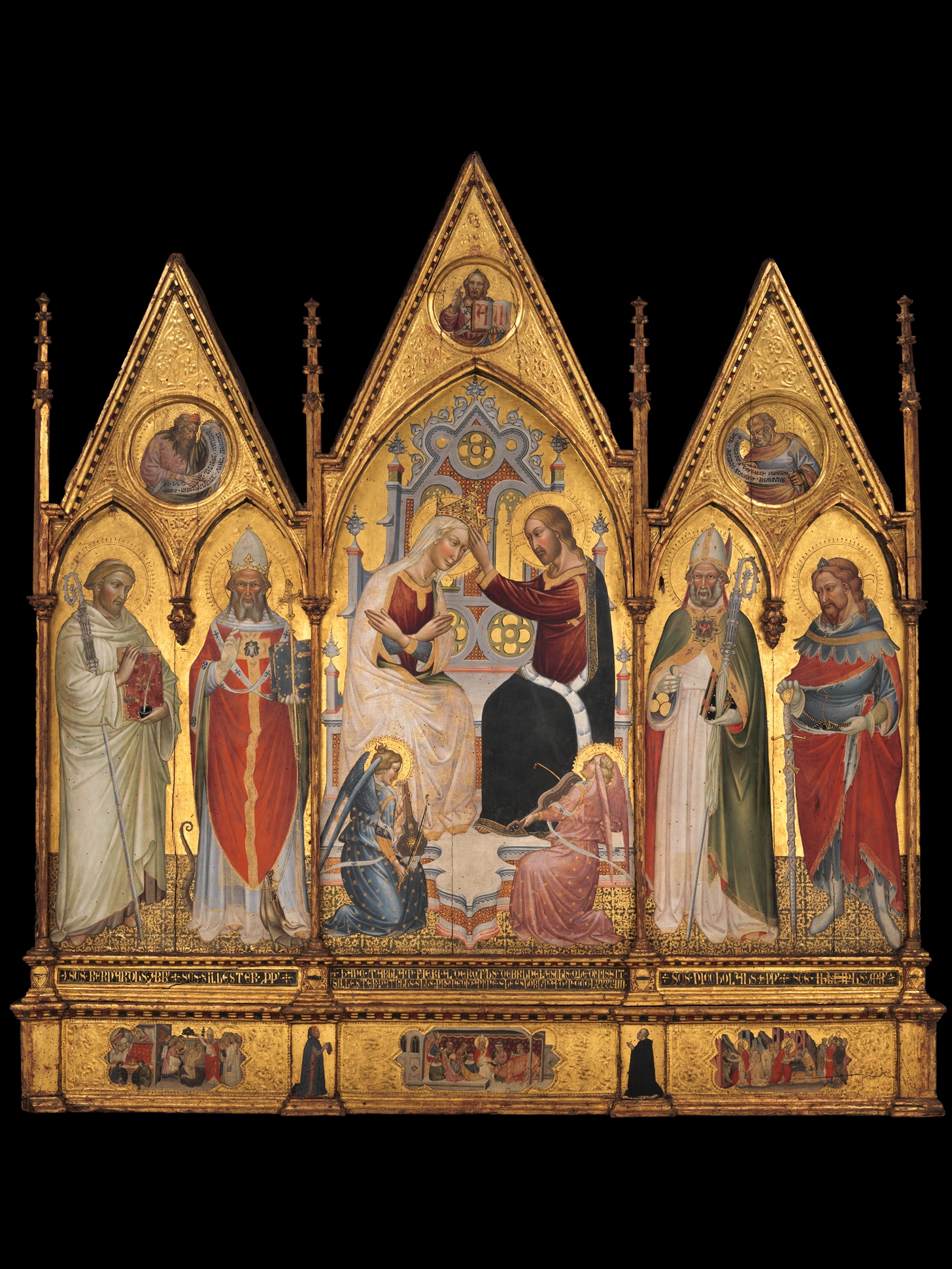
Altarpiece by Giovanni di Tano Fei depicting the Donation of Constantine on the predella. Photo from the website of the Metropolitan Museum of Art, altarpiece not currently on display.


When trying to decide the genre of La Commedia many scholars, including Giuseppe Mazzotta, make an argument that La Commedia is an encyclopedic work since it references many important classical works by authors such as Ovid and Homer as well as important biblical and historical events known to Dante. While reading on my iPad I have to have the footnotes of our copy open on a computer for quick reference and find myself frequently googling to find more information. Reading La Commedia is not just a poetic experience but also an intellectual journey through the classics and history. A short reference in  Canto 19 to the Donation of Constantine reminded me of the encyclopedic style of La Commedia that I think is an excellent example of Dante’s style.

Canto 19 takes place in the third pouch of the eight circle of Hell which holds the simonists. Simony is the sin of selling church offices or indulgences placing monetary gain on the earthly realm over spiritual virtue. The contrapasso in this canto places sinners upside down in mock baptismal fonts with fire on their feet. The simonists are inverted in Hell because when they were living these sinners had their priorities inverted, placing monetary and political gain over the salvation of their mortal soul. A note in my copy mentions that the anointing of their feet with oil is a reference both to Jesus being anointed with oil in the gospels as well as to four of the seven sacraments which require being anointed with oils.

While there are many things I could write about this canto, I am going to focus on just one terzina found in Canto 19, lines 115-117 in which Dante writes:

Ah, Constantine, not your conversion, but that

dowry which the first rich father took from you, has

been the mother of so much evil.

This terzina, discussing the Donation of Constantine, was the first example of the encyclopedic nature of Dante’s Commedia I was introduced to and whose layers I find fascinating.

The Donation of Constantine was an event that was thought to have taken place in the 4th Century AD. The story was that the Emperor Constantine the Great had contracted leprosy and was healed by Pope Sylvester after being converted and baptized. Grateful to Pope Sylvester, Constantine gave the Church parts of his empire, including sites important to the Church such as Jerusalem and Rome with an imperial decree documenting this transfer of power.

Canto 19 lines 115-117 is not the only time Dante wrote about the Donation of Constantine. In an earlier uncompleted treatise on the nature of power titled De Monarchia (3.10.1) Dante writes extensively about whether the Catholic Church or the Empire should have supremacy over the other. Many scholars in Dante’s time used the Donation of Constantine as evidence why the Pope should have authority over the Emperor. Dante disagreed, arguing that the land was not Constantine’s to give nor Pope Sylvester’s to accept. The terzina quoted above is Dante holding Constantine responsible for the many evils done by Popes that were justified by the Donation of Constantine. In just these three lines, Dante references not just a historical event but also a current debate in his time. While one does have to know the background about the Donation of Constantine to truly understand the point Dante making, the multiple layers of reference still make La Commedia an encyclopedic work in my eyes.

During Dante’s lifetime, the Donation of Constantine was believed to be a true event that undoubtedly occurred. It was only in the 1400s when two priests, Lorenzo Valla and Nicholas of Cusa, analyzed the Latin used in the document and proved that the Latin was far too modern to have been written in the 300s when the Donation of Constantine was said to have taken place. Although Dante was proved right when he wrote that the Donation of Constantine did not give the Pope power over the Emperor, it was not for the reasons Dante argued but that the event did not actually happen.

Curiously, the placement of a reference to the Donation of Constantine in Canto 19 of Inferno is unintentionally perfect on Dante’s part. Virgil and Dante have just left sinners who commit violence using intellect or fraud in Canto 18 and are about to reach thieves in Canto 24. The forgery of the Donation of Constantine was an act that I would classify as violence using intellect or in a broader term fraud as well as a theft of power from those who held it by dishonest means. Putting a reference to the Donation of Constantine between those two types of sins is unintentionally genius since the forgery is a marriage of those two sins. Of course, Dante did not place this reference here knowingly since he believed that the Donation of Constantine happened. Regardless, I believe it is worth mentioning as an interesting observation even though it is undoubtedly without intent.

The image above is an altarpiece in the Metropolitan Museum of Art’s collection which is not currently on display but has been previously. The bottom of the three panels depict the events leading up to and including the Donation of Constantine. The altarpiece was recently on display and the details were much clearer when I saw it in person last year. Once it is back on display to the general public I would encourage anyone to go see it in person since the altarpiece is much larger than it appears in the photo and exquisitely detailed.

Blog post due on Monday, March 18 and announcements

This is your first reflection post. Follow the instruction on the Assignment page of our website/Blogging.

On March 20, you have to come prepared to class, that is having studied the assigned cantos (even though you haven written a blog post on those cantos). We’ll make up for the missed  post with an in-class reading questionnaire.

Late submissions won’t be accepted starting from today.


Dante’s Fear

Dante and Virgil are now entering the sixth pouch of the eighth circle. While they believed they had escaped the demons in the previous pouch, they now realize they are being chased by a huge pack of the Malabranche, meaning “evil claws.”

The canto seems to give the travelers a sense of uneasiness. In the beginning of the Canto, Dante seems afraid that they angered the  “Silent, alone, no one escorting us, we made our way. One went before, one went after, as Friars Minor when they walk together.” (Inferno 23, 1-3) 

Saving Dante, Virgil grabs him and jumps through the sixth pouch of the Eighth Circle with Dante in his arms. Now that they have lost the Malabranche, they are in the Sixth Pouch, where they see more souls aligned in a circle.

“And they were dressed in cloaks with cowls so low they fell before their eyes.” (Inferno 23, 76)

Dante is trying to find one of the souls now that he might recognize as he has been. Instead, he is now the one who is recognized by his Tuscan language. “Stay your steps, o you who hurry so along this darkened air!” (Inferno 23, 77)

Dante seems unsure of what will happen next, but seems to continue to symbolize his truths and emotions through the constant darkness and uncertainty of his journey with Virgil through the circles into hell. 

Of Cosmological Apatheia

Stoicism is a school of philosophy that dates back from 300 B.C.E. It emphasizes philosophy ought to be practiced not as academic studies, but as a way of life. Alighieri has indeed incorporated many stoical concepts and references throughout the Cantos from thinkers like Epictetus, Seneca, and Cicero. Of those concepts, I would like to introduce what Apatheia is. Apatheia, as the stoic Epictetus would define, ‘is freedom from unhealthy passion’ (pain, fear, craving, and pleasure) and having apatheia in one’s life would constitute a life of that is both virtuous and flourishing (IEP).

The method of practicing and developing apatheia towards one life can be achieved through the visualization of the cosmos from the omnipresent perspective of looking at the world down below and up above.

We can see that Alighieri expresses a similitude of the grandeur view of the cosmos. On line 1-3 of Canto 24, There is an astrological description showing the relative relation between the Sun and the constellation of Aquarius, which causes the changing of the firmament. It is important to notice the order of this Terzina because the cosmological element is ordered like this: Sun, Aquarius, and the sky.

In that part of the youthful year when the sun

tempers its locks under Aquarius and already the

nights are moving south (Inf. 24. 1-3)

Then on the next Terzina, the causal relationship between the ground and the frost – which hints at the melting of frost – alludes to the Earth and the changing of the weather.

when on the ground the frost copies the image of

her white sister, but her pen retains its temper only

briefly (Inf. 24. 4-6)

And again, the element of frostiness is being mentioned again in later line, “see the fields all white”. But more importantly, the perspective of the cosmos shifts into a one that focuses on human matter. And there is some type of unbalanced display of emotions that are concerned with the changing of season and nature.

[the peasant] goes back in his house, and complains here and

there, like a wretch who knows not what to do; then

he goes forth again and stores hope in his wicker basket

again (Inf. 24. 10-12)

Those dispositions can be characterized as being fearful, anxious, and distressed when the changes in the environment are not depended on our expectations and our ability to control certain situations. Such moment of unstable emotion is emphasized on line 16-17, “so my master made me lose confidence, when I saw his brow so clouded”. However, there is a sudden shift in Virgil’s disposition in the next two Terzina that can be summarized as:

with the sweet expression I first saw at the foot of the mountain, / he opened his arms and took hold of me (Inf. 24. 20-23)

And as Seneca has said

“The wise man and devotee of philosophy are needless to say inseparable from his body, and yet he is detached from it so far as the best part of his personality is concerned, directing his thoughts towards things far above.” (Letter LXV, Letters from a Stoic)

The excerpt brought from Seneca highlights the importance of Virgil’s virtuous strength, in which draws a connection when the pilgrim praises Virgil “And like one who uses judgment as he acts, always seeming to look ahead, so, carrying me up to the top.” We can see there is an implicit iconography of ascension by comparing these two excerpts. It is the one who directs his study above earthly and cosmological configurations to establish a complete perspective of the cosmos, thus enables one to have an outlook of mental calmness on life.

As a whole Alighieri’s meticulous layering of the cosmos imagery provides adequate ground for that one must see the world in a way that goes beyond human and social affairs, the changing of earthly environment and seasons. We must put our fascination onto the stars and the constellations to develop a sense of universal apatheia, that human worries and suffering is so insignificant compared to the sublime vastness of the universe. From there on, we can go ‘up’ to see the world in perspective starting from the smallest anthropological layers to the cosmological layers (human and society, the earth, the firmament, and the stars) to have a complete view of nature and the divine, and that we must confront the uncontrollable nature with emotional resilience like that of the cardinal virtues (justice, prudence, fortitude, temperance).
